
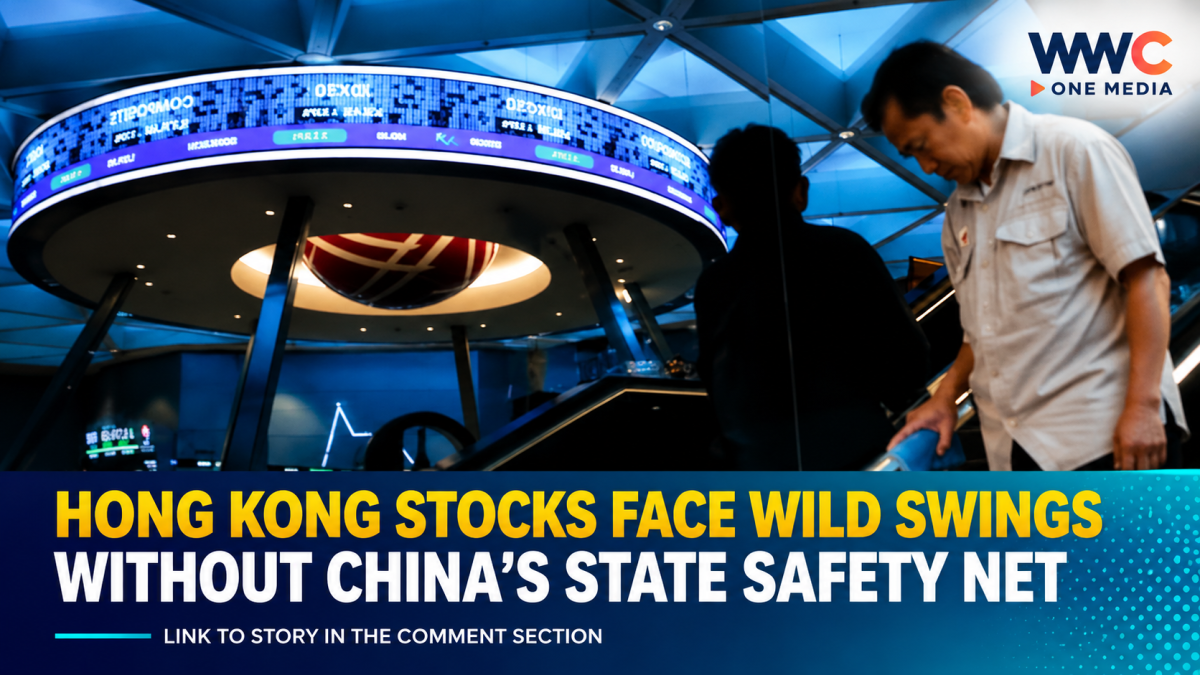
HONG KONG — Hong Kong’s stock market is facing renewed volatility as investors confront a growing list of global and regional risks — but unlike mainland China’s markets, it cannot count on large-scale state intervention to calm panic selling.
While coordinated state buying has helped put a floor under mainland Chinese shares as Beijing works to stabilise its onshore markets, Hong Kong investors are being left to navigate sharp swings without the same government-backed support.
Mainland Stocks Have a Safety Net
State intervention has become an important stabilising force for mainland China’s stock market.
Government-backed buying can help support share prices and provide liquidity during periods of intense selling, reducing the risk of a sudden market rout.
Fund manager Dai Ming of Huichen Asset Management said such intervention could help smooth volatility and stabilise mainland stocks, at least in the short term.
Hong Kong, however, operates under a very different market structure.
The city’s market is more exposed to international capital flows and does not have the same expectation of direct government support when investor sentiment turns sharply negative.
A Growing List of Market Risks
Hong Kong investors are currently dealing with several factors that could trigger further market swings.
These include:
- Rising geopolitical tensions
- Sluggish corporate earnings growth
- A weakening artificial intelligence trade
- Possible further US monetary tightening
- Expiring share lock-ups that could increase stock supply
- Rising oil prices
- Elevated US Treasury yields
- The risk of a Japanese yen carry-trade unwind
The combination has created a particularly difficult environment for Hong Kong equities, which remain highly sensitive to overseas investor flows.
Hang Seng Falls as Global Pressure Builds
The Hang Seng Index fell 1.3% by the midday break on September 10, putting the benchmark on track for its biggest decline in two weeks.
The CSI 300 Index in mainland China was comparatively more resilient, edging down just 0.3%.
The contrast highlighted the difference between the two markets as global investors turned more cautious towards risk assets amid higher Treasury yields and rising crude oil prices.
Oil Above US$100 Adds to Investor Anxiety
Renewed military strikes in the Middle East pushed oil prices above US$100 a barrel, adding another layer of uncertainty for global markets.
Higher oil prices can fuel inflation and complicate interest-rate decisions, raising concerns that borrowing costs could remain elevated for longer.
At the same time, Washington’s latest move to purchase up to US$6 billion in long-term Treasuries failed to stop the recent bond-market sell-off, keeping pressure on global yields and investor sentiment.
Yen Carry Trade Could Add More Selling Pressure
Another major risk comes from Japan.
Investors are increasingly expecting the Bank of Japan to accelerate interest-rate increases, raising the possibility of an unwinding of the yen-funded carry trade.
For years, investors have borrowed cheaply in Japanese yen and invested the money in higher-returning assets elsewhere.
If those positions are rapidly unwound, investors could be forced to sell assets around the world — including Hong Kong stocks.
Because Hong Kong is heavily exposed to international capital, the market could be particularly vulnerable to sudden outflows.
Liquidity Remains a Key Concern
Liquidity is also becoming a growing concern for Hong Kong investors.
Dai said the Hong Kong market had become “to some extent marginalised” because of poor liquidity.
Lower liquidity can make market swings more severe because relatively large trades can have a bigger impact on prices when there are fewer buyers and sellers available.
That creates a difficult cycle: volatility can discourage investors, while weaker participation can make the market even more volatile.
Hong Kong’s Market Faces a Tough Test
Hong Kong continues to play a major role as a gateway between China and international investors, particularly for technology companies and Chinese firms seeking offshore capital.
The city has also regained momentum in its IPO market and remains an important bridge to China’s technology sector.
But the current environment is testing the market’s ability to withstand external shocks without direct state intervention.
With geopolitical tensions, high energy prices, bond-market pressure and uncertainty surrounding global interest rates all converging, Hong Kong investors may have to rely more heavily on market forces than their mainland counterparts.
The Bottom Line
Hong Kong stocks are facing a volatile period without the same government-backed safety net available to mainland Chinese markets.
State buying appears to be helping limit panic selling in China’s onshore market, while Hong Kong remains more exposed to global capital flows and external shocks.
The Hang Seng’s sharper decline compared with mainland benchmarks underscores that vulnerability.
For Hong Kong, the real question is whether its market can weather the next wave of volatility on its own — or whether investors will demand stronger support as global risks continue to pile up.
WWC ONE MEDIA J.M.D

Leave a Reply