
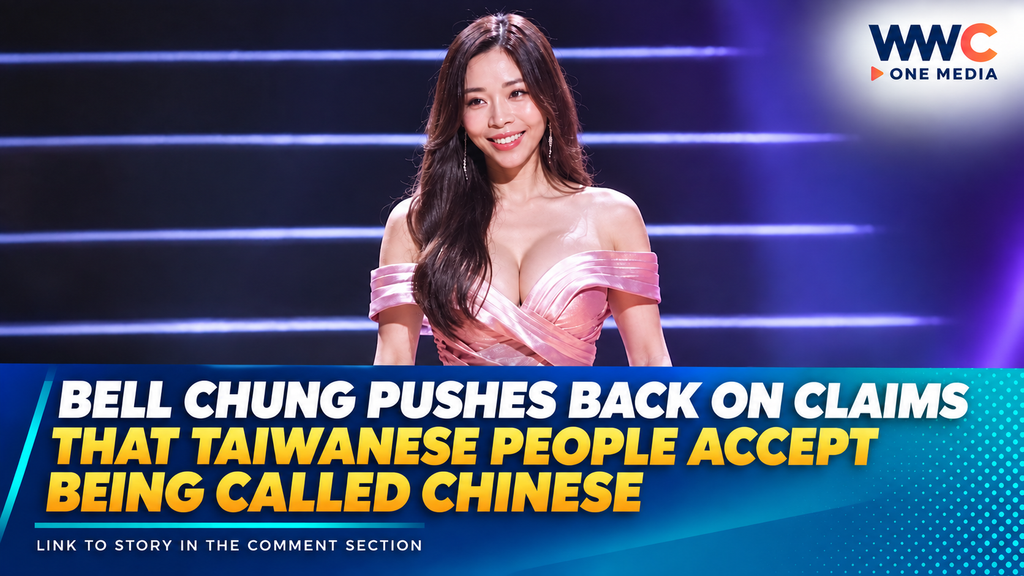
TAIPEI — Taiwanese singer-songwriter Bell Chung has sparked discussion about identity after rejecting the idea that Taiwanese people generally do not care whether they are identified as Chinese.
Chung, 32, whose Chinese name is Chung Chi (鍾綺), addressed the issue in a social-media video after a friend told her that many Taiwanese people encountered overseas appeared indifferent to their identity and would not object to being called Chinese.
Chung said she found that characterization difficult to understand and emphasized that people with such views should not be treated as representing all Taiwanese people.
Bell Chung: One person’s view does not speak for everyone
According to Taiwanese media reports, Chung said a friend had told her that most Taiwanese people she had encountered did not seem particularly concerned about questions of identity.
The friend reportedly suggested that some would even be comfortable being called Chinese.
Chung said the comment deeply affected her.
Rather than accepting that description as representative of Taiwan, she used her video to stress that Taiwanese society contains many people who have a clear sense of how they identify.
Her central message was that individual Taiwanese people who identify differently should not automatically be treated as speaking for the entire population.
The singer’s reaction quickly drew attention
Taiwanese outlet FTV reported that Chung became emotional while discussing what she had heard, saying she could not understand why someone would be uncomfortable identifying with the place where they grew up.
She also said her reaction was not about being ashamed of being Taiwanese. Rather, she described feeling embarrassed by what she viewed as a failure by some people to appreciate their connection to Taiwan.
The comments quickly circulated online, prompting discussion among social-media users about Taiwanese identity, national labels and how people from Taiwan describe themselves when living or traveling abroad.
Yahoo Taiwan also carried the report, highlighting Chung’s reaction to the claim that many Taiwanese people supposedly did not care about the distinction.
This was not a survey of Taiwanese public opinion
One of the most important points for understanding the controversy is that Chung’s comments were not based on a nationwide survey.
Her remarks were prompted by a conversation with a friend about experiences involving Taiwanese people overseas.
That means the claim that “most Taiwanese don’t mind being called Chinese” should not be presented as an established fact about Taiwan’s population.
Instead, the episode reflects a disagreement over how Taiwanese identity is perceived and represented abroad.
Liberty Times’ video coverage likewise framed the incident around Chung’s reaction to the characterization of Taiwanese identity rather than presenting it as statistical evidence about public opinion.
A singer whose music is closely tied to Taiwan
Chung’s reaction also fits with the cultural identity expressed throughout her musical career.
The singer-songwriter is known for combining Taiwanese-language music with contemporary Western musical influences and has promoted Taiwanese-language music to international audiences.
Her Spotify artist profile describes her work as an effort to bring Taiwanese-language music to a global audience.
Her connection to Taiwanese-language music also has a family dimension.
In a 2025 interview, Chung recalled her grandfather encouraging her to continue singing in Taiwanese and describing the language as a connection to her roots.
That background helps explain why questions surrounding Taiwanese identity and language have particular significance for the singer.
Her music crosses borders—but her identity message is local
Chung has spent part of her career using international musical influences to introduce Taiwanese-language songs to wider audiences.
Her 2025 release “Coming Home” (換我疼恁), for example, was presented as a deeply personal Taiwanese-language song inspired by her relationship with her parents and her experiences living away from home.
That international experience has also shaped the way she approaches Taiwanese culture.
Rather than separating global musical influences from Taiwanese identity, Chung has attempted to combine the two.
Her recent comments therefore extend beyond a political argument: they are connected to a broader artistic effort to make Taiwanese-language culture visible internationally.
Why the comments resonated
The controversy touches on a sensitive question in Taiwan: how people from the island describe their own identity and how outsiders describe them.
Those questions can become especially complicated when Taiwanese people travel or live overseas, where others may use broader or different national labels.
Chung’s argument was essentially that an outsider’s encounter with one group of Taiwanese people should not be treated as evidence that everyone in Taiwan shares the same position.
That distinction is crucial.
Taiwanese society contains a range of views about national and cultural identity, and individual experiences do not necessarily capture the views of the entire population.
Social media turns a personal reaction into a wider debate
Chung’s remarks quickly became part of a larger online conversation.
FTV reported that commenters responded with a mixture of agreement and personal reflections about Taiwan and Taiwanese identity.
The reaction demonstrates how quickly comments from public figures can move beyond entertainment and into broader cultural discussions.
For Chung, however, the issue was closely connected to something personal: her belief that people who identify strongly with Taiwan should not be made invisible by the actions or opinions of others.
The bigger picture
The episode illustrates why identity remains such a sensitive subject in Taiwan.
Terms such as Taiwanese and Chinese can carry different cultural, historical and political meanings depending on the person and context.
Chung’s comments represent her own position. They should not be interpreted as evidence that all Taiwanese people share her view—or the view attributed to the friend who prompted her response.
That nuance is especially important as the discussion spreads beyond Taiwan.
The bottom line
Bell Chung’s remarks have reignited a conversation about Taiwanese identity, cultural representation and how people from Taiwan are described overseas.
Her central point was straightforward: one person’s identity—or one person’s experience with Taiwanese people—does not speak for everyone.
And while her comments have generated debate, they also highlight something much broader about Taiwan: identity is personal, complicated and far from universally defined by a single label.
WWC ONE MEDIA G.A




Leave a Reply