
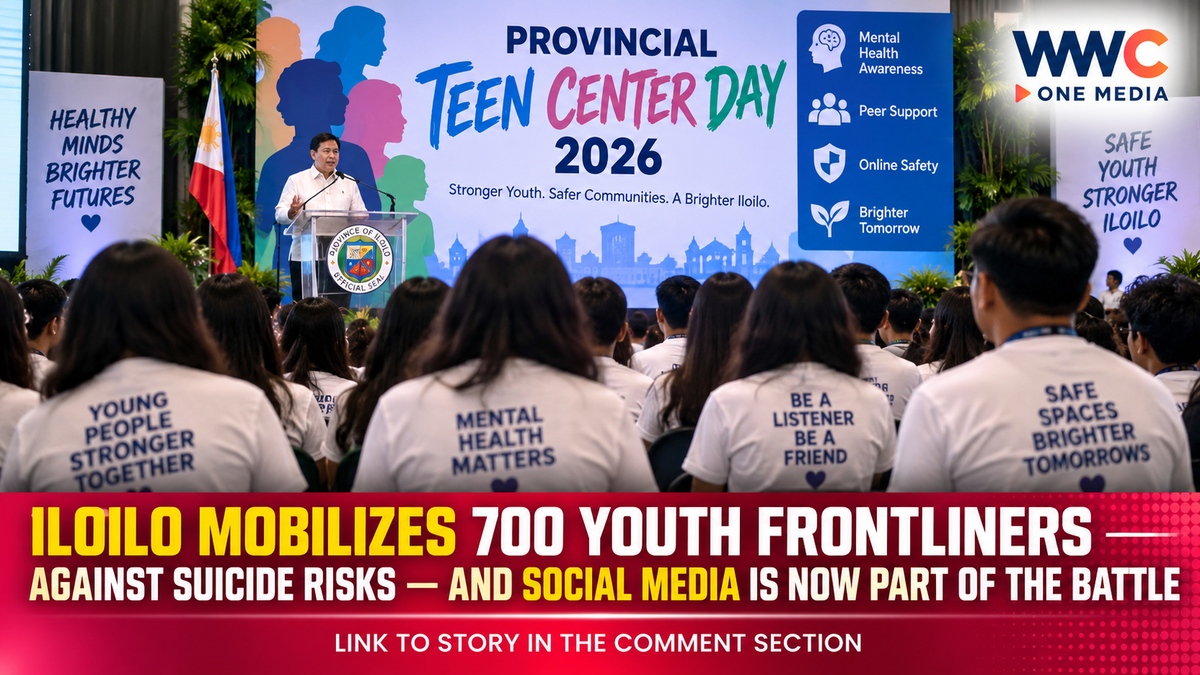
ILOILO — More than 700 young people are being positioned on the front lines of Iloilo’s campaign to protect adolescents from mental-health crises, as provincial officials intensify efforts to identify troubled teenagers early and address harmful online influences.
The initiative brought together more than 700 peer helpers and teen center coordinators during the 2026 Provincial Teen Center Day at the Iloilo Convention Center on September 3.
Iloilo Gov. Arthur Defensor Jr. urged the young participants to become early-warning partners who can recognize when classmates or friends are struggling and connect them with appropriate support.
The strategy starts with young people helping young people
Defensor described peer helpers as the “nerve endings” of the province’s youth programs — people who may recognize problems among their peers before adults or institutions do.
The governor stressed that authorities cannot effectively provide counseling when they do not know what young people are experiencing.
Provincial Population Officer Atty. Ruel Von Superio likewise emphasized that peer helpers should see themselves not simply as volunteers, but as listeners, advocates and bridges to support for fellow young people.
The approach reflects a broader strategy: make support available closer to where teenagers actually live, study and interact.
Social media becomes a major focus
Officials also singled out the online environment as an important part of the challenge.
Defensor warned that while social media and the internet are now essential parts of everyday life, young users can also encounter harmful material, including misinformation, gambling content, pornography and bullying.
The provincial government is preparing to launch PRIMETIME, a program being developed with the Department of Education that will establish guidelines aimed at healthier and more responsible social-media use among young people.
The National Youth Commission is also getting involved.
NYC Chairperson and Undersecretary Joseph Francisco “Jeff” Ortega said the commission plans to work with Meta and bring a team to Iloilo to promote cyber hygiene and responsible social-media use among young people and their parents.
Iloilo already has a growing support network
The province’s response goes beyond the 700 youth participants.
Iloilo currently has 102 school-based teen centers, including 21 standalone Teen Center 2.0 facilities. The program began in 2011 and was expanded in 2023 through the Teen Center 2.0 model, which provides dedicated spaces and additional psychological-support resources.
The province has also been expanding its mental-health infrastructure.
In July, the provincial government announced P42.5 million for 10 additional youth-focused facilities — five Teen Center 2.0 facilities and five Family and Youth Development Centers — intended to bring counseling, early intervention and family support closer to schools and communities.
A 24/7 helpline is already operating
Iloilo also launched the PRIME Helpline, a round-the-clock service providing psychosocial support, crisis intervention and referrals for people experiencing mental or emotional difficulties.
The provincial government said the service is staffed by social workers and psychometricians.
Importantly, official provincial data cited when the helpline was launched showed that reported suicide cases in Iloilo declined from 76 in 2024 to 63 in 2025.
That means the latest initiative should not be framed as proof that suicides are currently increasing. Rather, officials are responding to what they describe as a serious continuing mental-health concern among young people and strengthening prevention and early-intervention systems.
The concern extends beyond suicide prevention
The province’s youth programs are also addressing broader adolescent health concerns.
Earlier reporting from Panay News cited the Iloilo Provincial Health Office as identifying mental-health problems, teenage pregnancy, suicide, sexual abuse and other health concerns among issues requiring stronger intervention. The provincial government has been working with schools and health facilities to improve adolescent services.
The focus on digital responsibility is also not entirely new.
In May, Iloilo City held a youth forum on information integrity, digital responsibility and social-media civility, where young participants were taught about misinformation, disinformation, AI-generated content and responsible online behavior.
The message: Don’t wait for a crisis
The latest initiative reflects a shift toward early intervention rather than waiting until a young person’s problems become an emergency.
Teen centers are being positioned as safe spaces where adolescents can seek guidance, discuss problems and access support.
Superio described them as places for questions, guidance, healing, friendship and hope.
That makes the more than 700 peer helpers particularly important.
They are not being asked to replace mental-health professionals. Their role is to notice warning signs, listen without judgment and help connect young people with adults and professional services when needed.
And that may ultimately be the most important part of Iloilo’s strategy.
The province is betting that sometimes the person who notices a teenager is struggling first isn’t a doctor, counselor or government official — it’s a friend sitting beside them.




Leave a Reply