
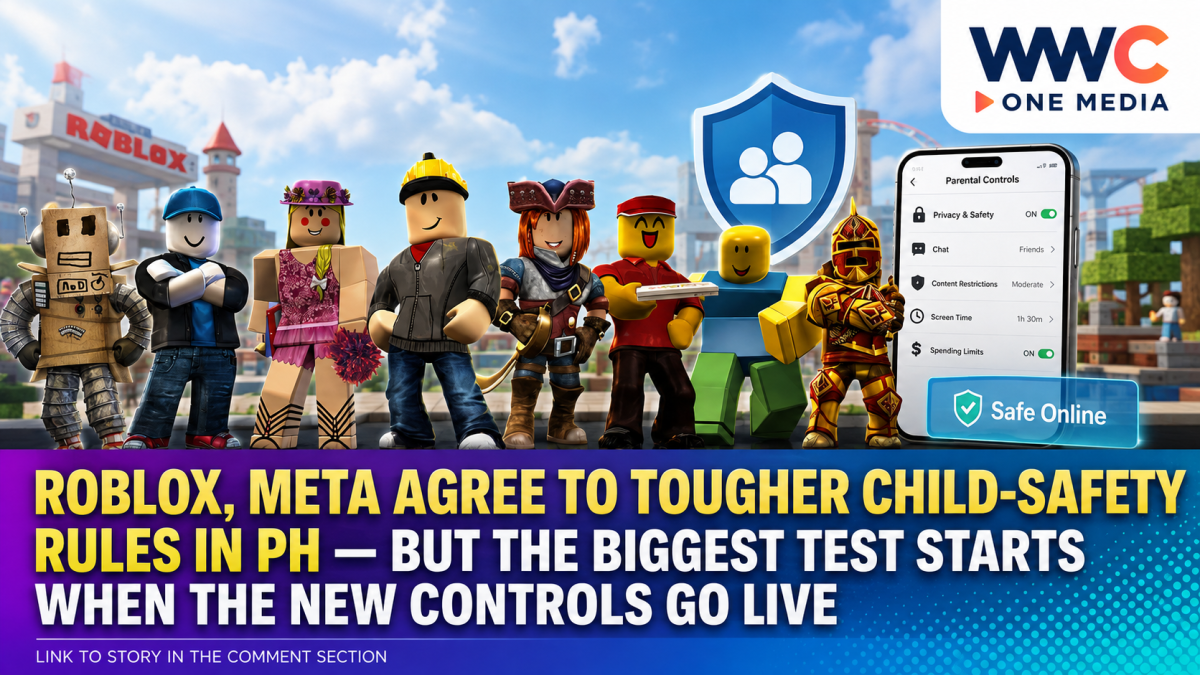
MANILA, Philippines — The Philippine government has secured new child-safety commitments from two of the world’s biggest digital platforms, with Roblox and Meta agreeing to tighten protections for young Filipino users amid growing concern over online grooming, abusive content, deepfakes and violent material.
But the more important question now is whether those promises can be translated into safeguards that actually work.
Philippine officials met executives of Meta and Roblox in Singapore on August 27, with the discussions focusing on protecting minors and improving the response of technology companies when authorities investigate serious online threats.
Among the most significant commitments is Roblox’s plan to strengthen age and identity verification for Philippine users, including integration with the Philippine Identification System or national ID system, according to Philippine officials.
Roblox also committed to establishing a local office in the Philippines by October 2026, another condition sought by the Department of Information and Communications Technology as the government pushes for greater accountability from platforms operating in the country.
Roblox Moves to Keep Adults Out of Children’s Online Spaces
The proposed verification changes are aimed at one of the most difficult problems facing child-focused online platforms: determining whether users are really the age they claim to be.
Cybercrime Investigation and Coordinating Center executive director Renato Paraiso said Roblox agreed to develop measures intended to restrict communication between children and significantly older users, while closing loopholes that could potentially be exploited by groomers or extremist actors attempting to enter spaces used by minors.
Interior Secretary Jonvic Remulla separately raised concerns over what he described as extremist conversations involving alleged foreign and Filipino groomers on Roblox, saying authorities had encountered discussions encouraging teenagers toward violence. These are allegations and investigative findings cited by Philippine officials; they should not be interpreted as proof that Roblox itself caused specific violent incidents involving minors.
Roblox already operates age-based safety systems more broadly. The company says users can undergo age checks through government-issued identification or facial age-estimation technology, with younger accounts receiving tighter communication and content restrictions.
For its youngest users, Roblox says some accounts have chat disabled by default, while other age groups are placed under different content and communication rules.
The Philippine agreement could therefore become a crucial test of how those systems work when paired with government-backed identity verification.
Meta Promises Faster Action on Deepfakes and Child-Abuse Cases
Meta, which owns Facebook, Instagram and Messenger, also committed to improving its response to harmful content affecting Filipino users.
Philippine officials said the technology company agreed to take a more proactive approach to harmful AI-generated deepfakes and respond more quickly to lawful requests related to cybercrime and other serious online threats.
Authorities are particularly seeking faster cooperation in investigations involving online sexual abuse and exploitation of children, child sexual abuse material, online abuse, scams and other criminal activity.
Any disclosure of user information, however, would still have to take place through applicable legal processes rather than giving authorities unrestricted access to users’ private data.
Meta officials are expected to hold further discussions with Philippine authorities in September to work on formal information-sharing procedures that could assist the National Bureau of Investigation and other agencies in building cases. OneNews reported that authorities want the arrangements eventually placed into a written memorandum or agreement.
That may prove more consequential than another public pledge.
For police and cybercrime investigators, delays in obtaining platform information can mean the difference between identifying an online suspect quickly and losing crucial investigative leads.
Meta Is Already Under Massive Global Pressure Over Teen Safety
The Philippine talks are also happening while Meta faces extraordinary international scrutiny over how Facebook and Instagram affect younger users.
In a separate development in the United States, Meta recently reached an agreement worth approximately $18 billion involving state attorneys general and major changes to teen protections on Facebook and Instagram.
Those U.S. measures include a default two-hour daily limit for teenagers, restricted access between midnight and 6 a.m., reduced notifications during school hours, stronger parental supervision tools and additional age-assurance measures.
Importantly, those specific settlement requirements apply in participating U.S. jurisdictions and should not be assumed to automatically apply to Filipino users.
Still, the agreement demonstrates how rapidly governments are moving from asking social networks to voluntarily protect children toward demanding measurable safeguards and accountability.
Meta has also been expanding Teen Account protections globally, including AI-assisted age assurance and stronger content settings for teenagers.
Philippine Lawmakers Are Moving in the Same Direction
Pressure on Roblox and Meta is unlikely to end with the Singapore meetings.
Numerous measures dealing with children and social media are currently pending in the Philippine House of Representatives.
Proposals include mandatory age verification, minimum-age requirements for social media accounts, safety-by-design obligations for platforms, parental controls and regulations designed to combat online grooming and radicalization.
Some proposals would restrict or prohibit younger children from independently maintaining social media accounts, while others would create broader child online-safety frameworks covering digital platforms.
That means the voluntary commitments being discussed today could eventually be overtaken by mandatory rules.
One Critical Distinction
Officials have cited recent violent incidents involving young people while calling for stronger online protections.
But caution is necessary when linking individual attacks directly to gaming platforms or social media.
In the Ateneo de Zamboanga University case cited in the broader OneNews report, the school said the Philippine National Police investigation found no evidence of conspiracy or coordination with other people and no evidence that bullying or a school-related grievance motivated the attack.
That does not eliminate broader concerns about grooming, violent online communities or radicalizing content.
It does mean authorities and news organizations should distinguish between documented platform risks and claims about what caused a specific crime.
The Biggest Test Comes After the Announcement
On paper, the commitments are significant.
Age verification could make it harder for adults to masquerade as children. Age-based communication barriers could reduce opportunities for grooming. Faster content removal could limit the spread of violent or exploitative material. A Philippine Roblox office could give regulators and law enforcement a clearer local point of contact.
But none of those guarantees success.
Authorities will still have to determine how national-ID-based verification can be implemented without creating new privacy risks, how quickly platforms respond to legitimate emergencies, how minors without suitable identification are handled and whether adults can still circumvent age controls.
There is also the question of measurement.
If harmful content is supposed to disappear faster, how much faster? If suspected predators are supposed to be blocked from children’s spaces, how will regulators know the system is working? And when platforms make mistakes, what appeal and privacy protections will legitimate users receive?
Those details will decide whether this week’s agreement becomes a meaningful child-protection breakthrough — or another set of technology-industry promises that sounded stronger at the negotiating table than they proved to be online.


Leave a Reply