
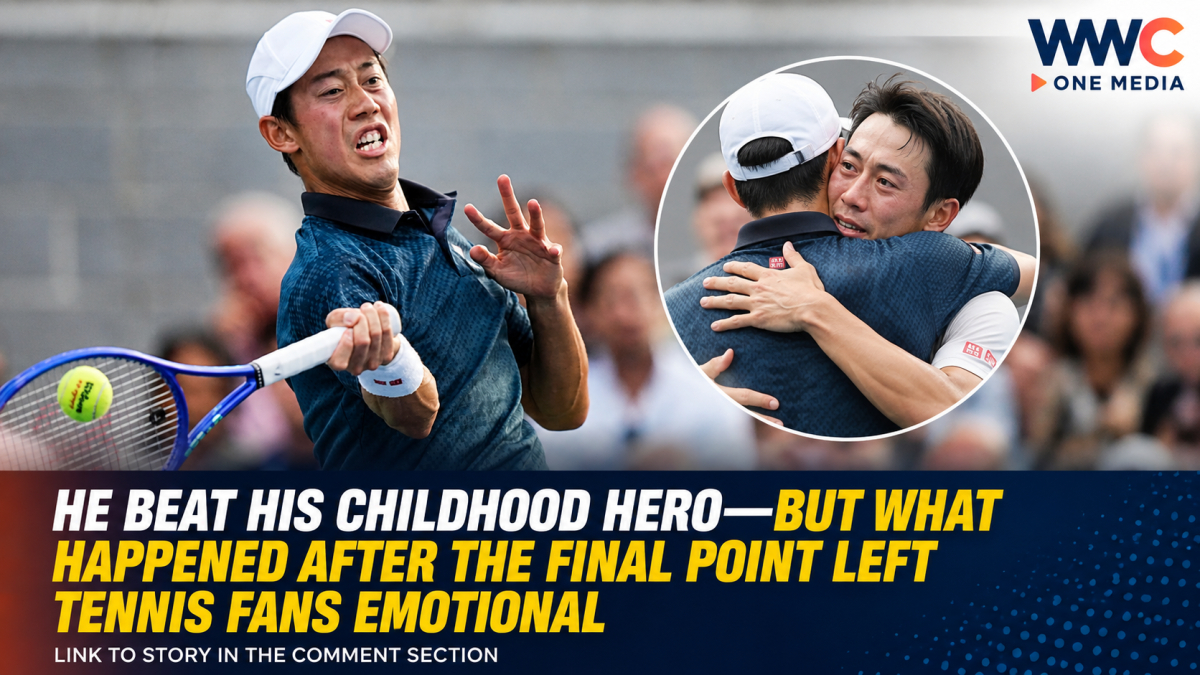
NEW YORK — It was the kind of victory Rei Sakamoto had dreamed about as a young tennis fan—but perhaps never imagined would come with so much emotion.
The 20-year-old Japanese rising star defeated his childhood idol, Kei Nishikori, 6-4, 7-6 (3) in the final round of qualifying at the 2026 US Open, securing a coveted place in the tournament’s main draw while bringing an emotional end to one of Japan’s greatest tennis careers at Grand Slam level.
For Sakamoto, the celebration came with mixed emotions.
After all, the man standing across the net was the player he grew up watching—and the superstar who helped inspire an entire generation of Japanese tennis players.
“I honestly grew up watching him play, and he was my idol for my whole life,” Sakamoto said after the match, describing the moment as difficult to put into words.
A Victory That Felt Like a Farewell
The match carried far more weight than a typical qualifying contest.
Nishikori, 36, was attempting to reach the US Open main draw for what would have been his final appearance in a Grand Slam tournament. The Japanese icon had entered qualifying on a wild card and fought his way through two matches, setting up a dramatic showdown with the young player widely seen as part of Japan’s tennis future.
But Sakamoto refused to be overwhelmed by the occasion.
According to Associated Press coverage, the young Japanese star fired 19 aces, including one to seal the victory after Nishikori had saved two match points. The result sent Sakamoto into the US Open main draw for the first time—but it also ensured that his hero’s Grand Slam farewell would end one round short of the main event.
The official US Open later honored Nishikori in an on-court ceremony, recognizing the extraordinary career of a player whose name became synonymous with Japanese men’s tennis.
Nishikori’s Message to the Man Who Beat Him
Despite the disappointment of defeat, Nishikori had nothing but praise for the player who ended his US Open journey.
“I’m not happy to lose today, but happy for Rei,” Nishikori said, calling Sakamoto the next major hope for Japanese tennis and expressing confidence in his potential to reach the sport’s elite.
It was a remarkable moment of sportsmanship—and one that made the match feel less like an ending and more like a changing of the guard.
Sakamoto, meanwhile, made clear that Nishikori’s influence on Japanese tennis cannot be overstated.
Nishikori became the first Asian man to reach a Grand Slam singles final when he advanced to the US Open championship match in 2014. He later reached a career-high ranking of world No. 4, won 12 ATP singles titles and captured an Olympic bronze medal at the 2016 Rio Games. His deepest Grand Slam runs also came in New York, where he reached the semifinals in 2016 and 2018.
From Idol to Opponent—and Now, a New Beginning
For Sakamoto, the memory of Nishikori’s historic 2014 US Open run remains deeply personal. The young star was still a child when he watched Nishikori carry Japanese and Asian tennis onto one of the sport’s biggest stages.
More than a decade later, their paths crossed on the same tournament grounds—but this time, they stood on opposite sides of the net.
And after the final point, the symbolism was impossible to ignore.
Nishikori was presented with a special framed tribute during the farewell ceremony, with Sakamoto joining him for photographs—a powerful image of one generation standing alongside the next.
The defeat marked Nishikori’s final Grand Slam match, although his professional career is not over just yet. The US Open confirmed that he plans to retire from professional tennis following the Japan Open in Tokyo later this year, giving Japanese fans one more opportunity to celebrate one of their country’s greatest sporting icons.
The Future of Japanese Tennis?
Sakamoto now moves forward with a place in the US Open main draw—and with expectations that will inevitably grow after such a symbolic victory.
But perhaps the most memorable part of the day was not simply that a young player defeated a legend.
It was the way the legend responded.
There was no bitterness, no attempt to overshadow the rising star. Instead, Nishikori publicly celebrated the player who had just denied him one final Grand Slam appearance.
For Japanese tennis, it may have been goodbye to one era.
But as Sakamoto walked off the court with his biggest opportunity yet waiting ahead, one question suddenly became impossible to ignore:
Was this merely the end of Kei Nishikori’s Grand Slam story—or the beginning of Japan’s next great tennis chapter?
The answer may be coming sooner than anyone expected.




Leave a Reply