
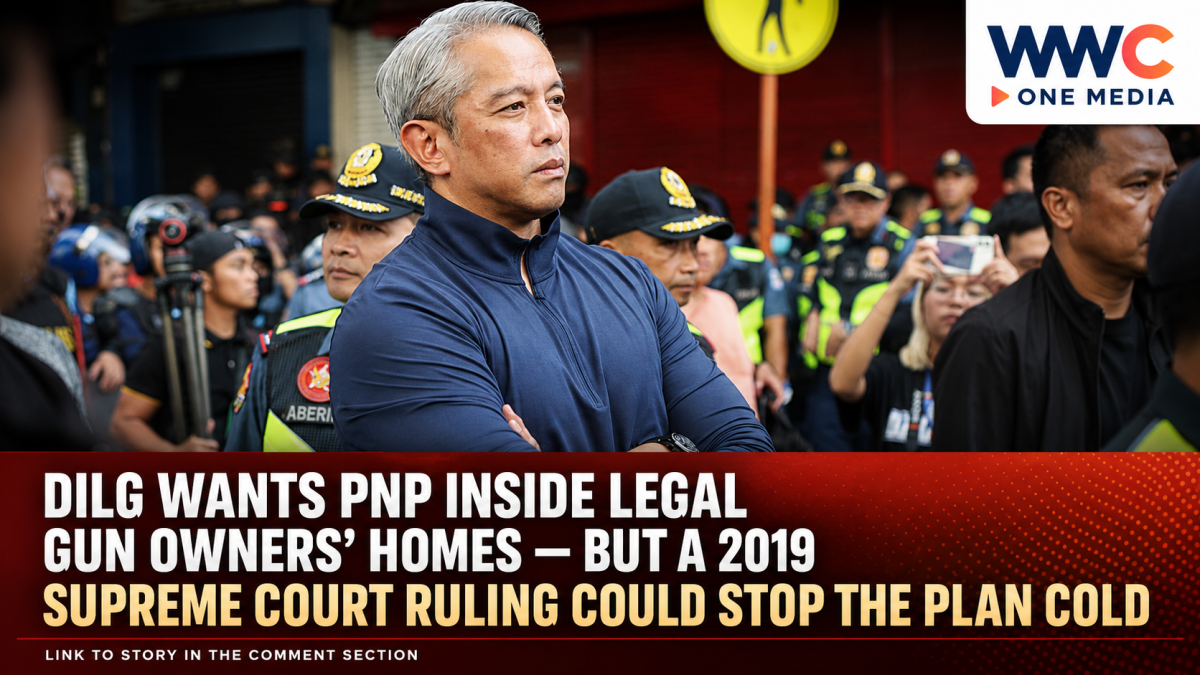
MANILA, Philippines — A government push to prevent another deadly school shooting is rapidly turning into a much bigger debate over gun safety, police powers and the constitutional privacy of Filipino homes.
Interior and Local Government Secretary Jonvic Remulla wants the Philippine National Police to be able to inspect how legally owned firearms are stored inside residences, arguing that licensed gun owners must prove that their weapons cannot easily fall into the hands of children or other unauthorized people.
But there is a major problem confronting the proposal.
The Supreme Court has already ruled on a strikingly similar policy.
And in that 2019 decision, the Court made clear that while Filipinos have no constitutional right to own firearms, government regulation of guns does not automatically erase the constitutional protection of the home.
That legal collision could become the most important part of the story.
From School Shootings to Home Inspections
Remulla raised the proposal during deliberations on the Department of the Interior and Local Government’s proposed 2027 budget at the House of Representatives on Aug. 27.
The DILG chief said police should be authorized to check whether firearms issued or legally registered to owners are being properly secured when not in use.
The proposal emerged after two deadly school shootings—one in Tacloban City on June 22 and another at Ateneo de Zamboanga University on Aug. 18—put firearm storage and owner accountability under intense scrutiny.
At San Jose National High School in Tacloban, two minors were accused of carrying out a shooting that killed three students and wounded several others. Authorities said one of the weapons used was linked to the policewoman aunt of one of the suspects.
The Zamboanga case raised similar questions.
A student opened fire at the Ateneo de Zamboanga University Junior High School campus, killing another student before also dying. Authorities later confirmed that firearms connected to the suspected shooter’s father, a Bureau of Customs official, were involved.
The Bureau of Customs responded by relieving and preventively suspending the official while ordering a nationwide accounting of BOC-issued firearms and a review of rules covering their custody, transport and safekeeping.
Customs Commissioner Ariel Nepomuceno also said the firearms had reportedly been left inside a vehicle.
That detail went directly to the issue Remulla is now trying to address: What happens when a legally possessed firearm is not illegally acquired—but is simply left somewhere another person can reach it?
Remulla’s New Proposal: Sign a Waiver, Get One Day’s Notice
The proposal became even more significant on Aug. 28 when Remulla clarified how he wants the system to work.
Instead of police seeking a search warrant every time they inspect firearm-storage arrangements, Remulla said gun owners could be required to sign a waiver allowing police to conduct an inspection after one day’s notice.
He stressed that the purpose would not be to treat licensed owners as criminals, but to make sure firearms are stored safely and appropriate storage facilities are actually being used.
The idea sounds straightforward from a public-safety standpoint.
The legal situation is anything but straightforward.
Philippine Gun Law Already Requires Secure Storage
Republic Act No. 10591, or the Comprehensive Firearms and Ammunition Regulation Act, already imposes firearm-storage requirements.
For individual firearm licenses, the law requires a vault, locked container or another security measure for keeping firearms safe.
The law classifies individual licenses according to how many registered firearms a person may possess, ranging from Type 1 licenses for up to two firearms to Type 5 licenses for certified collectors with more than 15.
RA 10591 also specifically provides inspection and bond requirements for Types 3 to 5.
But the words “inspection requirement” became the center of a constitutional battle years ago.
And that is where Remulla’s current proposal runs into trouble.
The Supreme Court Has Been Here Before
On Oct. 15, 2019, the Supreme Court decided consolidated cases involving challenges to provisions of RA 10591 and its implementing rules.
One controversial requirement involved a form asking firearm applicants to give the PNP advance consent to inspect firearms at their residence.
The Court agreed that gun ownership in the Philippines is a government-regulated privilege rather than a constitutionally guaranteed right.
But it drew a sharp distinction between regulating guns and entering a private home.
The Court held that the government could not use firearm regulation as justification for requiring applicants to surrender their constitutional protection against unreasonable searches.
Most importantly for the current controversy, the Court declared the relevant inspection provision of the 2013 implementing rules unconstitutional and prohibited the PNP from requiring firearm applicants to sign the consent-to-inspection provision or submit their homes to inspection unless police have a search warrant.
That ruling could present a direct obstacle to Remulla’s proposed waiver system.
The issue is especially striking because the mechanism rejected by the Court in 2019 also involved gun owners supposedly giving the government their consent before receiving or maintaining firearm privileges.
Remulla Knows About the Ruling
Remulla has acknowledged the Supreme Court decision.
He said the administration intends to raise the issue with Congress and bring the matter before the Supreme Court to determine whether inspections could legally proceed under a system involving advance notice.
That means the proposal is not yet an existing power of the PNP.
Police cannot simply begin visiting every licensed gun owner’s residence because Remulla announced the idea.
Legislation, revised regulations and potentially another major constitutional battle would have to come first.
And even the PNP appears to recognize that problem.
PNP: Privacy Concerns Must Be Addressed
PNP chief Gen. Jose Melencio Nartatez Jr. said the proposal will be carefully studied and that police will consult affected stakeholders before supporting any implementation.
Nartatez specifically identified privacy as an issue because the proposed inspections would involve people’s homes.
He said any system would need clear procedures and safeguards and must remain within existing law while respecting individual rights.
That position is significant.
The institution that would actually conduct the inspections is effectively saying that the plan cannot simply be implemented as an administrative shortcut.
Gun Ownership Is a Privilege — Privacy Is Still a Right
Remulla is correct on one central legal point: unlike in the United States, the Philippine Constitution does not guarantee an individual constitutional right to bear arms.
The Supreme Court itself said firearm possession is not a constitutional or property right and may be heavily regulated by the government.
But the same ruling also emphasized something equally important.
The absence of a constitutional right to own a gun does not mean a licensed gun owner loses the constitutional protection of his or her home.
Article III, Section 2 of the 1987 Constitution protects people and their houses against unreasonable searches and seizures.
In other words, the government may impose conditions on owning a firearm.
Whether one of those conditions can be a pre-signed permission slip allowing police into a private residence is another question entirely—and one the Supreme Court has already answered once.
There Is Another Path: Punish Negligence
The government is also exploring an approach that may avoid some of the constitutional problems surrounding mandatory home inspections: imposing stronger liability on gun owners who negligently allow their weapons to be accessed or used by others.
The PNP has publicly supported legislative efforts to hold negligent firearm owners accountable, especially in households where minors may gain access to weapons.
Remulla has separately pushed for tougher laws against loose firearms and stronger penalties for illegal possession.
Malacañang has said President Ferdinand Marcos Jr. is open to stiffer punishment, although the Palace said the President would still have to review whatever final legislation Congress approves.
That approach could shift the debate from “Can police enter your house to see your gun safe?” to “What happens to you if your failure to secure your gun gets somebody killed?”
Those are very different legal questions.
The Bigger Question
The tragedies in Tacloban and Zamboanga exposed a problem that deserves an answer.
Both cases demonstrated that a firearm can be perfectly legal on paper yet become deadly the moment its legitimate custodian loses control of it.
That makes stronger storage rules, government-firearm accountability and penalties for negligence difficult to dismiss.
But the answer cannot ignore another reality.
The Supreme Court has already said the government’s authority to regulate firearms does not give police an unrestricted doorway into private homes.
That is why Remulla’s proposal is likely to become much bigger than another gun-control debate.
Congress may eventually tighten firearm laws.
Police may strengthen storage rules.
Government agencies may impose stricter accountability on personnel issued service weapons.
But if the administration insists that licensed gun owners must sign away part of their privacy before keeping a firearm, the fight may ultimately return to the same place it reached seven years ago:
the Supreme Court.
And this time, the question will not simply be whether the Philippines needs tougher gun laws.
It will be whether preventing the next tragedy is enough reason to reopen a constitutional door the Court has already ordered closed.
Leave a Reply