
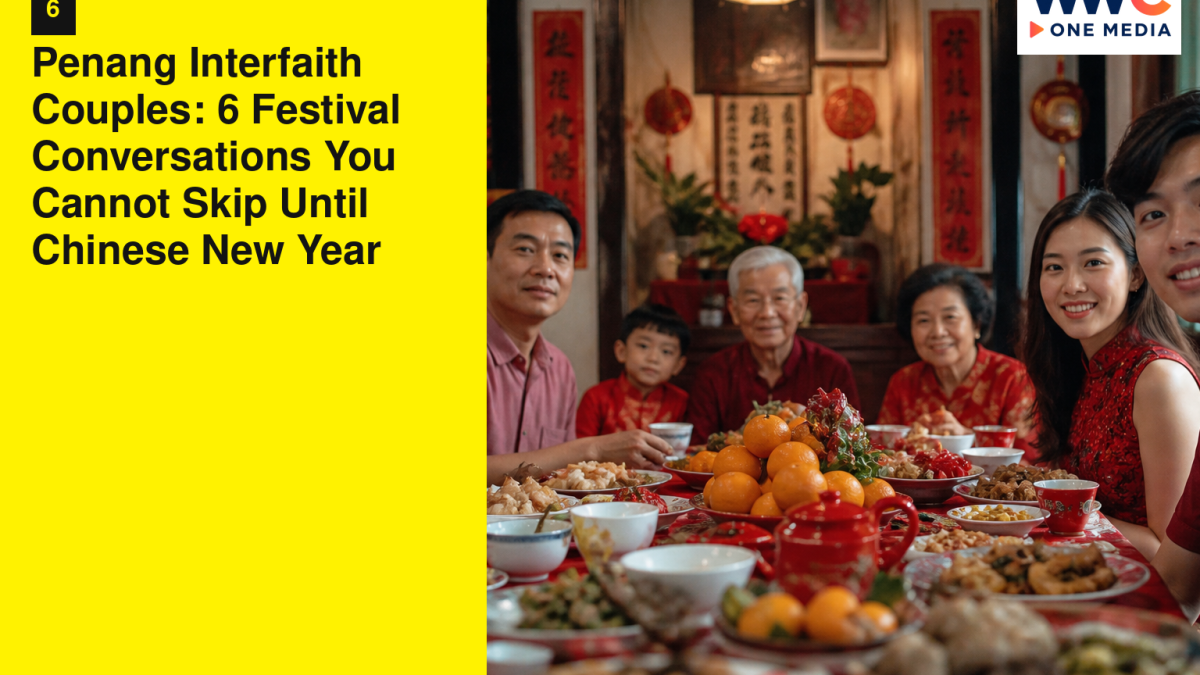
GEORGE TOWN, Malaysia — A Penang interfaith couple can date for months on kopitiam eggs and a walk around Armenian Street and still walk into Chinese New Year unprepared. The calendar will not wait. CNY, Hari Raya, Deepavali — in this state they are not abstract “diversity.” They are houses, tables, pork and no-pork, alcohol and no-alcohol, a mother who wants you in the hall, a father who wants to know what you are. Festival season is pressure with food. The conversations belong before the first open house, not in a kitchen during reunion dinner while someone is frying fish.
Six of them. What each festival will actually require of your body and your diary. The table: pork, alcohol, vegetarian, fasting. Parents and who gets the first morning. Money and gifts without a competition. What you will not perform. And what happens if a house cannot receive you. This is couple logistics and respect. It is not a ruling. Nobody in a newsdesk chair is your ustaz, your priest, your monk, or your temple committee. Ask your own people for religious guidance. Ask each other for a plan.
1. Map the year before Chinese New Year arrives, not during the supermarket rush
Penang’s festival year is visible on the roads: traffic into George Town, a closed street, a house that suddenly has extra cars from Kulim or from the mainland bridge. If one of you marks time by CNY and the other marks time by Ramadan and Hari Raya, and a third calendar — Deepavali, Christmas, Thaipusam, a church Holy Week — sits in the family somewhere, you need a shared note. Not a vibe. Dates, which house, which night you sleep over, which night you do not.
Chinese New Year is the one couples skip talking about because it feels like “everyone’s holiday.” It is not. For a Chinese household in Penang it can mean reunion dinner, visits, a morning in certain clothes, an expectation that the partner appears and is explainable. For a Muslim partner it can mean a house full of food they cannot eat, a toast they cannot join, a relative who asks questions that are really questions about conversion. For a Hindu or Christian or Buddhist or atheist partner the mix shifts, but the need does not: what is the minimum appearance, and what is a full participation you have not agreed to.
Hari Raya in a Penang Malay household is its own open-house gravity. Deepavali in an Indian household here has its own morning, its own sweets, its own family radius. You cannot rank them by which is “more Malaysian.” You can only rank them by which house will punish an absence.
Write three columns for the next twelve months: festival, whose family, what we already know we will do. Put CNY at the top if it is the next pressure, even if Hari Raya is bigger in the other house. The point of “until Chinese New Year” is the deadline. If you are still “seeing how it goes” in December, January will decide for you in a hall in Pulau Tikus or a terrace in Butterworth while you smile with your mouth shut.
A question that belongs in a weekday kopitiam, not in a festive hall:
“If your mother could design Chinese New Year with me in it, what would that look like. If my mother could design Hari Raya with you in it, what would that look like. Where do those pictures fight.”
Listen for the fight. Then schedule the compromise before the flight tickets and the baju and the mandarin oranges.
2. The table: pork, alcohol, vegetarian, fasting — as logistics, not a debate club
George Town eats in public. Food houses, hawker stretches in Gurney’s shadow, a morning nasi kandar, a night char kway teow that may or may not be cooked on a griddle that has seen pork. Interfaith couples in Penang do a quiet scan that tourists treat as fussiness. It is not fussiness. It is how you do not ambush someone you love with a plate.
This is not a religious ruling. Practices differ inside every community. Some Muslim partners will not enter a shop that serves alcohol. Some will sit, not drink, and eat what they have checked. Some Chinese families cannot imagine a CNY table without pork and a toast. Some Indian households will want vegetarian on a given day and meat on another. Some Christian families will put wine on a Christmas table and not understand why that is a problem. You do not adjudicate the theology at Wawasan or on a stool in New Lane. You ask this partner, this parent, this house.
Write a household table policy:
What we cook at home when it is just us.
What we cook when their parents visit.
What we accept on a visit to a house we do not control.
What we do at a hawker stall when the griddle is ambiguous — ask, skip, choose a different stall.
Alcohol: who drinks, where, whether a partner is comfortable in a bar on Beach Street, whether CNY toasts can be tea, whether a relative will take tea as an insult. Insult management is a couple skill. You can be respectful and still not drink. You can drink and still not pressure. What you cannot do is surprise.
Fasting months and fasting days: if one of you will not eat from dawn to dusk, the other person’s “let’s try this new place at 1 p.m.” is not cute. Put the fast on the calendar. Plan evenings. Do not treat hunger as a personality flaw.
Script for a parent who wants you to “just try”:
“I don’t eat that, I’m glad it’s on the table for whoever can. I’ll take the [vegetable / fish / fruit / rice] if that’s all right.”
If it is not all right, you are not at a food problem. You are at a control problem. The couple handles control later, outside, in a car on the way back toward Weld Quay, not in front of the aunties.
Do not use food to score piety points against each other. Do not use food to score modernity points against each other. Eat as you have agreed. The stall will still be there tomorrow.
3. Parents: who gets the first morning, and who gets a video call instead of your body
Festival mornings are the scarce resource. CNY first-day visits. Hari Raya morning. Deepavali morning. A church service. A temple time. You have one body each. Penang traffic will not give you three houses before noon, even if the island looks small on a map.
Name the rotation before anyone’s mother starts a campaign. Year A: CNY morning with family X, Hari Raya morning with family Y. Year B: swap. Deepavali and Christmas and the others get written in, not leftover. If one family is in George Town and the other is in KL or in a kampung on the mainland, travel is part of the respect. A 20-minute visit after you are already exhausted from another house can feel like an insult even if you meant it as effort.
Brief each other. Who will be in the hall. Which uncle asks about baptism, about mosque, about whether the Chinese partner will “jadi Islam,” about whether the Malay partner will eat at the CNY table, about grandchildren, about a house. You do not need a perfect answer. You need the same answer from both of you. Conflicting answers in two living rooms is how families decide you are not serious.
If a parent has already said they cannot receive the partner as a partner — only as a “friend,” only in the car, only at a restaurant, never in the house — believe them. Do not smuggle someone in wearing festival clothes and hope the atmosphere converts a household. Atmosphere is not a teacher. A restaurant meal can be a dignified middle while you wait to see if a house softens. A sneak appearance is a fight with snacks.
Script to a parent:
“We will come on [day] from [time] to [time]. We will eat what we can eat. We will not do a debate at the table. If you need a private conversation with me, set a time that is not the open house.”
Script to each other:
“If your uncle starts, I will smile and you will move us to the kitchen or the car. I will not perform a conversion chat for an audience.”
If you cannot promise to move each other out of a bad conversation, you are not ready for that house. Go to the food house in town instead, just the two of you, and call it a festival. A couple’s private plate is still a festival. It is not a failure.
4. Money, oranges, duit raya, clothes, and the gift that becomes a ranking
Festivals in Penang leak money. New clothes, a tin of cookies, oranges, a hamper, petrol across the bridge, a red packet, duit raya, a tray of something from a famous shop because a mother mentioned it once. Interfaith couples get trapped in a ranking: whose festival gets the more expensive hamper, whose nieces get cash, who looks stingy in which hall.
Pick a boring annual cap. Split it or assign it to the person whose family it is, with the other contributing a set amount. Do not compete. A CNY hamper that humiliates a Hari Raya visit, or the reverse, is not generosity. It is a scoreboard.
Clothes: ask what is respectful in that house. A sleeved blouse, a certain colour to avoid, shoes off, a head covering if that is what the partner asks for in their family’s home. Asking is respect. Assuming you know because you read a thread is how you arrive underdressed or over-costumed. You are not required to wear a full festive identity that is not yours. You are required not to treat their house like a beach.
If cash gifts to children are expected, carry small envelopes and a plan. If you cannot afford the same number as a richer cousin, do not skip the house out of shame and do not overspend to pass. Tell your partner. Let them help you look normal in their family’s economy.
Do not let a festival become the moment you announce a large financial merge — a joint house, a conversion someone has tied to money, a parent who wants a loan because “family.” That is a weekday conversation with numbers. Festival halls are emotional. They are bad banks.
5. What you will not perform — photos, prayers, jokes, and the conversion rumour
Open houses produce photographs. Photographs produce relatives in other states asking who that is. Agree what can be posted. A Penang interfaith couple can be fully real and still not want to be a Facebook education piece for people they have not briefed.
Prayer: if a house prays and you are a guest, ask your partner what standing, sitting, stepping into another room, or remaining quietly looks like in that family. Do not mock. Do not suddenly lead a ritual you do not know in order to score points. Do not film it.
Jokes: pork jokes, alcohol jokes, “when will you convert” as humour, “when will you take them to church” as humour. Shut them down once as a couple. If the family continues, you leave earlier next year or you skip. You cannot control a whole hall. You can control whether you keep delivering your partner to it without a shield.
Conversion rumours travel in this country with a speed that does not care about your actual timeline. If you have not decided anything, say you have not decided anything, and say it the same way in both languages you use. If you have decided, that is a different set of conversations with qualified people in your traditions — still not a column’s job. The couple’s job is not to let a festival rumour become the decision.
A line you can both use:
“We’re here to visit and eat. We’re not announcing a religious change today.”
Repeat as needed. Then talk about the kueh.
If one of you wants the other to perform more — more praying, more toasting, more lion dance enthusiasm, more mosque open-house hours — that want should be spoken in February or in Syawal’s aftermath, not as a hiss in a hallway. Performance under family eyes is how people start to resent the faith they might have approached with curiosity.
6. If a house cannot receive you — the plan until Chinese New Year anyway
Some houses will not open. A parent refuses. A religious boundary in that family is not something you vote off the table. You can be angry. You can also be practical.
Until Chinese New Year, you still need a plan: where you two will eat on the night the rest of the family gathers, how you will speak to the parent who did open a door, whether you travel to Penang at all or sit the year out in KL or in a rented room near Komtar and make your own reunion of two. A couple that only exists when families approve will feel fictional on ordinary Tuesdays.
Do not use children, if you do not have them, as a hypothetical weapon (“when we have kids they will have to accept us”). Do not use children if you do have them as props in a festival lobby. Kids deserve a simpler script: we visit the houses that are kind, we eat, we go home.
If both houses open but only with conditions — no overnight, no hand-holding, a separate table, a male relative present — decide which conditions you can live with for a three-hour visit. Conditions for a visit are not the same as conditions for a life. Do not confuse a festival truce with a future.
Keep a third space in George Town that is yours: a food house that already knows your order, a walk at the Esplanade, a church or mosque or temple you attend without the in-laws, or a quiet coffee on Lebuh Chulia that is not content. You need a Penang that is not a test.
Scripts for the months before the oranges come out
To your partner, October-ish if CNY is the next wall:
“I need six things on paper before we buy tickets. Calendar, table, which parent gets which morning, money cap, photo rules, and the backup if your house says no. I’m not asking you to choose me over your mother in a speech. I’m asking for a plan I can pack for.”
To a parent:
“I will come for [festival]. My partner will come if they are welcome as themselves, including how they eat. If that is not possible this year, I will come alone for [hours] and spend the rest of the day with them. I would rather say this now than fight in your kitchen.”
To a sibling who can ally:
“If uncle starts the conversion talk, can you change the subject to the food. We will not do that conversation with an audience.”
To yourself:
“I will not get baptised, registered, or announced because a reunion dinner is awkward. Awkward is allowed.”
What not to do as a Penang interfaith couple in festival season
Do not arrive at a house hungry and righteous. Eat a little before, so you can decline a dish without looking tragic.
Do not lecture a table about how “true” religion would be more inclusive. You are a guest. Be a guest. Have the politics on a weekday with people who asked.
Do not compare whose festival is more work. They are different work.
Do not get drunk at a CNY table if your partner has asked you not to, then call it culture.
Do not skip Friday prayers or Sunday service or a temple visit you normally keep just to look available, then punish your partner for “making you.” Your practice is yours. If you need it, keep it. If you are using it as a wall, admit the wall.
Do not surprise-invite a parent to a mixed table “so they can see we are fine.” Exposure therapy is not a dinner plan.
Do not treat George Town heritage streets as a neutral backdrop for a difficult talk. You will be interrupted by a tour and a scooter. Sit in a real chair.
Do not weaponise Malaysia’s legal or religious framework as a threat in a couple fight. That is bigger than a relationship and uglier than a festival. If you need legal or religious advice, get it from qualified people, not from a tantrum.
City logistics: island, mainland, open houses, and the car
George Town in peak CNY or Hari Raya open-house hours is a parking argument waiting to happen. Assign a driver who will not drink. Assign a time you leave even if an auntie is still talking. The last ferry is not your issue on the island, but the bridge and the traffic back to Butterworth or to a rented room in Jelutong is.
If one family is in Balik Pulau and the other is in town, you cannot do both well in a morning. Pick. Send food or a visit on another day to the house you did not pick.
Heat, rain, white clothes, turmeric, oil from a kitchen you do not control: pack a spare shirt in the car. This is not vanity. This is how you arrive at the second house looking like you meant to come.
Phones: festival group chats will ping. Agree that you will not answer a relative’s provocation in real time from the other family’s sofa.
If you do not drive, Grab availability on a festival morning is a plan, not a hope. Book thinking. Build slack.
Objections
“We’ll just be respectful and it will be fine.”
Respect is good. It is not a schedule. Houses need times and plates.
“In Penang everyone is used to mixed families.”
Some are. Some streets look mixed and some living rooms are not. Your partner’s living room is the data.
“It’s only once a year.”
Each festival is only once a year. Together they are a season. Seasons repeat.
“You’re asking me to hurt my mother.”
You are asking for a time box and a food plan. If that is indistinguishable from hurting your mother, the mother and the couple have a different problem, and Chinese New Year will not solve it.
“Religion is private.”
Practice can be private. Festivals are public. You are dating the public part whether you like it or not.
A working weekend in George Town that is not a festival, as rehearsal
Before CNY, do a boring Saturday as if it were a festival. Eat in a food house that requires a choice about meat. Visit a parent for two hours and leave. Do a short prayer time or a mass or a temple stop if that is real for one of you, and a beach or a nap for the other, without sulking. See if you can still like each other at 4 p.m.
If that rehearsal already fails, a reunion dinner will not succeed because there will be a lion dance in the distance.
If it works, you have a template. Templates survive heat better than speeches.
Bottom line
Penang interfaith couples do not get to improvise until Chinese New Year. Six conversations: a calendar that names CNY, Hari Raya, and Deepavali as real houses; a table policy for pork, alcohol, and fasting that is logistics not a ruling; parents and which morning you can actually give; money and gifts without a ranking; what you will not perform in a photograph or a prayer; and a plan if a house stays closed. George Town will feed you either way. The hall will remember whether you arrived as a rumour or as two people who had already spoken. Speak while it is still an ordinary kopitiam hour. The oranges will not wait.




Leave a Reply