
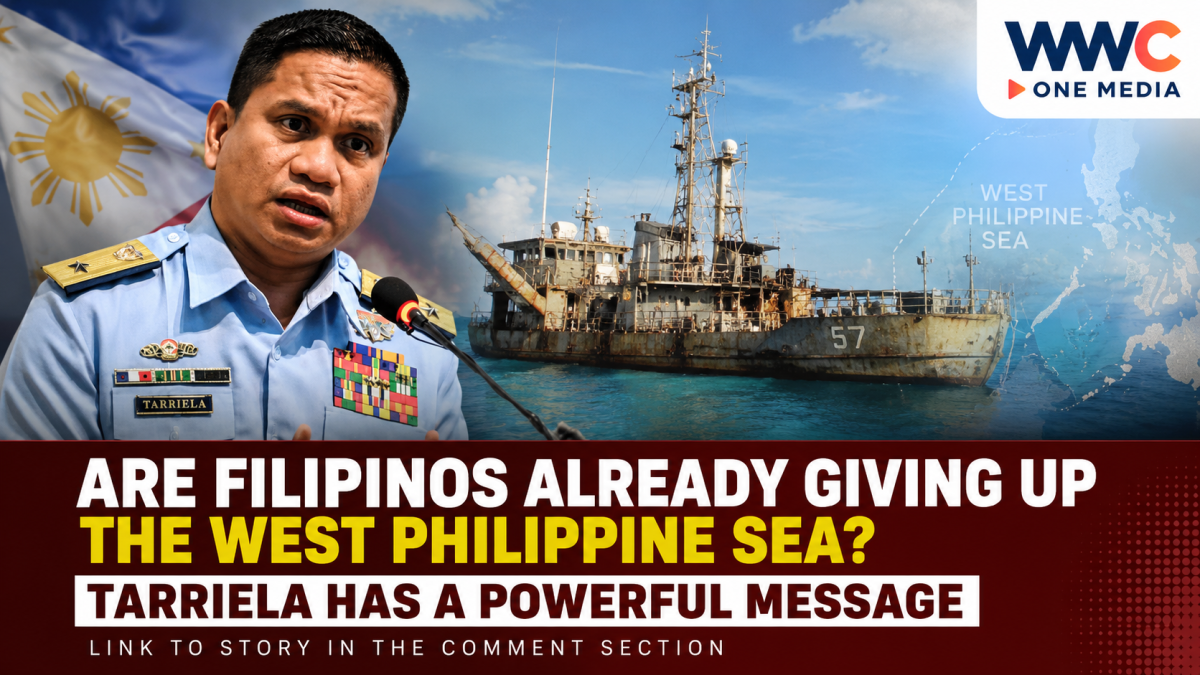
MANILA, Philippines — As the nation commemorated National Heroes’ Day, Philippine Coast Guard (PCG) spokesperson for the West Philippine Sea Rear Admiral Jay Tarriela delivered a message that goes beyond the country’s maritime dispute: Filipinos, he said, should not allow fear or pessimism to dictate how they defend their rights.
Tarriela urged the public to reject what he described as a “defeatist mindset,” drawing inspiration from the country’s heroes who fought for freedom despite facing more powerful colonial forces.
“Let us shed our defeatist mindset, because defeatism never represented what our heroes stood for,” Tarriela said in a statement.
His message comes as tensions continue in the West Philippine Sea, particularly over areas where the Philippines and China maintain sharply conflicting claims and positions. The latest exchange has centered on Ayungin Shoal, where the Philippine Navy’s BRP Sierra Madre remains grounded and serves as an outpost for Filipino troops.
The Message Behind Tarriela’s Call
For Tarriela, the question is not whether the Philippines can overpower a larger nation militarily. Rather, he argues that Filipinos should not surrender their rights simply because the challenge appears difficult.
“The only question [our heroes] lived to answer was whether we deserved to be free as a nation — not whether we could defeat the powerful conquerors of our history,” he said.
The remarks reflect a broader campaign by Philippine authorities to strengthen public understanding of the country’s position in the West Philippine Sea. Earlier this month, Tarriela told Philippine Military Academy cadets that misinformation, internal division and fear could weaken the country’s resolve, warning against narratives suggesting that asserting Philippine rights would inevitably lead to war.
Ayungin Shoal Remains at the Center of the Dispute
The latest war of words between Manila and Beijing was triggered by renewed Chinese calls concerning the BRP Sierra Madre at Ayungin Shoal. The Philippine vessel has been grounded there since 1999 and continues to house a small Philippine military contingent.
China maintains its own sovereignty claims over the area and has repeatedly challenged Philippine activities there. Tarriela, however, stressed that the Philippine outpost is located within the country’s exclusive economic zone and that resupplying Filipino personnel is lawful and does not require permission from another country.
The dispute remains rooted in fundamentally opposing positions. The Philippines points to the 2016 South China Sea arbitral award under the United Nations Convention on the Law of the Sea (UNCLOS), while China continues to reject the ruling and says it does not recognize it. The award itself is documented by the United Nations, while Beijing’s rejection of the decision remains its official position.
The Bigger Picture: Pressure at Sea, But Manila Is Holding Its Ground
The situation in the West Philippine Sea remains tense, but it is also more complex than a simple military confrontation.
The Department of Foreign Affairs recently said that the provisional understanding between the Philippines and China over resupply missions to Ayungin Shoal had facilitated 15 incident-free resupply missions over two years, demonstrating that mechanisms to manage tensions can coexist with the continuing dispute.
At the same time, the Philippine government is strengthening its maritime and defense capabilities. The country has been pursuing additional surveillance and defense assets as it shifts greater attention toward external security challenges, including tensions in the South China Sea.
Recent international reporting has also highlighted the continued presence of Chinese vessels near Philippine-held areas and fishing grounds, underscoring why the issue remains a major concern for Filipino communities whose livelihoods depend on the sea.
Defending Rights Does Not Mean Choosing War
This is perhaps the most important distinction in Tarriela’s message.
Standing firm on maritime rights does not automatically mean seeking conflict. The Philippines has consistently emphasized diplomacy, international law and peaceful means while continuing to assert its rights at sea.
Even as maritime tensions persist, Manila and Beijing have continued discussions on areas of possible cooperation, including energy, illustrating that diplomacy and disagreement can occur simultaneously. President Ferdinand Marcos Jr. recently said joint oil and gas exploration with China remains a possibility, provided difficult issues surrounding rights and arrangements can be addressed.
That reality makes the debate over the West Philippine Sea more than a question of ships and territory. It is also about how a country protects its legal rights, economic interests and national dignity without allowing fear to dictate its future.
A Challenge to Filipinos
Tarriela’s National Heroes’ Day message appears aimed not only at China but also at fellow Filipinos who have grown discouraged by the imbalance in military power between the two countries.
The Philippines may not possess the same military strength as China. But its position is not based solely on military capability. It is anchored on international law, diplomacy, alliances and the rights granted to coastal states under UNCLOS.
Whether Filipinos agree with every government policy or political leader, the West Philippine Sea remains a national issue that extends beyond partisan politics.
The question, as Tarriela’s message suggests, may not be whether the Philippines is the strongest country in the room. The more important question is whether Filipinos are willing to stand up for rights they believe are theirs—peacefully, lawfully and without surrendering before the fight is even over.
As tensions continue to unfold, one thing is clear: the battle for the West Philippine Sea is being fought not only on the water, but also in the minds of the Filipino people.




Leave a Reply