
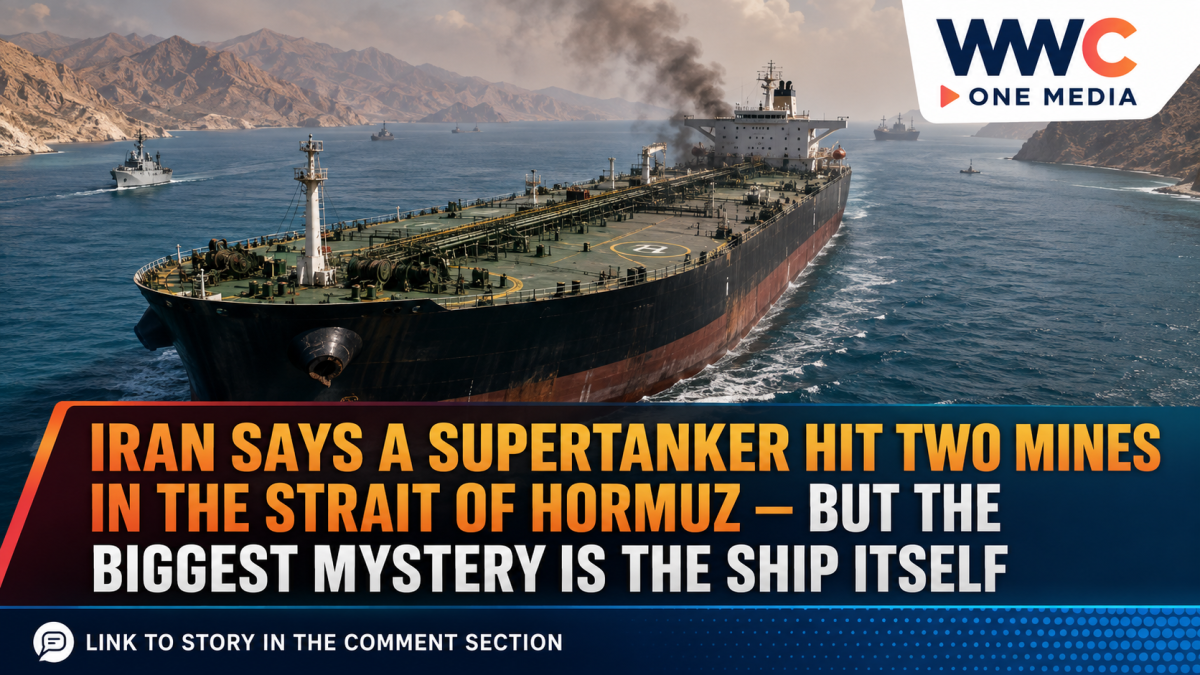
An unidentified supertanker caught fire and was brought to a halt in the Strait of Hormuz after allegedly striking two naval mines, according to Iran’s Islamic Revolutionary Guard Corps — a dramatic new incident in the waterway at the centre of the escalating confrontation between Iran and the United States.
Iranian state television reported on Monday, August 31, that the vessel was hit by two mines in the southern part of the strategic strait. The Revolutionary Guards said the tanker had been attempting to travel through what Tehran considered an unauthorised route.
But crucial details remain unknown.
Iran has not publicly identified the tanker, disclosed its flag or ownership, revealed what cargo it was carrying, or provided information about the condition of its crew. Independent maritime authorities had also not publicly confirmed the Iranian account in the initial reporting.
That uncertainty makes the incident especially significant: what happened to one ship could become the latest test of who actually controls passage through one of the world’s most important energy corridors.
IRGC Issues a Warning to Other Ships
The Revolutionary Guards said vessels travelling through the Strait of Hormuz must comply with Iranian security regulations, warning that other ships violating Tehran’s rules could face similar consequences.
That warning goes far beyond a single tanker incident.
Iran and the United States have effectively been contesting control of navigation through Hormuz during their six-month conflict, with Tehran insisting ships require its permission to use certain routes while Washington has challenged Iran’s efforts to restrict international shipping.
Reuters reported that Iranian authorities have rejected US assertions that the strait is fully open, while the United States says it has been working to eliminate the mine threat and protect maritime traffic.
The Timing Could Hardly Be More Dangerous
The reported tanker incident comes immediately after US forces struck two Iranian launchers on Larak Island, a strategically positioned island overlooking shipping lanes near the entrance to the Gulf.
A US official said Revolutionary Guard forces had been observed preparing launchers capable of deploying rockets carrying sea mines into the Strait of Hormuz.
US Central Command described the operation as a limited action against what it regarded as an imminent minelaying threat.
Iran said the attack caused military and civilian casualties and promised retaliation. Tehran subsequently launched ballistic missiles toward US bases in Jordan, according to Iranian media and US-linked reporting.
The strikes marked the first known US attacks inside Iran since late July, signalling that a period of comparatively reduced direct military action may be breaking down.
And that is what makes the supertanker report potentially more consequential than an isolated maritime accident.
If mines are again being deployed — or even if shipping companies merely believe they could be — insurers, tanker owners and energy traders may become even more reluctant to risk Hormuz.
Trump Said the Mines Had Been Cleared. The Latest Events Raise New Questions
Just days before the latest confrontation, US President Donald Trump said mines had been detonated or removed from the international waters of the Strait of Hormuz and warned that vessels attempting to lay new mines would be destroyed.
Iran disputed Washington’s description of the waterway as open.
Now, the US accusation that Iranian forces were preparing to deploy fresh sea mines, followed by Tehran’s claim that a supertanker struck two mines, has renewed uncertainty over whether supposedly cleared shipping lanes can actually be considered safe.
Mine clearance is particularly difficult because simply announcing that a corridor has been swept does not necessarily persuade commercial operators or insurers that the danger is over.
Reuters previously reported that maritime and security experts warned making Hormuz reliably safe from mines could require weeks even after political agreements were reached.
Shipping Through Hormuz Was Already Collapsing
Commercial traffic had already fallen sharply before Monday’s tanker report.
Visible commodity-vessel crossings dropped to just five ships per day over the weekend, according to shipping data cited by Reuters.
Some vessels may be travelling with their Automatic Identification System transponders switched off to reduce their visibility, meaning the true number could be somewhat higher. But the figures nevertheless underline how cautious shipowners have become.
Just days earlier, Kpler data showed only five commodity vessels crossing Hormuz on one monitored day, compared with a 10-day average of about 15.
Iran and Oman have also been discussing a temporary shipping corridor and mine-clearance arrangements in an attempt to stabilise navigation through the strait.
Those diplomatic efforts now face another severe test.
Why One Tanker Matters to the Global Economy
The Strait of Hormuz is not simply another shipping lane.
Before the current conflict and blockade, roughly one-fifth of global crude oil and liquefied natural gas shipments moved through the narrow waterway connecting the Gulf with the Arabian Sea and wider global markets.
That means disruptions can quickly spread far beyond the Middle East — affecting Asian refiners, fuel prices, shipping costs, inflation and financial markets.
Oil markets were already reacting to the renewed military confrontation.
Brent crude climbed more than 2 per cent to around US$90 a barrel during Monday trading after the US strike on Larak Island and Iran’s retaliation, while West Texas Intermediate also rose more than 2 per cent.
Analysts cited by Reuters warned that repeated flare-ups could delay any meaningful reopening of Hormuz and keep crude prices volatile.
And Asia may be particularly exposed.
Recent Reuters analysis has warned that reduced flows of refined fuels such as diesel, jet fuel and gasoline are creating additional pressure in Asian markets even beyond the headline question of how much crude oil is making it through Hormuz.
The Biggest Mystery Is Still the Tanker Itself
For now, one of the most important unanswered questions is also the simplest:
What ship was hit?
There has been no independently confirmed name, flag, owner, cargo, crew status or precise location released in the initial reports.
That means Iran’s description of the vessel as travelling illegally should also be treated as Tehran’s account rather than an independently established fact.
Still, the political message from the Revolutionary Guards is unmistakable.
Iran is signalling that it intends to enforce its own rules in the Strait of Hormuz — even while Washington says international shipping lanes should remain open.
After US strikes on suspected Iranian minelaying forces, Iranian missile retaliation, collapsing commercial traffic and now a reported supertanker mine strike, the struggle over Hormuz appears to be entering another dangerous phase.
And until the identity of the tanker — and the precise circumstances of the explosions — are independently established, the incident leaves the shipping industry with exactly what it fears most:
another major risk in the world’s most important oil chokepoint, and no certainty about where the next one will come from.




Leave a Reply