
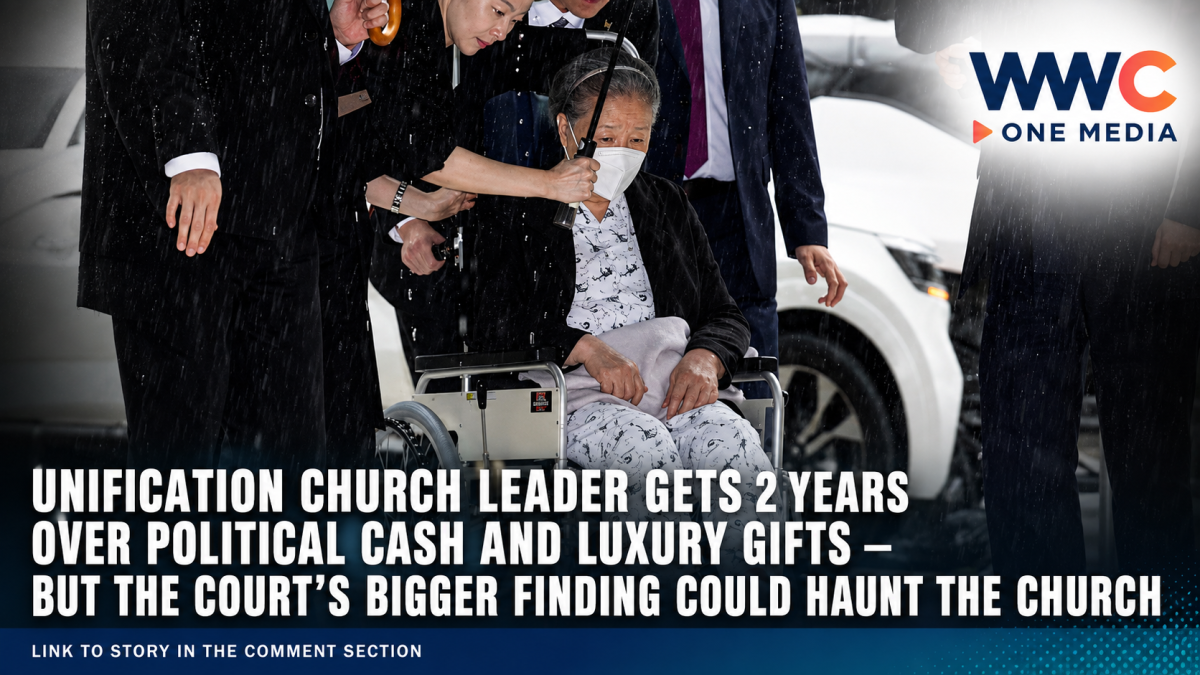
SEOUL — One of the most powerful figures in the global Unification Church has been sentenced to prison in South Korea, delivering another major blow to a religious movement already facing extraordinary legal and political pressure across Asia.
The Seoul Central District Court on Monday, August 31, sentenced 83-year-old Han Hak-ja, leader of the Family Federation for World Peace and Unification, widely known as the Unification Church, to a combined two years in prison over illegal political funding and luxury gifts connected to efforts to build influence with the former administration of President Yoon Suk Yeol.
The punishment was far below the 13-year prison term requested by special prosecutors, but the ruling was significant for another reason: the court concluded that church money and gifts were used as part of an effort to expand the organisation’s political influence.
One payment, one election — and a much bigger political question
Han received one year in prison for violating South Korea’s Political Funds Act, including her involvement in providing 100 million won — roughly US$70,000 — to politician Kweon Seong-dong shortly before the 2022 presidential election.
Prosecutors argued that the money was connected to efforts to secure favourable treatment for the church if Yoon Suk Yeol won the presidency. Yoon ultimately won the March 2022 election.
Kweon’s part in the affair has already produced dramatic consequences of its own.
In July, South Korea’s Supreme Court upheld his two-year prison sentence for accepting the 100 million won in illegal political funds. The final conviction also cost Kweon his seat in the National Assembly.
That earlier ruling strengthened the broader case surrounding the flow of money between church officials and political figures — and provided an important backdrop to Monday’s judgment against Han.
Chanel and a diamond necklace brought the scandal into the presidential circle
Han was handed another one-year prison sentence over her involvement in providing luxury goods to Kim Keon Hee, the wife of then-president Yoon.
Court proceedings centred on expensive items including a Chanel bag and a luxury diamond necklace, which prosecutors said were passed to Kim through an intermediary while the church sought government assistance or favourable consideration for its interests.
Reuters reported that Kim previously acknowledged receiving Chanel bags through an intermediary but disputed claims that the gifts represented a quid pro quo connected to Unification Church lobbying. Han, meanwhile, has consistently denied directing an effort to buy political influence.
The court nevertheless concluded that the activities went beyond isolated gifts.
According to the ruling, the defendants viewed the 2022 presidential election as an opportunity to expand the church’s influence by backing a favourable political candidate and later seeking support for church priorities.
That finding may ultimately be more damaging to the organisation than the relatively short prison term itself because it places political influence — rather than merely improper gift-giving — at the centre of the case.
Han says subordinates acted without her knowledge
Han, the widow of Unification Church founder Sun Myung Moon and a figure followers have called the “True Mother”, has denied personally ordering the illegal activities.
Her defence maintained that a former church official acted independently and was motivated by his own political ambitions. Han has also repeatedly said she was not interested in gaining political power in South Korea.
The church rejected Monday’s judgment and said it intends to appeal.
In its response, the Family Federation disputed the court’s conclusion that Han either directed the activities or knowingly approved their illegal purpose.
Han was brought to court in a wheelchair. Reuters reported that she was not being detained at the time of sentencing because her detention had been temporarily suspended on health grounds.
The court did not accept every accusation
Despite the guilty verdicts, prosecutors did not win on every part of their case — an important distinction as the ruling heads toward a likely appeal.
Yonhap reported that the court convicted Han and other former church officials over 144 million won in illegal political donations made with church money in March 2022, but acquitted Han of an embezzlement charge connected to those donations.
The court also dismissed allegations involving the alleged embezzlement of 787 million won in church funds connected to political activities in Nepal and Senegal, ruling that those accusations fell outside the special prosecutor’s authorised investigative mandate.
That distinction matters: Monday’s decision represents a serious conviction over political funding and improper influence, but it should not be reported as though the court validated every allegation levelled against Han.
The scandal reaches far beyond one church leader
The Han case sits inside a much larger collapse of political power surrounding former President Yoon Suk Yeol and former first lady Kim Keon Hee.
Special investigations expanded after Yoon’s controversial December 2024 declaration of martial law and subsequent removal from office, exposing a network of separate allegations involving politicians, intermediaries and religious figures.
The Unification Church itself has faced mounting scrutiny well beyond South Korea.
In Japan — historically one of the movement’s most important bases — the Supreme Court in June 2026 upheld an order dissolving the church’s Japanese religious corporation after courts found longstanding unlawful fundraising practices had caused serious financial and psychological harm. The order strips the Japanese organisation of its legal religious-corporation status, although followers can continue religious activities outside that corporate structure.
Scrutiny in Japan intensified dramatically after the 2022 assassination of former Japanese prime minister Shinzo Abe. His killer said resentment over his family’s financial losses to the Unification Church contributed to his decision to target Abe, whose political connections with church-linked organisations subsequently became a major national controversy.
Why the two-year sentence may not be the end of the story
For Han, the immediate battle now moves toward an appeal.
For the Unification Church, however, the larger problem may be harder to contain.
A former South Korean lawmaker has already lost his seat and received a two-year prison sentence over church-linked political money. Former church officials and intermediaries have faced their own convictions. Japan has stripped the organisation of its religious-corporation status. And now a South Korean court has formally concluded that the church’s financial resources were used in an effort to increase its political influence.
The courtroom battle over Han’s personal responsibility is therefore likely to continue.
But the more consequential question may already have shifted beyond Han herself: how deeply did the Unification Church’s political outreach penetrate South Korea’s corridors of power — and will the investigations uncover more connections before the appeals are finished?
Leave a Reply