
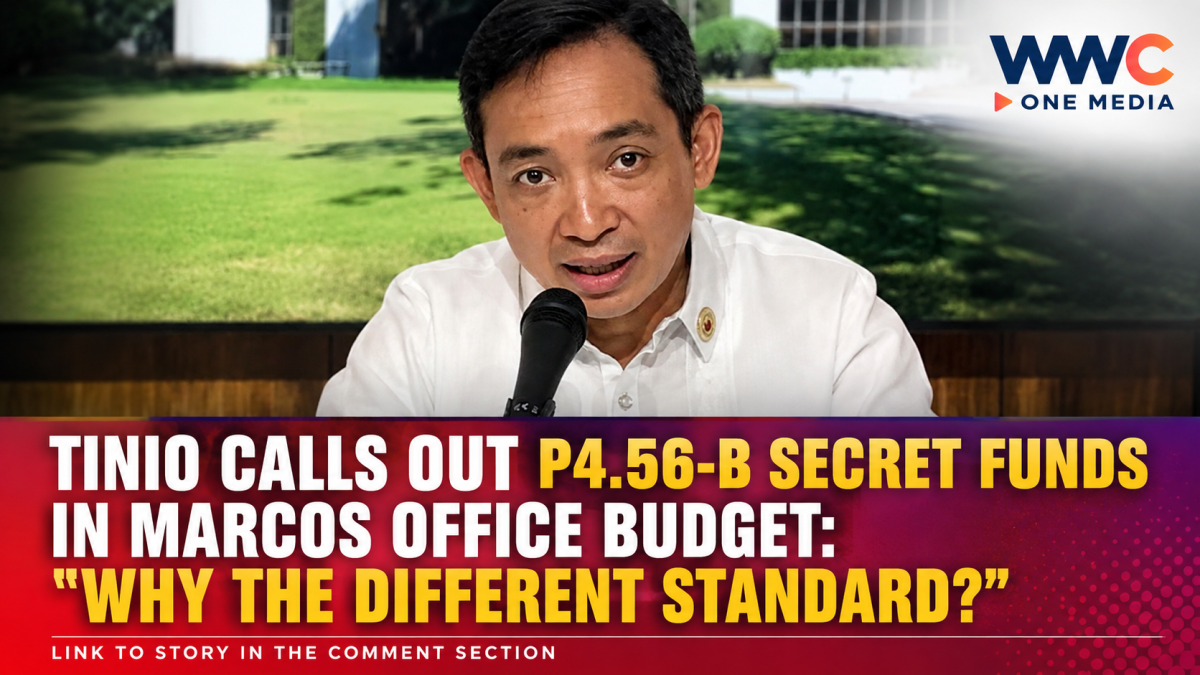
MANILA, Philippines — A fresh budget controversy is emerging in Congress after ACT Teachers party-list Rep. Antonio Tinio questioned why billions of pesos in confidential and intelligence funds remain in the proposed 2027 budget of the Office of the President (OP), even as lawmakers continue to scrutinize similar funds involving other government offices.
The issue surfaced on Tuesday, September 1, after the House Committee on Appropriations voted 37-5 to end further questioning on the OP’s proposed 2027 budget, citing parliamentary and inter-branch courtesy.
The OP is seeking approximately P10.16 billion for 2027. According to the National Expenditure Program, the amount is about 64% lower than the office’s 2026 budget.
But Tinio argued that the public deserves answers about the sizable confidential and intelligence fund allocation.
He pointed to approximately P4.56 billion earmarked for confidential and intelligence expenses—an amount equivalent to nearly 45% of the OP’s proposed budget.
“Why is it that almost half of the budget of the Office of the President is confidential and intelligence funds?”
Tinio questioned why Congress was demanding transparency from the Office of the Vice President while allowing the President’s proposed budget to move forward without similar scrutiny.
He called for what he described as a fair and consistent application of transparency rules across government.
Why the P4.56 billion matters
The debate comes at a politically sensitive time, with confidential funds at the center of the impeachment proceedings involving Vice President Sara Duterte.
The issue has also attracted attention because the OP has historically been one of the government’s largest users of confidential and intelligence funds.
COA data previously showed that the Office of the President spent a combined P4.56 billion in confidential and intelligence funds in 2023—P2.25 billion in confidential expenses and P2.31 billion in intelligence expenses. That made the OP the country’s biggest spender of such funds that year.
The figure is therefore not simply a new budget proposal; it reflects a level of spending that has drawn scrutiny in previous national budget cycles.
Recto: President needs confidential funds for national security
Executive Secretary Ralph Recto defended the inclusion of confidential and intelligence funds in the President’s budget.
Recto said the President, as chief executive and commander-in-chief of the Armed Forces of the Philippines, has responsibilities involving law enforcement and national security that justify access to such funds.
He also pointed to the Commission on Audit’s unmodified opinion on the OP’s finances as evidence of proper financial management.
The House has previously heard similar arguments from lawmakers who maintained that the President’s constitutional role and national-security responsibilities justify confidential allocations.
What are confidential and intelligence funds actually for?
Under Joint Circular No. 2015-01, confidential funds are intended primarily for surveillance and related confidential activities of civilian government agencies, while intelligence funds cover intelligence information-gathering activities connected to national security.
The rules require these funds to be supported by physical and financial plans and subject them to specific accounting, liquidation and auditing requirements.
The circular also establishes restrictions on how the money may be spent and requires agencies to submit accomplishment and liquidation reports to the appropriate authorities and the Commission on Audit.
This means that “confidential” does not mean the funds are completely outside government auditing or accountability mechanisms.
The bigger question: one standard for everyone?
Tinio’s criticism centers on what he sees as an uneven application of transparency.
His argument comes amid continuing scrutiny of the OVP’s use of confidential funds during the impeachment trial. In recent proceedings, witnesses and auditors have testified about the documentation and implementation of the OVP’s confidential-fund expenditures.
At the same time, the Senate has signaled a tougher approach toward confidential funds for civilian agencies, with Senate President Sherwin Gatchalian saying such allocations should generally be limited to offices with clear law-enforcement or national-security mandates.
That creates a broader policy question for Congress: Should the same transparency and justification standards apply to every government office receiving confidential or intelligence funds—including the Office of the President?
Budget hearing ends before lawmakers can fully question OP
The controversy intensified because Tuesday’s OP budget briefing lasted less than an hour.
GMA News reported that the House panel approved the OP’s proposed P10.155758-billion budget after voting to extend institutional and inter-branch courtesy, effectively ending further interpellation. Tinio was among the lawmakers who objected and argued that the OP should answer questions concerning its confidential and intelligence funds as well as other government issues.
The panel said outstanding questions and concerns could be addressed during the plenary stage.
For Tinio, however, the issue goes beyond a single budget hearing.
It is about whether transparency is applied consistently—regardless of which government office is being examined.
And with billions of pesos still classified under confidential and intelligence spending, the question now hanging over the 2027 budget process is straightforward:
If Congress expects other agencies to explain their secret funds, how much scrutiny should the Office of the President receive?




Leave a Reply