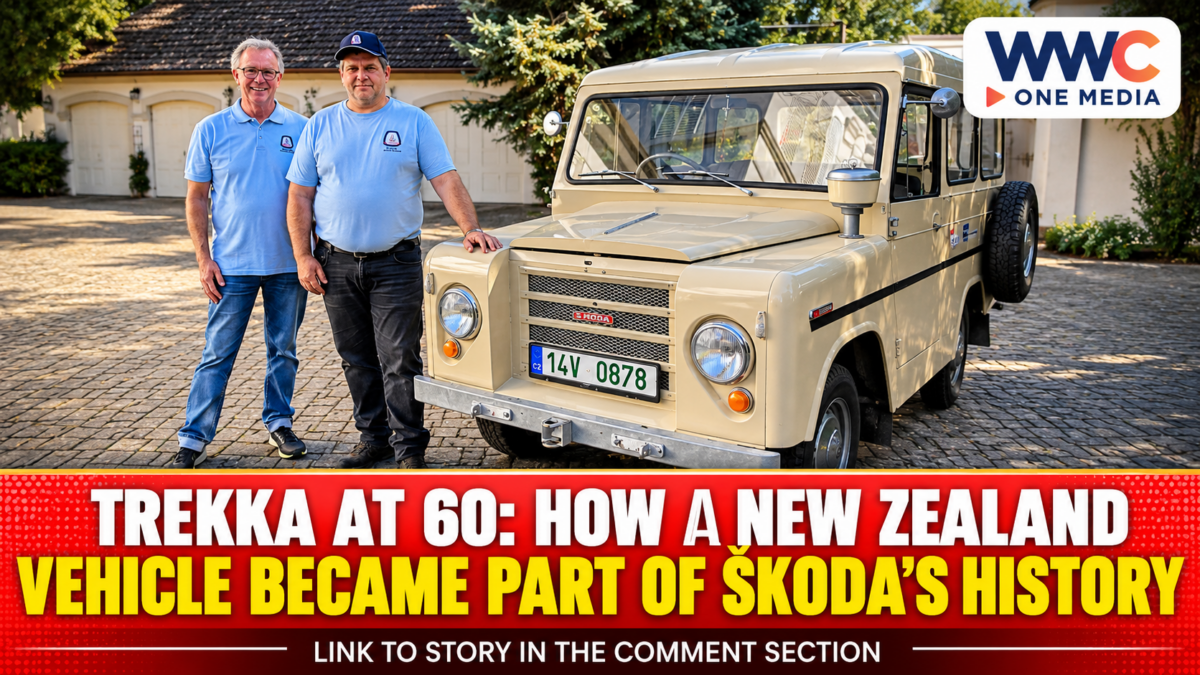
A vehicle developed for New Zealand’s roads and working conditions is approaching a milestone that connects two very different automotive histories. The Trekka, a locally developed utility vehicle built with Škoda mechanical components, marks 60 years since its first examples took to the road on December 2, 1966.
Its anniversary is more than a celebration of an old model. The Trekka illustrates how a relatively small market developed its own vehicle through local design, imported engineering and cooperation with an overseas manufacturer—a combination that remains relevant to countries seeking to build industrial capability without producing every component domestically.
Trekka anniversary puts a rare local vehicle back in focus
Production of the Trekka began in Otahuhu, Auckland, in 1966. The vehicle was developed through cooperation involving Škoda in Mladá Boleslav, the Czech manufacturer’s New Zealand importer Motor Industries International, and local specialist businesses.
The project began with a practical objective: create an affordable vehicle suitable for commercial work and leisure use, with enough off-road capability to handle rougher conditions.
The result did not carry a Škoda badge, but its engineering foundation came from the Škoda Octavia. The Trekka used a modified Octavia chassis, with changes to the wheelbase and final-drive ratio. Its locally adapted body and combination of imported and locally sourced components gave it a distinct identity.
The first vehicles took to the road on December 2, 1966. Škoda’s October 2026 historical material identifies the Trekka as a vehicle developed jointly with its New Zealand importer and describes it as a likely early forerunner of the company’s present-day sport utility vehicles.
A vehicle shaped by New Zealand’s manufacturing conditions
The Trekka emerged during a period when New Zealand’s vehicle market operated under restrictive import arrangements. Local assembly and the use of imported vehicle kits formed part of the environment in which the project developed.
Rather than establish a completely independent vehicle-manufacturing operation, the Trekka programme combined an existing mechanical platform with local design and production work.
That approach allowed the vehicle to respond to local requirements while drawing on engineering already developed overseas. It also brought together a foreign automaker, a local importer and specialist businesses.
The distinction matters when describing the Trekka’s place in New Zealand history. It was not a vehicle whose every component originated locally. Its identity came from the way local development and manufacturing were combined with Škoda engineering.
The Museum of Transport and Technology in Auckland describes the Trekka as the only New Zealand-designed and manufactured vehicle to reach mass production. Its collection includes a restored prototype and a later production-line example, preserving different parts of the vehicle’s history.
Škoda engineering gave the Trekka its mechanical foundation
The Trekka was based on a modified Škoda Octavia chassis. The wheelbase was shortened from 2,389 millimetres to 2,165 millimetres, while the final-drive ratio was changed from 4.78 to 5.25.
Its technical specifications reflected its intended utility. The vehicle used a 1,221-cubic-centimetre, four-cylinder engine producing up to 34 kilowatts, or 47 horsepower, according to Škoda’s historical account. It had a four-speed synchromesh gearbox and a stated top speed of up to 110 kilometres per hour.
The vehicle also offered several body configurations. Buyers could choose among different roof arrangements, while estate and beach versions expanded its potential uses.
Those options helped the Trekka serve more than one purpose. It could be used for work, transport and recreational activities, rather than being limited to a single commercial role.
The technical relationship also helps explain why the vehicle remains part of Škoda’s historical narrative. The company’s October press material includes a dedicated Trekka section in its Classic Days 2026 historical press kit, placing the New Zealand project within a wider account of the manufacturer’s development.
Production ended, but the vehicle travelled beyond New Zealand
The Trekka’s production run did not last indefinitely. Škoda records production ending in 1972, with remaining stock sold in 1973. Its historical account puts total production at around 2,800 units.
The vehicle also reached markets beyond New Zealand. Škoda records exports to Fiji and other Pacific islands, as well as shipments in knocked-down form to Pakistan and Australia. A small number were used as ambulances in Vietnam.
The model’s overseas history is significant because it shows that the Trekka was not simply a domestic curiosity. Its practical design and production arrangement gave it a limited international footprint.
The vehicle’s later connection with the Czech Republic further strengthened that history. Škoda’s museum collection now includes a Trekka, bringing a product developed for the New Zealand market into the manufacturer’s own heritage collection.
The Auckland transport museum has also expanded its holdings. It announced the acquisition of a largely original 1968 production-line flat-deck Trekka, which joined a restored prototype already held in its collection.
What the Trekka story says about industrial cooperation
The Trekka’s history offers a useful example of how industrial development can happen through partnerships rather than complete domestic self-sufficiency.
New Zealand had the local businesses and market knowledge needed to adapt the vehicle to its requirements. Škoda supplied the mechanical foundation and engineering expertise. The resulting product was distinctive enough to become part of the country’s automotive identity.
That is not the same as proving that the project created a permanent mass-market car industry. Production ended after changes in the vehicle market and import conditions, and the Trekka did not become a long-running model range.
But the project remains relevant to discussions about manufacturing policy. Countries seeking to strengthen domestic production must consider more than the final assembly of a vehicle. They also need suppliers, technical skills, engineering knowledge, product development and access to markets.
The Philippines faces its own questions about how to strengthen automotive manufacturing and supplier participation. WWC has examined the funding and implementation challenges surrounding the country’s RACE automotive manufacturing programme, as well as the importance of technical skills in the automotive workforce.
The Trekka is not a direct template for the Philippine market. Its historical circumstances were different. But it demonstrates how a local industrial project can draw on international engineering while retaining a distinct domestic identity.
What happens next
The Trekka’s 60th anniversary falls on December 2, 2026. Škoda has already included the vehicle in its 2026 historical material, while examples remain preserved in museum collections in New Zealand and the Czech Republic.
The anniversary offers an opportunity to look beyond the vehicle’s unusual appearance and examine the industrial decisions behind its development.
Its history is neither a story of complete local independence nor simply a foreign vehicle assembled overseas. It was a collaborative product shaped by the requirements of a specific market.
Six decades later, that combination of local adaptation and international engineering remains the most important part of the Trekka’s legacy.
Frequently asked questions
What is the Trekka?
The Trekka is a utility vehicle developed in New Zealand with Škoda and its local importer. It used a modified Škoda Octavia chassis and locally developed components.
When did the Trekka first take to the road?
The first Trekka vehicles took to the road on December 2, 1966.
Was the Trekka completely made in New Zealand?
No. It combined local design and production with mechanical components from Škoda, including an adapted Octavia chassis.
How many Trekkas were produced?
Škoda’s historical account puts total production at around 2,800 vehicles. Production ended in 1972, with remaining stock sold in 1973.
Where can people see a Trekka today?
Examples are held in museum collections in New Zealand and the Czech Republic, including the Museum of Transport and Technology in Auckland and the Škoda Museum.