
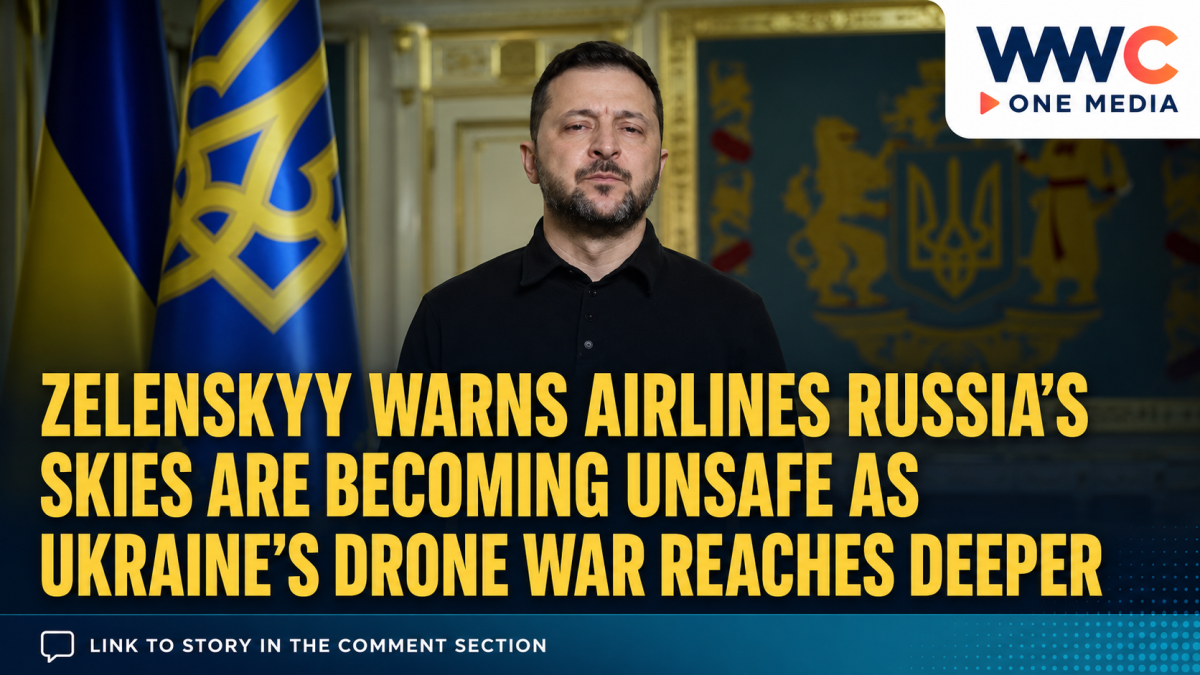
KYIV — Ukrainian President Volodymyr Zelenskyy has issued an unusually direct warning to international airlines and aviation insurers: flying through Russian airspace is becoming increasingly dangerous as Ukrainian drones penetrate farther into Russian territory.
The warning, delivered in Zelenskyy’s evening address on September 1, marks a new phase in the expanding drone war between Russia and Ukraine. While Zelenskyy stressed that Ukraine does not deliberately threaten civilian aircraft, he said airlines, insurers and operators using major Russian airports can no longer ignore the growing presence of drones in Russian skies.
His message was blunt: the war Moscow launched against Ukraine is increasingly affecting Russia’s own aviation environment.
But there is an important distinction. Russia has not announced a nationwide closure of its airspace. Zelenskyy’s claim that the airspace is “effectively” closing is a warning about operational risk rather than confirmation of an official aviation shutdown.
Ukraine’s Drone Campaign Is Reaching Much Deeper Into Russia
The warning comes as Ukraine expands long-range drone operations against targets hundreds of kilometers from its borders, particularly facilities connected to Russia’s oil, fuel and military infrastructure.
On the same day Zelenskyy issued his warning, Russia’s Defense Ministry claimed its forces had intercepted 516 Ukrainian drones across 18 Russian regions, occupied Crimea and the Black Sea. Russian authorities also reported a fire at the Ust-Luga oil and gas terminal in the Leningrad region following a drone attack.
Ust-Luga sits more than 800 kilometers from Ukraine, illustrating just how far Ukrainian strike capabilities can now reach. The Russian interception figures are Moscow’s claims and have not been independently verified in full.
Ukraine’s campaign against Russian energy facilities has become increasingly significant because oil and fuel revenues remain critical to Moscow’s wartime economy. Russian President Vladimir Putin himself acknowledged this week that Ukrainian drones had caused real damage to Russian refineries, even as he insisted defenses were improving.
That growing reach is precisely what is worrying aviation-security specialists.
Why Airlines Could Take Zelenskyy’s Warning Seriously
Aviation risk consultancy Osprey Flight Solutions has warned that although many Ukrainian drone and missile attacks are expected to remain concentrated within roughly 300 kilometers of the Ukrainian border, strikes deep inside Russia — including around Moscow and St. Petersburg — are expected to remain a continuing threat.
Osprey has also highlighted the possibility of misidentification or miscalculation in areas affected by military operations.
That risk is particularly important because Russia operates sophisticated surface-to-air missile systems capable of engaging aircraft at high altitudes. Even when neither side intends to target a passenger jet, a crowded environment involving drones, missiles, electronic warfare and air-defense systems can dramatically increase aviation risk.
The concern is not theoretical.
The region has already experienced deadly incidents involving civilian aviation. Malaysia Airlines Flight MH17 was shot down over eastern Ukraine in 2014, killing all 298 people on board. More recently, 38 people died when an Azerbaijan Airlines aircraft crashed in 2024 after an incident involving Russian air defenses during Ukrainian drone activity.
Those events are likely to remain important considerations for airline risk managers and insurance companies assessing routes through Russian territory.
Western Airlines Stay Away — But Others Still Fly Over Russia
Since Russia’s full-scale invasion of Ukraine began in February 2022, European and American airlines have largely stopped using Russian airspace because of sanctions, reciprocal aviation bans and security concerns.
But Russian airspace is still used by some carriers from countries including China, Türkiye, the United Arab Emirates and other Gulf states.
That matters commercially.
Flying across Russia can significantly shorten some routes between Europe, Asia and North America, reducing travel time and fuel consumption. U.S. airlines have previously argued that competitors allowed to use Russian airspace can gain a cost advantage over carriers forced to take longer routes around the country.
Zelenskyy’s warning therefore creates more than a security question.
If insurers raise premiums, impose exclusions or refuse coverage for certain routes — or if individual airlines decide the risk has become unacceptable — Russia could become increasingly isolated from major international flight corridors even without Moscow formally closing the skies.
For now, however, there is no evidence that all foreign carriers have abandoned Russian airspace.
The Warning Comes as Russia Intensifies Attacks on Ukraine
Zelenskyy’s statement followed another major Russian assault on Kyiv.
According to Ukrainian officials and reporting by the Associated Press, Russia bombarded the Ukrainian capital for more than 12 hours, killing at least 12 people in Kyiv and the surrounding region.
Six employees of Ukraine’s state railway company were among those killed.
Ukraine’s air force said the assault involved ballistic and cruise missiles along with 218 drones and decoys, including faster jet-powered drones that are more difficult to intercept. Russia said it was targeting weapons facilities and military-related infrastructure, while Ukrainian authorities reported damage to residential and civilian sites.
The attack was the sixth consecutive day of heavy Russian strikes on Kyiv, underscoring how dramatically unmanned aircraft and long-range weapons are reshaping the conflict on both sides of the border.
Putin Fires Back
Putin responded sharply to Zelenskyy’s airline warning, describing it in terms of “state terrorism” and saying Moscow would find a way to respond if Ukraine attempted to make Russian airspace unusable.
At the same time, Putin acknowledged that drones have become one of Russia’s most serious military challenges, both in the air and across other domains.
The exchange highlights a larger shift in the war.
For years, Ukrainian civilians have lived with air-raid alerts, airport closures and the constant threat of Russian missiles and drones. Ukraine is now increasingly trying to push some of those strategic costs back into Russian territory by striking military and economic targets far from the front.
And the consequences may no longer be limited to military installations or oil refineries.
They could increasingly affect airlines, insurance companies, international passengers and the economics of flying between Europe and Asia.
Whether Zelenskyy’s warning actually triggers a large-scale retreat by foreign carriers remains uncertain.
But one development will now be closely watched: how long airlines still flying across Russia decide the time and fuel savings are worth the growing risk in the skies above them.
WWC ONE MEDIA MJE

Leave a Reply