
oil prices, crude oil, US-Iran conflict, Brent crude, WTI, Strait of Hormuz, global oil supply, fuel prices, Middle East conflict
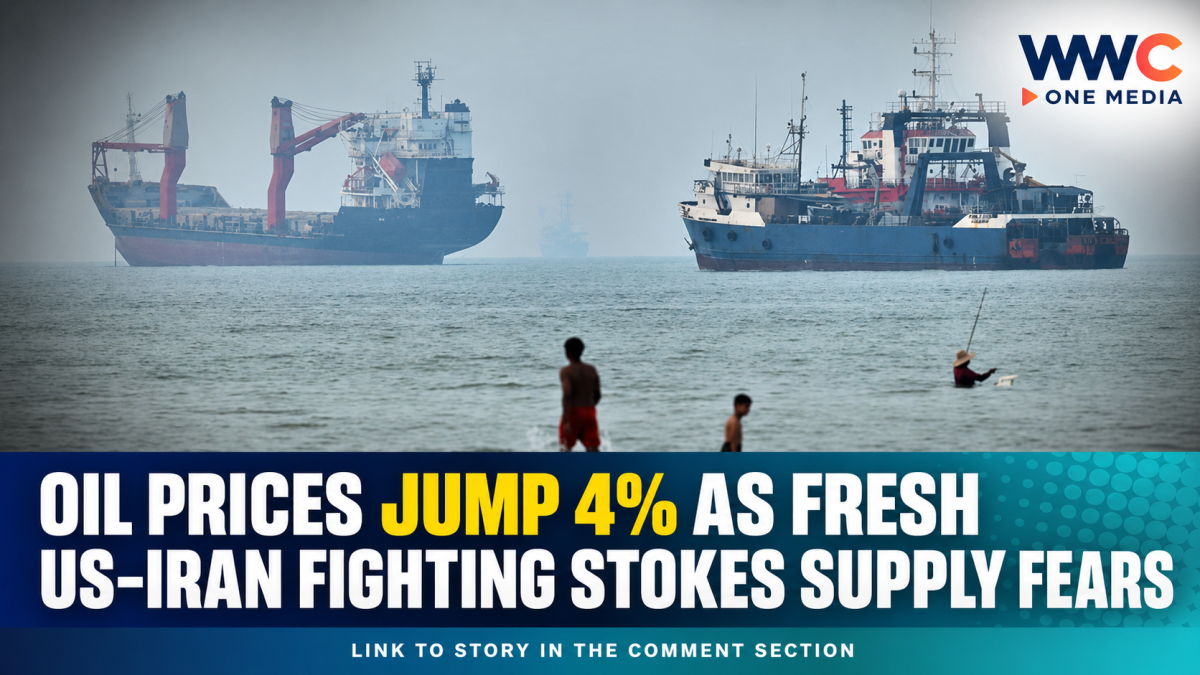
Global oil prices surged sharply as renewed U.S.-Iran fighting pushed traders to reassess the risk of major disruptions to Middle East energy supplies, particularly through the strategically vital Strait of Hormuz.
On Tuesday, Brent crude jumped $4.16, or 4.6%, to settle at $94.65 a barrel, while U.S. West Texas Intermediate (WTI) climbed $4.46, or 5.2%, to $90.22. Both benchmarks reached their highest closing levels in roughly five weeks.
The rally continued into Wednesday. Brent was up about 1.1% at $95.68, while WTI gained around 0.7% to $90.83 in early trading, extending the previous day’s surge.
WHAT IS DRIVING THE OIL PRICE SPIKE?
The immediate trigger is the renewed exchange of military strikes between Washington and Tehran.
U.S. forces carried out new strikes against Iranian targets, while Iran responded with missile and drone attacks against U.S.-linked positions in the region. The renewed fighting has revived concerns that the conflict could spread and interfere with commercial shipping and energy infrastructure.
For oil traders, the biggest concern is the Strait of Hormuz, one of the world’s most important energy chokepoints.
The waterway previously carried roughly one-fifth of global oil consumption, making any prolonged disruption potentially significant for energy-importing countries around the world.
Two tankers were also reportedly hit after leaving the Strait on Monday, adding another layer of concern for shipping companies and crude buyers.
BUT THERE’S AN IMPORTANT TWIST
Despite the disruption fears, oil has not completely stopped moving through the region.
U.S. Energy Secretary Chris Wright said approximately 17 million barrels of crude passed through the Strait of Hormuz on Monday, the highest reported level since oil flows were sharply reduced during the conflict.
That means the market is currently reacting not only to actual lost supply, but also to the risk of future disruption.
Analysts cited by Reuters said the market is increasingly pricing in the economic consequences of a conflict that remains unresolved, rather than simply the possibility of war itself.
GLOBAL MARKETS ARE ALREADY FEELING THE HEAT
The oil rally is spilling into financial markets.
Asian stocks fell sharply Wednesday as higher crude prices raised concerns about inflation, economic growth and interest rates. Reuters reported that the MSCI Asia-Pacific index excluding Japan fell about 2%, while South Korea’s KOSPI dropped nearly 4% and Japan’s Nikkei declined 2.9%.
Higher oil prices can increase transportation, manufacturing and energy costs, creating another inflationary challenge for countries that depend heavily on imported crude.
For oil-importing economies across Asia—including the Philippines—a sustained rise in crude prices could eventually translate into higher fuel and transportation costs.
WHAT ABOUT THE PHILIPPINES?
Filipino motorists entered September with some relief after local fuel prices were cut. According to Philstar’s September 1 price tracker, diesel fell ₱3.83 per liter, kerosene dropped ₱3.84, and gasoline declined ₱0.32. The report noted that global oil movements remained heavily influenced by the U.S.-Iran conflict.
But the latest international surge could change the picture if elevated crude prices persist.
The Department of Energy maintains an official weekly liquid-fuel price monitor for Philippine gasoline, diesel and kerosene prices.
In other words, the latest global oil jump does not automatically mean an immediate equivalent increase at Philippine pumps. Local pump prices reflect the timing of international price movements, exchange rates, inventory and other market factors.
THE NEXT BIG QUESTION: WILL OIL BREAK $100?
That is now the number traders are watching.
Brent crude is already approaching the $100-a-barrel psychological threshold, while renewed military action around the Strait of Hormuz creates the possibility of another sharp risk premium if shipping disruptions worsen.
At the same time, OPEC+ members continue to monitor market conditions and international energy routes. The group has emphasized the importance of protecting maritime routes and avoiding disruptions that could further destabilize global supply.
The situation therefore remains highly fluid.
If fighting intensifies and tanker traffic through Hormuz falls significantly, oil could face another major surge. If shipping normalizes and diplomatic efforts regain momentum, some of the geopolitical premium could quickly disappear.
WWC ONE MEDIA G.A




Leave a Reply