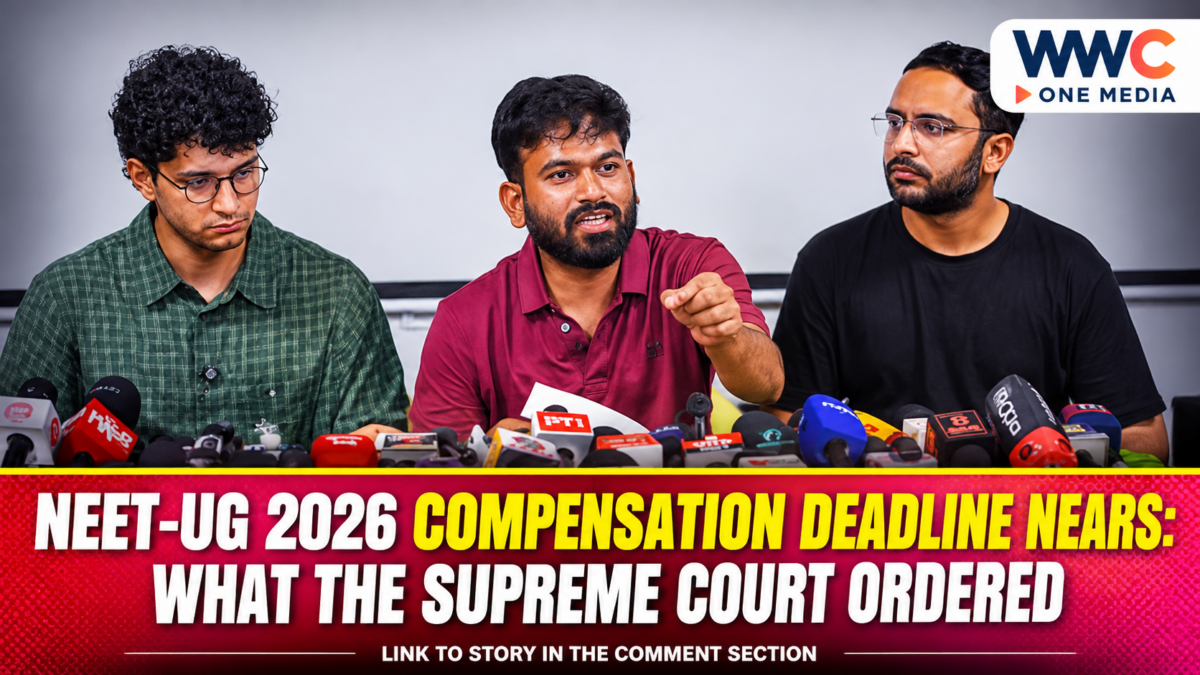
NEW DELHI, Nov. 29, 2026 — The Union government is approaching a November 30 deadline to formulate a nationwide compensation arrangement for families of students who died by suicide in connection with the NEET-UG 2026 examination, following a direction issued by the Supreme Court on September 1.
The court directed the Centre to work with state governments and Union territories on a national framework and to arrange payment without delay once the policy or arrangement is formulated. The order establishes a nationwide obligation, but does not itself specify a compensation amount, detailed eligibility rules or a payment schedule for individual families.
The approaching deadline places attention on an important distinction: the court directed the government to create a framework, while the practical details of who qualifies, how claims are assessed and how assistance is delivered must be addressed through the resulting arrangement.
NEET-UG compensation: What the Supreme Court directed
The direction arose in proceedings in Shailendra Mani Tripathi v. Union of India, heard on September 1, 2026, alongside applications in a related public-interest case.
During the hearing, the Solicitor General told the court that students who had died by suicide in connection with the examination were located in different parts of the country. A nationwide approach, developed in consultation with state governments, was therefore considered necessary.
The court recorded the government’s commitment and directed the Centre, in consultation with state governments and Union territories, to formulate a policy or make an arrangement on a pan-India basis for payment to the affected families within 90 days.
It also directed that payment be arranged without delay. The court added that state governments and Union territories could subsequently adopt the framework as a regular mechanism for compensatory measures.
The order is significant because it moves the issue beyond separate state-level responses. It places responsibility on the Union government to coordinate a national approach while involving the governments that may be needed to implement it.
Why November 30 matters
The Supreme Court issued its order on September 1 and allowed 90 days for the government to formulate the framework. Counting the period from the following day places the 90th day on November 30.
That makes the end of November the key date for assessing the government’s response to the direction.
However, the wording of the order matters. The court directed the formulation of a policy or arrangement within 90 days and the arrangement of payments thereafter without delay. It did not set out a separate public-notification procedure, a fixed compensation amount or an individual disbursement deadline for every case.
Those distinctions should not be lost in coverage of the deadline. Completing a policy framework and delivering assistance to each eligible family are connected responsibilities, but they are not necessarily the same administrative step.
The public record reviewed for this report establishes the court’s direction and timetable. It does not, by itself, establish whether a later government decision or policy has been issued.
The compensation framework still needs practical rules
A nationwide arrangement would need to address questions that the September 1 order does not answer in detail.
These include the evidence families must submit, the authority responsible for receiving applications, the process for determining whether a death falls within the circumstances covered by the order, and the method for resolving disputed or incomplete claims.
The framework would also need to explain how the Centre and state governments coordinate responsibilities. Families may be located in different states, while relevant records and administrative processes may involve different institutions.
A clear process would help prevent uncertainty from becoming another burden for families seeking assistance. It would also give government agencies a consistent basis for assessing applications.
The court’s direction does not specify a uniform sum. It would therefore be premature to publish a proposed compensation figure as though the Supreme Court had fixed it.
The broader question of examination accountability is also relevant. WWC has examined India’s efforts to strengthen examination security and respond to paper-leak risks. That issue is distinct from compensation, but both concern the responsibility of institutions to maintain public confidence in high-stakes examinations.
The order also addressed student protests
The compensation direction formed part of a broader order dealing with cases registered during student protests held between July 20 and July 25, 2026, amid concerns over irregularities in NEET-UG.
The court recorded commitments from the Union government and several state governments concerning the handling of those cases. It then quashed the FIRs specifically listed in the proceedings and directed that other FIRs relating to the same protest incidents should not be pursued or investigated, subject to the exception described in the order.
The court also stated that no state or Union territory should register fresh FIRs concerning those protest incidents, apart from the specified provision allowing the Central Government and Delhi Police to register a fresh FIR concerning 2,873 individuals described in the Delhi Police application.
The two parts of the order address different concerns: the treatment of protesters and the creation of a compensation arrangement for bereaved families. They should not be conflated into a claim that the court found every allegation surrounding the examination to be proven.
The wider public debate over examination fairness has also extended to employment and education. In an earlier report, WWC examined the pressure facing young Indians as graduate numbers and suitable job opportunities diverge. That context helps explain why trust in competitive selection systems matters, although it does not determine the legal scope of the compensation order.
Why the details matter to affected families
A national policy is useful only if families can understand how to access it and what evidence is required.
Without clear eligibility criteria, applicants could face inconsistent decisions across states. Unclear responsibility between central and state authorities could also make it difficult to identify where a claim should be filed or how a delayed application should be followed up.
A workable framework should therefore explain the responsible agencies, documentary requirements, assessment process, communication with applicants and the route for reviewing rejected or delayed claims.
These are practical implementation questions, not details that can be assumed from the court’s short direction. The final arrangement will need to answer them.
The issue also sits within a wider discussion about student welfare and institutional responsibility. WWC has previously examined how examination authorities are adapting safeguards to protect fairness. The legal and administrative systems differ, but transparent procedures and consistent safeguards are relevant to public confidence in examinations.
What happens next
November 30 is the date to watch for the completion of the 90-day period set by the Supreme Court. The immediate questions are whether the Centre has completed the nationwide framework, how state governments and Union territories will participate, and when payments will begin.
The September 1 order provides the legal direction, but the practical value of the arrangement will depend on its details and implementation.
Until an official policy or government statement is available for examination, specific claims about compensation amounts, eligibility, payments already made or non-compliance should be treated cautiously.
For families affected by the deaths, the central issue is whether the court-directed process becomes a clear and accessible route to assistance rather than remaining only an administrative commitment.
Frequently Asked Questions
What did the Supreme Court order on NEET-UG 2026 compensation?
The court directed the Union government, in consultation with states and Union territories, to formulate a nationwide compensation policy or arrangement for families of students who died by suicide in connection with NEET-UG 2026.
When is the 90-day deadline?
The order was issued on September 1, 2026. Counting 90 days from the following day places the deadline on November 30, 2026.
Did the Supreme Court specify a compensation amount?
No. The September 1 direction does not specify a fixed amount or detailed eligibility criteria.
Who is responsible for preparing the compensation framework?
The Union government is responsible for formulating the nationwide policy or arrangement in consultation with state governments and Union territories.
Does the order guarantee that every family will automatically receive payment?
The order directs the government to create the framework and arrange payment without delay. It does not set out individual claim procedures or establish that every case will qualify automatically. The resulting policy or arrangement will need to clarify how eligibility and payment are determined.