South Korea’s sulphuric acid industry faces an increasingly complex international market as changing raw material costs, mineral processing requirements and semiconductor investments reshape demand for one of the world’s essential industrial chemicals.
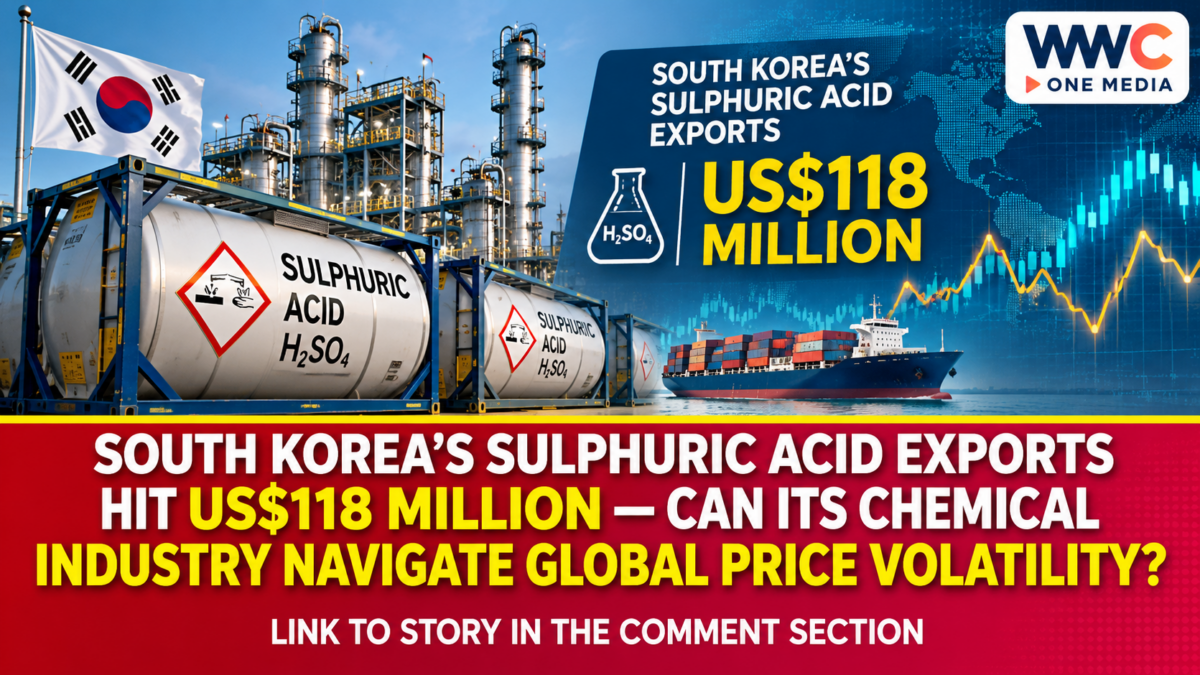
Official merchandise trade figures show that South Korean exports of sulphuric acid and oleum reached US$118.49 million in 2025, more than doubling from US$54.19 million in 2024.
However, the South Korea sulphuric acid market faces continuing uncertainty as international manufacturers assess procurement costs and the reliability of chemical supplies.
The challenge for exporters is maintaining commercially attractive prices while navigating increasingly interconnected mining, agricultural and advanced manufacturing supply chains.
South Korea Sulphuric Acid Exports More Than Double in Value
South Korea exported approximately 2.39 million metric tonnes of sulphuric acid and oleum in 2025, demonstrating its importance to international chemical supply chains.
The recorded export value increased by approximately 118.7% compared with 2024.
India emerged as the largest destination by value, purchasing US$39.51 million worth of the chemical products, equivalent to approximately one-third of South Korea’s total export value.
Chile followed with US$14.68 million, while Thailand accounted for US$13.02 million, Indonesia US$11.85 million and Vietnam US$10.25 million.
The Philippines also purchased US$9.20 million worth of these products during the year.
These trading relationships demonstrate the importance of South Korean chemical suppliers to industrial and agricultural markets across the Asia-Pacific region.
However, the substantial increase in export value should not automatically be interpreted as an equivalent increase in physical shipments.
The available 2024 trade record does not provide a complete worldwide export quantity, preventing a reliable comparison of total annual shipment volumes.
Why Sulphuric Acid Matters to the Global Mining Industry
Sulphuric acid is used in the production of fertilisers and the processing of several economically important minerals, including copper, nickel, cobalt, lithium and rare earth elements.
For mining companies, changes in chemical procurement costs can influence the commercial performance of processing operations.
The relationship between mineral production and industrial chemical availability is particularly important because sulphuric acid can also be recovered as a by-product of metal smelting.
Consequently, developments affecting smelter operations can have implications beyond the metals themselves.
This industrial relationship is relevant to China’s copper smelting challenges and declining processing fees.
Changes in smelter activity could influence chemical availability, although the precise impact would depend on individual production facilities and their operating arrangements.
For chemical buyers, understanding these interconnected markets can be as important as monitoring the price of sulphur itself.
Global Sulphur Supply Disruptions Complicate Industrial Planning
International energy research released in 2026 highlighted significant vulnerabilities in global sulphur and sulphuric acid supply chains.
The Middle East accounts for approximately one-quarter of worldwide sulphur supply, while around half of global seaborne sulphur trade passes through the Strait of Hormuz.
Disruptions affecting these trade flows have increased procurement risks for industries dependent on imported raw materials.
China also curtailed sulphuric acid exports in May 2026 following disruptions to sulphur supplies, creating additional pressure on international mineral processing and fertiliser value chains.
These developments illustrate why industrial chemical prices can change considerably even when underlying demand remains relatively stable.
For South Korean producers, international supply interruptions could create opportunities to serve alternative markets.
However, the commercial benefits would depend on available production capacity, existing contractual commitments, transportation costs and the ability of customers to absorb additional shipments.
The possibility of supply disruptions also makes it difficult to assume that any short-term decline in chemical prices will develop into a sustained period of lower industrial costs.
Indonesia and Chile Highlight the Importance of Reliable Chemical Supplies
Two of South Korea’s major export destinations, Indonesia and Chile, are particularly relevant to international mineral supply chains.
Indonesia’s nickel processing industry depends partly on imported sulphur and sulphuric acid.
International Energy Agency research estimates that approximately three-quarters of Indonesia’s sulphur imports originate in the Middle East.
This concentration exposes Indonesian mineral processors to potential supply interruptions and higher procurement costs.
Meanwhile, developments in Chile’s copper industry remain important to the wider mineral supply chain, including Codelco’s efforts to attract private investment and expand copper development partnerships.
These trading relationships illustrate how industrial chemical demand can be linked to mining investment, processing capacity and the commercial performance of mineral projects.
However, international trade statistics alone do not identify the final industrial use of every sulphuric acid shipment.
Not all Korean chemical exports to Chile or Indonesia should therefore be attributed exclusively to copper or nickel processing.
Korea Zinc Expands Semiconductor-Grade Sulphuric Acid Capacity
While conventional industrial chemical markets face fluctuating procurement conditions, South Korea is also strengthening its capabilities in specialised semiconductor materials.
On Sept. 4, 2026, Korea Zinc announced that its annual production capacity for semiconductor-grade sulphuric acid had increased to 320,000 tonnes.
The expansion involved additional production lines at the company’s Onsan Smelter, providing 40,000 tonnes of additional annual capacity.
The company also outlined the possibility of gradually increasing capacity to as much as 500,000 tonnes annually, depending on customer demand and investment schedules.
Korea Zinc estimates that it supplies approximately 60% or more of South Korea’s domestic semiconductor sulphuric acid requirements.
Around 95% of its production is supplied to major domestic semiconductor manufacturers, with overseas customers also located in Japan and Singapore.
Semiconductor-grade sulphuric acid is used in wafer cleaning and must meet demanding purity and quality requirements.
Its commercial characteristics differ from those of conventional industrial acid.
Consequently, price movements in bulk commodity sulphuric acid should not automatically be applied to specialised materials used by semiconductor manufacturers.
Could Lower Chemical Prices Improve Industrial Profitability?
A sustained reduction in sulphuric acid procurement costs could provide financial benefits to industrial buyers that rely on the chemical as a production input.
However, the effect on profitability would depend on supply contracts, transportation costs, inventory levels and the proportion of overall expenses attributable to chemicals.
Mining businesses must also account for financing arrangements, regulatory obligations and operational readiness, as illustrated by the development and ownership challenges surrounding the Kalinga copper-gold project.
The circumstances of individual projects differ, but changes in commodity input prices represent only one component of their wider commercial performance.
For chemical producers, lower selling prices could create margin pressure unless production expenses decline sufficiently to compensate.
What Happens Next for South Korea’s Sulphuric Acid Market?
The next important indicators will include updated export statistics, publicly verifiable commodity price assessments, smelter production developments and purchasing activity among major industrial customers.
South Korea’s established chemical export relationships and expanding semiconductor materials capacity provide opportunities for further industrial development.
Nevertheless, the country’s chemical producers remain exposed to international supply disruptions and changing commercial conditions.
The bigger question is whether South Korea can maintain its competitiveness in bulk chemical exports while expanding into higher-value industrial materials.
Frequently Asked Questions
How much sulphuric acid does South Korea export?
South Korea exported approximately 2.39 million metric tonnes of sulphuric acid and oleum in 2025, valued at US$118.49 million.
Which country buys the most South Korean sulphuric acid?
India was South Korea’s largest export destination by value in 2025, accounting for US$39.51 million in sulphuric acid and oleum shipments.
Why is sulphuric acid important to manufacturing?
It is used in fertiliser production, mineral processing, chemical manufacturing and specialised semiconductor applications.
How much semiconductor-grade sulphuric acid can Korea Zinc produce?
Korea Zinc announced annual production capacity of 320,000 tonnes in September 2026, with a potential expansion to 500,000 tonnes subject to demand.
Will lower sulphuric acid prices reduce fertiliser and metal production costs?
Potentially, but the actual savings depend on procurement contracts, transportation expenses, production processes and other operating costs.