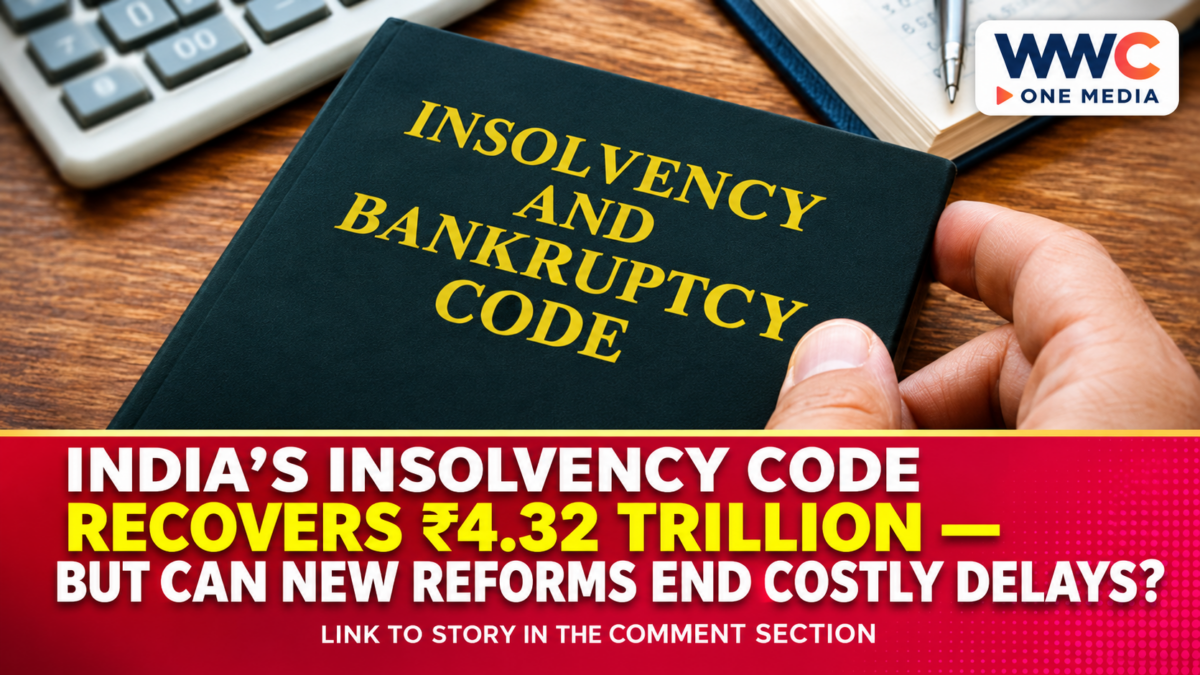
NEW DELHI, India — India insolvency recovery has reached a significant financial milestone, with creditors recovering approximately ₹4.32 trillion through approved corporate resolution plans by March 2026, even as prolonged proceedings continue to challenge the country’s bankruptcy framework.
Nearly a decade after the introduction of the Insolvency and Bankruptcy Code (IBC), India is pursuing another round of legislative reforms designed to accelerate corporate restructuring and improve the efficiency of debt recovery.
For banks, institutional lenders and investors, the challenge extends beyond determining how much money can be recovered. The time required to regain access to that capital can be equally consequential.
India Insolvency Recovery: Trillions Recovered, but Challenges Remain
By March 2026, India had admitted 8,987 corporate insolvency proceedings under its bankruptcy framework, with 1,419 corporate debtors successfully resolved through approved restructuring plans.
The cumulative creditor recovery of ₹4.32 trillion, equivalent to ₹4.32 lakh crore, demonstrates the considerable financial scale of India’s corporate insolvency system.
However, the remaining cases cannot automatically be classified as failed resolutions. Insolvency proceedings can end through liquidation, settlements, withdrawals and other legally recognised mechanisms.
The distinction is important when assessing the effectiveness of the framework.
A successful restructuring can preserve an operating business while allowing creditors to recover part of their outstanding claims. Liquidation, by comparison, generally involves selling assets and distributing the proceeds under applicable legal priorities.
The appropriate outcome depends on the financial circumstances and commercial viability of each company.
Why the Size of a Distressed Company Is Not the Only Factor
Large corporate insolvencies can involve substantial industrial facilities, property holdings, established customer networks and other commercially valuable assets.
However, a company’s size does not automatically guarantee superior creditor recoveries.
The condition of its assets, outstanding liabilities, operational viability and ability to attract investors can influence the eventual financial outcome.
Time is another important consideration.
A business that remains financially distressed for an extended period may experience declining customer confidence, employee departures and deteriorating commercial relationships.
For lenders, delayed recoveries can restrict the capital available for other financing opportunities.
These considerations demonstrate why financial restructuring requires more than an assessment of outstanding debt.
Corporate financial discipline and effective allocation of capital are also important themes in WWC ONE MEDIA’s coverage of Aboitiz’s financial leadership and corporate risk management strategy.
India’s Banks Depend Heavily on the Insolvency Framework
The IBC has become a significant mechanism for recovering distressed bank loans.
During the 2024–25 financial year, India’s scheduled commercial banks recovered ₹1,04,099 crore through various debt-recovery channels.
Of that amount, ₹54,528 crore was recovered through the IBC, representing approximately 52.4% of the total.
These figures demonstrate the importance of bankruptcy proceedings within India’s wider banking system.
However, the percentage of bank recoveries attributable to the IBC should not be confused with the percentage of outstanding creditor claims recovered through individual insolvency cases.
They represent different financial measurements.
Banks must also manage the risks associated with their existing operations, subsidiaries and investment commitments.
These wider challenges are illustrated by UnionBank’s proposed restructuring of UnionDigital and UBX, a separate corporate development involving organisational efficiency rather than India’s statutory insolvency framework.
Why Delays Can Reduce the Economic Value of Recoveries
India introduced an overall 330-day resolution time limit through its 2019 insolvency legislation amendment.
Nevertheless, the government has acknowledged that proceedings in several cases have exceeded the prescribed period.
Prolonged legal disputes and delays in adjudication can undermine efforts to preserve the commercial value of distressed companies.
Consider a hypothetical lender entitled to receive ₹100 crore through a restructuring agreement.
Receiving that amount after several years may be economically less valuable than receiving the same amount much earlier, particularly when financing costs and alternative investment opportunities are considered.
This is why recovery efficiency cannot be measured exclusively by the nominal amount returned to creditors.
The timing and certainty of payments are also relevant to evaluating the financial outcome.
For institutional investors considering distressed-asset acquisitions, lengthy proceedings can create uncertainty surrounding transaction costs, asset conditions and future commercial opportunities.
The importance of evaluating assets, liabilities and financing commitments before completing transactions is also examined in AboitizPower’s proposed ₱6.12-billion Pagbilao acquisition.
India’s 2026 Bankruptcy Reforms Target Procedural Bottlenecks
The Insolvency and Bankruptcy Code (Amendment) Act, 2026 introduces measures intended to address weaknesses identified during the previous decade.
The legislative changes strengthen procedural deadlines, provide creditors with greater oversight during liquidation and introduce an alternative creditor-initiated resolution mechanism for specified companies.
The reforms are intended to reduce uncertainty and make corporate restructuring more practical.
Under the revised framework, adjudicating authorities are required to record reasons when they fail to decide insolvency applications within the prescribed 14-day period.
The legislation also addresses challenges involving regulatory approvals, transactions that may have improperly disadvantaged creditors and the implementation of approved restructuring arrangements.
However, introducing stronger legal provisions does not guarantee that every existing insolvency proceeding will conclude more quickly.
Implementation, institutional capacity and subsequent judicial decisions will remain important considerations.
What Happens Next for India’s Distressed-Asset Market?
Future insolvency statistics will provide an indication of whether the 2026 legislative reforms are producing measurable improvements.
For creditors and investors, important indicators include the duration of proceedings, recovery rates, actual payment schedules and the number of financially distressed businesses successfully rehabilitated.
International businesses operating in India may also consider the predictability of insolvency proceedings when evaluating commercial partnerships and investment risks.
A credible bankruptcy framework can support financial confidence by establishing clearer procedures for dealing with corporate distress.
India has already recovered trillions of rupees through its insolvency system. The next challenge is determining whether that system can deliver more timely, predictable and commercially effective outcomes.
Frequently Asked Questions
What is India’s Insolvency and Bankruptcy Code?
The IBC is a legal framework introduced in 2016 to manage financial distress, corporate restructuring and insolvency proceedings.
How much money has India recovered through the IBC?
Creditors recovered approximately ₹4.32 trillion through approved resolution plans by March 2026.
How many companies have been resolved under India’s insolvency framework?
As of March 2026, 1,419 corporate debtors had been resolved through approved resolution plans.
What is the statutory timeline for corporate insolvency resolution?
India’s 2019 legislative amendment introduced an overall 330-day resolution time limit. Actual proceedings can extend beyond that period in certain circumstances.
Why are insolvency delays financially significant?
Delayed proceedings can reduce the commercial value of distressed assets, postpone creditor payments and increase uncertainty for prospective investors.