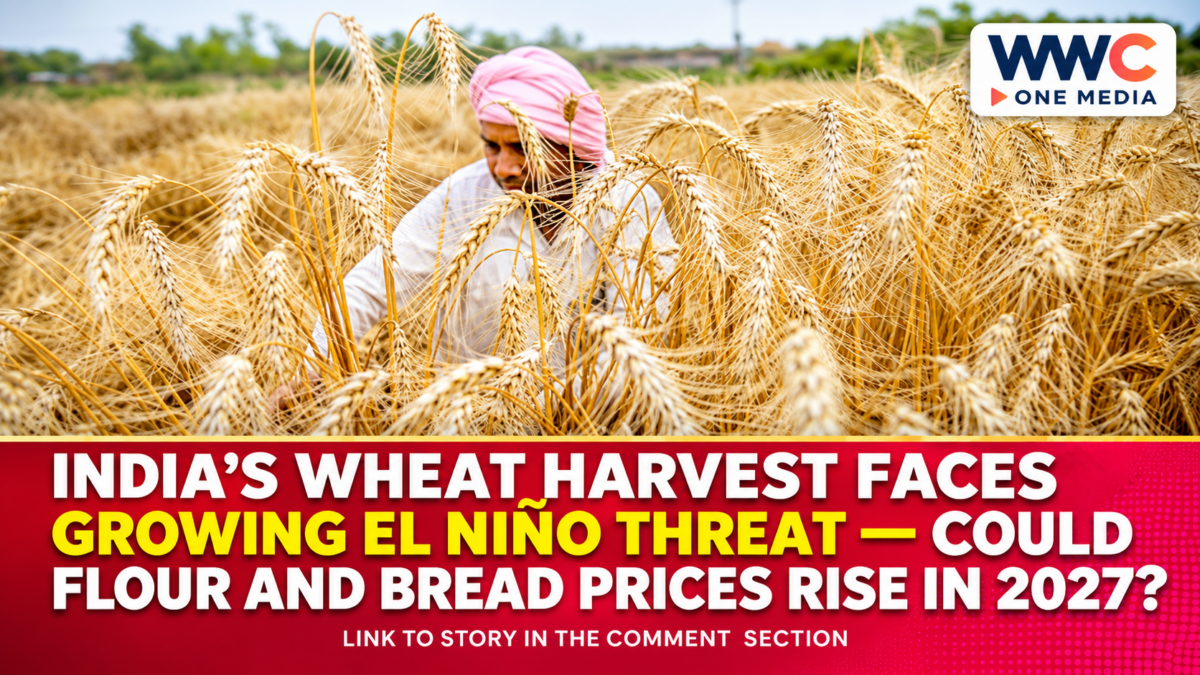
NEW DELHI, INDIA — India’s wheat harvest faces increasing weather-related risks heading into 2027 as an unusually weak monsoon, declining water availability and very strong El Niño conditions threaten agricultural production in the world’s second-largest wheat-producing country.
The emerging concerns come despite India’s agriculture ministry announcing on Nov. 26, 2026, that wheat production reached a record 122.064 million metric tonnes during the 2025–2026 agricultural year.
India is now confronting a different challenge: whether farmers can maintain strong production during the next growing season under less favourable environmental conditions.
A weaker harvest could increase pressure on domestic grain supplies, flour manufacturers and food prices, although the extent of any disruption remains uncertain.
India Wheat Harvest Faces Growing Weather Risks
India recorded 759.4 millimetres of rainfall during the June–September 2026 southwest monsoon, approximately 13% below its long-term average of 868.6 millimetres.
Rainfall shortages varied considerably across the country.
Eastern and northeastern India experienced a 26% rainfall deficit, while the southern peninsula recorded rainfall 24% below normal.
Northwestern India experienced a smaller deficit of 6%, while central India recorded rainfall 3% below its long-term average.
The uneven distribution is significant because agricultural conditions cannot be assessed using national rainfall figures alone.
Areas with insufficient rainfall may face difficulties maintaining soil moisture and securing enough water for winter crops.
For wheat producers, the challenge is ensuring that crops receive adequate moisture during establishment and subsequent development.
Very Strong El Niño Conditions Threaten Winter Agriculture
India’s official meteorological outlook, released on Oct. 31, projected that very strong El Niño conditions would persist throughout November and December 2026.
The forecast also indicated a likelihood of warmer daytime temperatures and below-average rainfall across much of the country during November.
Some areas in northwestern, central and northeastern India were expected to experience more favourable rainfall conditions, demonstrating that El Niño does not affect every agricultural region equally.
The weather phenomenon is also attracting attention elsewhere in Asia, including Taiwan’s preparations for very strong El Niño conditions and changing winter weather risks.
For agricultural producers, the immediate concern is whether weather conditions will provide sufficient moisture and suitable temperatures throughout the growing season.
The meteorological outlook establishes an elevated risk, but it does not confirm that India’s next wheat harvest will decline by a specific amount.
Declining Water Reserves Add Pressure to Farmers
Water availability represents another important challenge for India’s winter agricultural season.
An official US agricultural assessment recorded approximately 132.734 billion cubic metres of available water across 178 major Indian reservoirs as of Oct. 1, 2026.
The figure represented 71.84% of their combined live storage capacity and approximately 79.55% of the volume recorded during the corresponding period in 2025.
Water reserves were also below their normal level for that time of year.
Agricultural assessments identified areas of inadequate soil moisture across several southern and western states, including parts of Maharashtra, Gujarat, Rajasthan and Madhya Pradesh.
Such conditions could influence decisions about which crops farmers cultivate and how much land they allocate to water-intensive agricultural production.
Weather-related agricultural disruptions are not confined to India. Similar supply concerns have emerged in Southeast Asia, where Indonesia’s coffee production faces a projected 8.2% decline during the 2026–2027 marketing year.
Although wheat and coffee have different growing requirements, both illustrate the exposure of agricultural supply chains to changing rainfall and temperature patterns.
India’s Wheat Support Price Rises to ₹2,610
India’s government approved new minimum support prices for winter crops on Sept. 30, 2026.
For wheat, the minimum support price for the 2027–2028 marketing season was increased from ₹2,585 to ₹2,610 per quintal, equivalent to 100 kilograms.
The ₹25 increase represents approximately 0.97%.
Other winter crops received larger increases in absolute monetary terms.
Rapeseed and mustard received an increase of ₹413 per quintal, while lentils received an increase of ₹390.
The price adjustments form part of the government’s broader policy of supporting agricultural incomes and encouraging crop diversification.
However, the size of an increase alone does not determine which crops offer farmers the most attractive financial returns.
Production expenses, expected yields, irrigation requirements and market conditions also influence agricultural decisions.
The wheat minimum support price should not be confused with the retail price of flour or the international market price of wheat.
Record Wheat Production Provides an Important Buffer
Despite growing concerns about the upcoming harvest, India enters the new agricultural season following record wheat production.
The final production estimates released on Nov. 26 placed the 2025–2026 wheat harvest at 122.064 million metric tonnes, compared with 117.945 million metric tonnes in the previous agricultural year.
That represents an increase of 4.119 million metric tonnes.
India’s agriculture minister also indicated that the country had adequate wheat and rice stocks.
Government procurement during the 2026–2027 wheat marketing season reached 35.757 million metric tonnes, providing an additional indication of the scale of domestic supply management.
These figures offer important context when evaluating the risk of future shortages.
A challenging planting season does not necessarily translate immediately into a national supply crisis, particularly when existing stocks can provide a temporary buffer.
Nevertheless, the ability to maintain adequate supplies will depend partly on how the upcoming harvest develops.
Could Wheat Prices Rise Across Asia-Pacific?
A significant reduction in Indian wheat production could tighten domestic supply conditions and increase the importance of government stock management.
For flour manufacturers, bakeries and food distributors, higher grain acquisition costs could create pressure on operating expenses.
However, international wheat prices are influenced by multiple producing countries, agricultural output, transportation costs and trade policies.
India’s production ranking should not be mistaken for an equivalent ranking in global wheat exports.
Food businesses across APEC economies must therefore assess supply developments across multiple agricultural markets.
The importance of diversified sourcing is also reflected in China’s expanding agricultural trade opportunities with Latin America.
India’s wheat outlook represents an important regional development, but it is not sufficient on its own to predict the direction or magnitude of global food price movements.
What Happens Next?
The most important indicators for India’s agricultural outlook will include updated planting statistics, reservoir storage, winter rainfall, temperature forecasts and subsequent crop production estimates.
These developments will help establish whether the current weather-related risks translate into lower agricultural output during 2027.
Existing wheat stocks and government procurement provide some protection against immediate supply pressures.
However, the duration and severity of El Niño could influence how effectively India maintains its recent production gains.
For farmers, food manufacturers and consumers, the coming months will be decisive in determining whether the current agricultural concerns develop into a more substantial food price challenge.
Frequently Asked Questions
Why is India’s wheat harvest at risk in 2027?
Below-average monsoon rainfall, reduced water reserves and very strong El Niño conditions have increased uncertainty surrounding India’s winter agricultural season.
Is India the world’s second-largest wheat producer?
Yes. India ranks second globally in wheat production, behind China.
What was India’s latest completed wheat production estimate?
India’s final estimate for the 2025–2026 agricultural year reached a record 122.064 million metric tonnes.
What is India’s new minimum support price for wheat?
The minimum support price for the 2027–2028 marketing season is ₹2,610 per 100 kilograms, up from ₹2,585.
Will El Niño cause wheat, flour and bread prices to increase?
Higher prices are a possibility if agricultural production and available supplies decline. However, future prices will also depend on existing stocks, international harvests, trade conditions and government interventions.