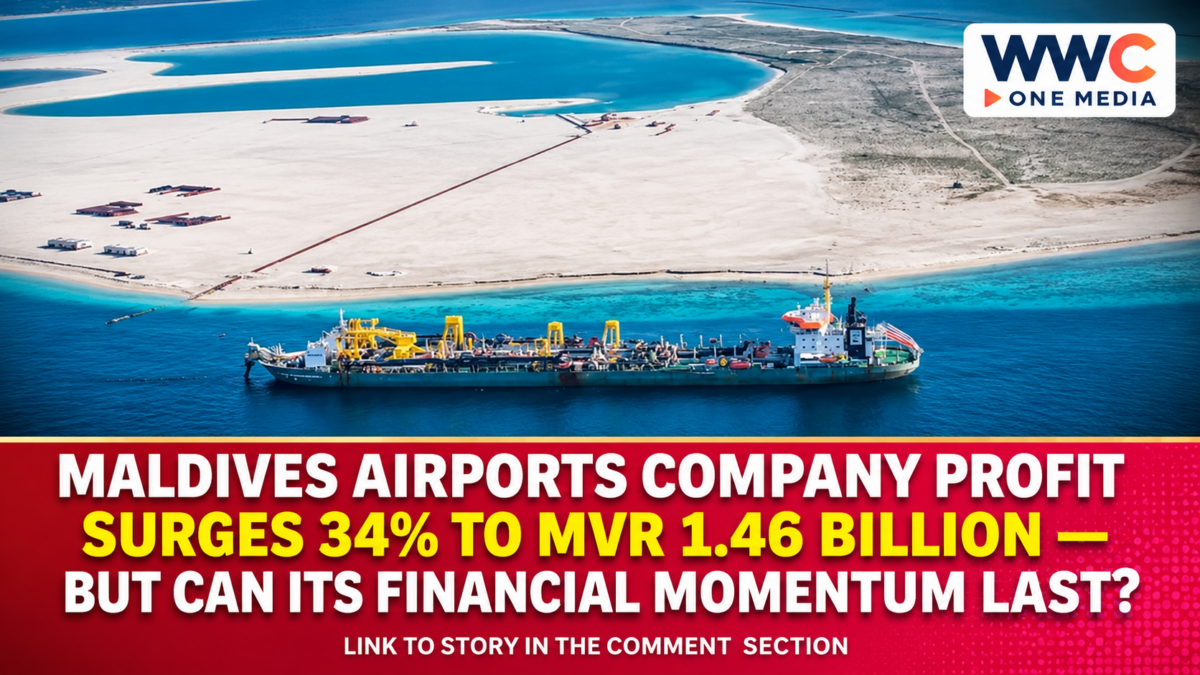
MALÉ, Maldives — Maldives Airports Company Limited (MACL) recorded a substantial increase in consolidated earnings in 2025, with annual profit after tax rising to MVR 1.46 billion as the state-owned aviation company continued investing in infrastructure.
MACL’s financial performance highlights the commercial significance of the Maldives’ principal airport operator, whose responsibilities extend beyond passenger transportation into aviation services and infrastructure development.
The improved earnings also provide important context for the company’s performance-based employee compensation programme, which includes annual bonuses.
However, stronger accounting profits have been accompanied by declining operating cash flows and substantial construction expenditure, creating a more complex financial picture.
MACL Financial Performance: Annual Profit Climbs Nearly 34%
MACL’s consolidated profit after tax reached MVR 1,464,806,000 in 2025, compared with MVR 1,095,164,000 in 2024.
The increase represents annual earnings growth of approximately 33.8%.
Group operating profit also increased from MVR 1.58 billion to MVR 1.91 billion during the same period.
These figures include the financial results of MACL and its consolidated subsidiaries.
The parent company separately recorded profit after tax of approximately MVR 1.28 billion, compared with MVR 1.10 billion in the previous financial year.
Distinguishing consolidated earnings from the parent company’s individual performance is important because the two accounting measures represent different corporate structures.
The results cover the financial year ended Dec. 31, 2025. The audit report was signed on Nov. 2, 2026.
They should not be interpreted as MACL’s complete financial results for 2026.
Employee Bonuses Form Part of MACL’s Compensation Programme
MACL’s published employment framework includes annual bonuses linked to corporate and individual performance.
The company’s compensation arrangements also encompass salaries, allowances, medical coverage, pension support and professional development opportunities.
Performance-related compensation can help aviation companies retain skilled employees and maintain operational standards, particularly in businesses that require specialised technical expertise and continuous service delivery.
However, annual corporate profitability does not automatically determine the amount received by every employee.
Individual payment amounts may depend on the applicable compensation policies and performance requirements.
A complete official breakdown of the latest annual bonus allocations has not been publicly established in the reviewed corporate records.
Workforce development is also an important consideration in the country’s hospitality industry, as reflected in Amilla Maldives’ appointment of new leadership to strengthen its international commercial reach.
Both airport operators and hospitality businesses depend on skilled personnel to maintain service quality.
Why Higher Profits Do Not Tell the Entire Financial Story
Despite MACL’s improved earnings, consolidated net cash generated from operating activities declined during 2025.
The figure fell from approximately MVR 3.05 billion in 2024 to MVR 2.05 billion in 2025, representing a reduction of approximately 32.8%.
The difference between accounting profit and operating cash flow is important when evaluating a company’s financial capacity.
Accounting profits reflect income and expenses recognised during a financial period. Operating cash flow measures the actual movement of money associated with business operations.
A company can therefore report rising profits while generating less operating cash than in the previous year.
For an infrastructure-intensive business, cash availability remains important because operating expenses, financing commitments and construction projects require funding.
MACL’s results illustrate why profitability should be evaluated alongside liquidity and investment requirements rather than in isolation.
Airport Infrastructure Investment Remains a Major Financial Commitment
MACL’s consolidated construction expenditure on capital projects reached approximately MVR 4.73 billion in 2025, compared with MVR 3.39 billion a year earlier.
Investment on this scale can support long-term aviation development, although the financial benefits may emerge over several years.
The company’s responsibilities include operating Velana International Airport and providing aviation-related services at government-owned regional airports.
MACL is wholly owned by the government of the Maldives.
Its corporate structure also includes interests in aviation catering, air traffic services and infrastructure development businesses.
These operations place the company within a wider network of activities supporting national connectivity and economic development.
The broader Maldivian aviation industry is also exploring new transportation opportunities, including the country’s first crewed electric vertical take-off and landing island crossing.
While emerging aviation technologies and conventional airport infrastructure address different commercial opportunities, both highlight the importance of connectivity in an island economy.
Why MACL Matters to Asia-Pacific Tourism Businesses
Air connectivity is an essential consideration for travel operators, international airlines and hospitality businesses serving the Maldives.
Airport operations influence the movement of passengers, baggage and cargo between international markets and island destinations.
For businesses across the Asia-Pacific, the development of Maldivian aviation infrastructure can create opportunities involving travel distribution, passenger services and tourism-related partnerships.
However, airport infrastructure alone cannot guarantee sustained growth in airline connectivity.
Individual carriers must also manage operating costs, commercial demand and the financial viability of their routes.
Those challenges are reflected in BeOnd’s extended suspension of scheduled Maldives flights, a separate development illustrating the commercial uncertainties facing aviation businesses.
MACL’s long-term financial performance will therefore depend on its ability to manage infrastructure requirements while maintaining commercially sustainable operations.
What Happens Next for Maldives Airports Company?
MACL enters its next reporting cycle with stronger historical earnings but significant ongoing investment requirements.
Future financial disclosures will provide further information about whether the company can maintain profitability while improving cash generation and meeting its infrastructure commitments.
For employees, the company’s performance-based compensation framework remains an established component of its published employment arrangements.
For the government, MACL’s financial performance is relevant because the company is a wholly state-owned enterprise responsible for strategically important aviation infrastructure.
The next test will be whether the airport operator can translate its investments into sustainable financial returns while maintaining operational efficiency and service quality.
Frequently Asked Questions
How much profit did MACL earn in 2025?
MACL recorded consolidated profit after tax of MVR 1,464,806,000, approximately 33.8% higher than in 2024.
Who owns Maldives Airports Company Limited?
MACL is wholly owned by the government of the Maldives.
Does MACL provide annual employee bonuses?
Yes. Its published employment framework includes annual bonuses linked to company and individual performance.
Has MACL officially disclosed an MVR 25,000 employee bonus?
The individual payment amount has not been independently established through the original corporate disclosures reviewed for this article.
How much did MACL spend on construction projects in 2025?
Consolidated construction expenditure on capital work in progress reached approximately MVR 4.73 billion during the financial year.