
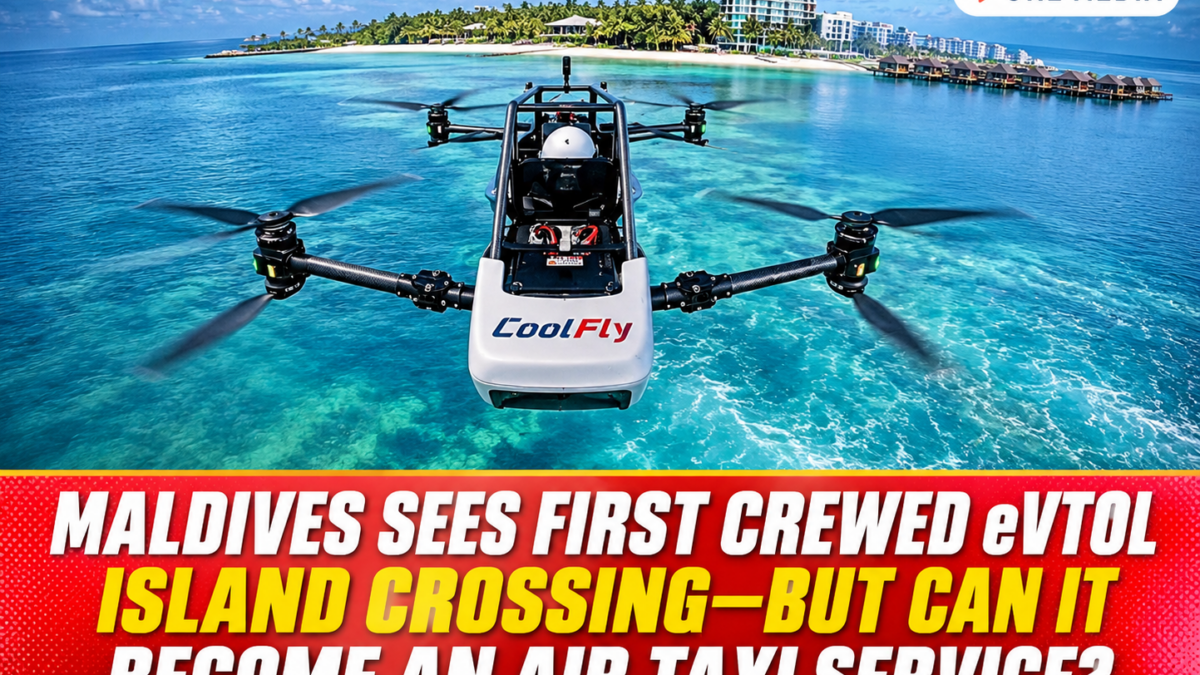
A single-seat electric vertical take-off and landing aircraft developed by China’s CoolFly has completed a crewed crossing between Malé and Villimalé during demonstrations in the Maldives, the company announced on November 23, 2026. The flight covered approximately three kilometres over open water, marking what CoolFly describes as the country’s first crewed cross-island flight by a personal aircraft.
The demonstration puts a practical question in front of the Maldives’ aviation and tourism sectors: could compact electric aircraft eventually serve island resorts, sightseeing operators or other short-distance transport needs? The flight offers a real-world example of the technology operating over water, but it does not establish that the aircraft is certified for regular commercial passenger services.
Maldives eVTOL demonstration moves beyond the exhibition floor
The aircraft involved was CoolFly’s Dream ST, a single-seat personal aircraft using an electric vertical take-off and landing design. The company said its pilot flew from the Malé waterfront to neighbouring Villimalé, with the aircraft also making repeated crossings during a series of public demonstrations.
The demonstrations began on November 6 and lasted three days, according to the company’s announcement. The aircraft first flew over the channel off Hulhumalé Phase 1 before undertaking the Malé–Villimalé crossings.
The distinction between a demonstration and a transport service is important. The flight showed that the aircraft could undertake the reported route under demonstration conditions. It did not establish scheduled operations, passenger ticketing, commercial availability or approval for routine public transport.
CoolFly had previously announced plans to bring the Dream ST to Maldives Expo 2026, describing the aircraft as a lightweight, single-seat electric model with eight propellers. The company’s earlier announcement presented island tourism and aerial sightseeing as possible applications, rather than confirmed services.
What the Dream ST could offer an island economy
The Maldives is a geographically dispersed island country where transport between communities and tourism destinations is a practical challenge. Boats, ferries, seaplanes and conventional aircraft already serve different parts of that transport network.
A compact aircraft capable of vertical take-off and landing could, in principle, offer another option for selected short-distance journeys. It would not need a conventional runway for take-off and landing, potentially making certain locations easier to access than they would be for fixed-wing aircraft.
The possible tourism applications are also straightforward to understand. Resorts could explore aerial sightseeing, while operators might consider short recreational flights over suitable coastal areas.
But these are potential uses, not proven business opportunities. A commercial operator would still need to establish whether the aircraft can carry the intended payload, operate reliably in local weather and marine conditions, meet safety requirements and generate enough demand to cover operating expenses.
A useful comparison is the wider business aviation market. WWC has examined the different economics of private aircraft in its report on the Gulfstream G700’s arrival in Manila. A personal eVTOL is a very different aircraft, but both examples illustrate how aviation technology must be assessed in terms of its intended users, operating model and costs.
Maldives aviation rules remain central to commercial operations
A successful demonstration does not automatically give an aircraft permission to carry paying passengers.
The Maldives Civil Aviation Authority publishes separate regulatory requirements covering aircraft, air operations and commercial air transport. Under the Maldives Civil Aviation Act, an aircraft registered in the country must obtain a certificate of airworthiness before it can be operated. The Act also establishes requirements for the provision of air transport services.
The Civil Aviation Authority states that commercial air transport operators must obtain an Air Operator Certificate. The requirement applies to operators transporting passengers or cargo for remuneration, regardless of the size of the aircraft or operation.
That makes the distinction between a public demonstration and a commercial service especially important. A demonstration flight does not, by itself, establish that the aircraft has received all applicable approvals for commercial operation in the Maldives.
The company says the Dream ST was designed around the United States Federal Aviation Administration’s Part 103 ultralight category and that it holds CE and FCC certifications. Those are company-reported product details; they should not be mistaken for confirmation of Maldivian airworthiness approval or permission to operate a passenger service.
Two agreements open discussions, not a confirmed launch
CoolFly also disclosed that it signed a strategic cooperation agreement with Maldivian aviation company Skylink Aviation and a memorandum of understanding with CMBGA, a China-Maldives business association.
The company said the partners would explore regulatory approval, local operations and possible tourism applications, including resort flight experiences, ocean sightseeing and yacht-related leisure activities.
These agreements indicate that the parties intend to examine possible cooperation. They do not establish that a commercial route has been approved, that a fleet has been ordered or that a launch date has been set.
For businesses considering the technology, that difference matters. A cooperation agreement can create a framework for discussion, but actual operations depend on further technical, regulatory and commercial decisions.
The Maldives’ broader aviation infrastructure also matters. Airports, landing areas, airspace coordination and operational oversight all shape which aircraft can be used and where. WWC’s coverage of NAIA’s airport modernisation and passenger experience examines a different aviation market, but it illustrates why infrastructure and operational performance remain central to aviation development.
Why safety and airspace management cannot be an afterthought
An aircraft flying between islands must operate within a controlled aviation environment, not simply find an open stretch of water.
Regulators must consider aircraft performance, pilot qualifications, operating procedures, weather conditions, emergency response arrangements and the relationship with other air traffic. The requirements may differ depending on the aircraft’s registration, operating category and intended use.
The distinction between crewed eVTOL aircraft and unmanned drones is also important. They are not interchangeable regulatory categories. WWC previously reported on Makati’s temporary restrictions on drone flights, a separate issue involving unmanned aircraft and local airspace management. A crewed personal aircraft raises its own certification and operating questions.
For the Maldives, the challenge is to determine whether a new type of aircraft can be integrated into existing aviation arrangements without compromising safety or disrupting established services.
What happens next
The next meaningful milestones would be evidence of the relevant regulatory approvals, confirmation of an authorised operating model and details of any proposed commercial service.
CoolFly’s announcement describes its agreements as a basis for exploring those steps. It does not provide a confirmed launch date, passenger fares, a fleet size or a schedule for regular flights.
Until those details are established, the Dream ST crossing should be treated as a technology demonstration with potential commercial applications—not the start of a new public transport network.
Frequently Asked Questions
What is an eVTOL aircraft?
An eVTOL is an electric aircraft designed to take off and land vertically. The term covers different aircraft designs, including personal aircraft and larger proposed air-taxi models.
Where did the CoolFly Dream ST fly in the Maldives?
CoolFly said its pilot flew the single-seat aircraft between the Malé waterfront and Villimalé, a distance of approximately three kilometres over open water.
Can the Dream ST already carry paying passengers in the Maldives?
The company announcement does not establish approval for routine commercial passenger services. Commercial air transport operators in the Maldives must obtain the required Air Operator Certificate.
Did CoolFly sign agreements with Maldivian partners?
Yes. The company announced a strategic cooperation agreement with Skylink Aviation and a memorandum of understanding with CMBGA. The stated purpose is to explore approvals, local operations and possible tourism applications.
Does the demonstration mean electric air taxis are launching in the Maldives?
No. The flight demonstrates the aircraft’s reported operation on a specific route. A commercial launch would require further regulatory, operational and business arrangements.










