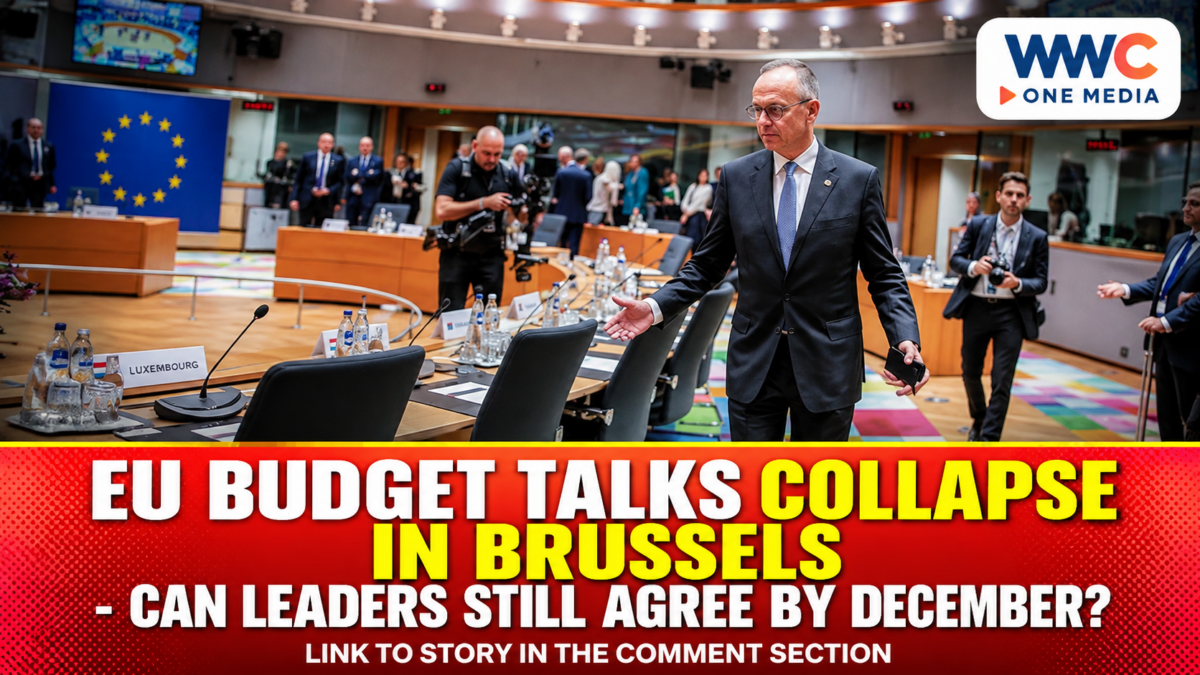
European Union leaders have failed to reach an agreement on the bloc’s next seven-year budget, exposing deep divisions over spending priorities, national contributions and financial support for Ukraine.
The discussions took place during a special European Council meeting in Brussels on November 26, 2026. The proposed Multiannual Financial Framework (MFF) covers 2028 to 2034 and will determine how the EU finances major programmes, from agriculture and regional development to defence, research and economic competitiveness.
European Council President António Costa confirmed that leaders did not reach an agreement. However, the meeting also produced a separate development on Ukraine: 24 member states supported the European Commission’s proposal for an additional loan to help finance the country in 2027.
Bulgaria said it would participate only in the non-military component, with a focus on regions where its national minority lives.
The outcome reveals a difficult political balance. European governments broadly recognise the need to fund new security and economic priorities, but they remain divided over how much the EU should spend, which programmes should receive protection and how the financial burden should be shared.
The next challenge is whether those differences can be narrowed before the end of 2026.
Why the EU’s Seven-Year Budget Is Stuck
The EU’s next long-term budget is expected to finance nearly €2 trillion in spending between 2028 and 2034 under the European Commission’s original proposal.
The framework is designed to support the bloc’s priorities, including security, defence, competitiveness, climate resilience, agriculture and regional development.
But the negotiations involve more than deciding how much money to allocate. Governments must also agree on how the funding will be distributed and how the EU will raise additional revenue.
At the November 26 meeting, Costa identified three central issues: the overall size of the budget, the distribution of funding between spending priorities and a package of new EU revenue sources.
The discussions exposed competing demands.
Some governments called for further reductions in the proposed budget. Most opposed additional cuts, while some wanted previous reductions reversed, particularly those affecting cohesion funding.
A large majority also argued against compressing allocations for agriculture and cohesion.
These disagreements matter because the EU budget is not financed like a national government’s annual spending plan. It pools contributions and other revenue to fund programmes shared across the 27 member states.
A country may prioritise lower national contributions, while another may depend heavily on EU funding for agricultural support, infrastructure and regional development.
The result is a negotiation in which every government has financial and political interests to protect.
Agriculture and Regional Funding Remain Major Flashpoints
Agriculture and cohesion policy are among the most sensitive parts of the negotiations.
The Common Agricultural Policy (CAP) supports farmers and rural communities across the bloc. Cohesion funding is designed to reduce economic and social disparities between regions by supporting infrastructure, employment and development.
The two areas have traditionally accounted for substantial portions of the EU budget.
Governments that rely heavily on these programmes are concerned that shifting money towards defence, technology and competitiveness could weaken established funding arrangements.
Other member states argue that the EU must modernise its spending to respond to new strategic challenges and avoid placing excessive pressure on national budgets.
The Commission’s proposed framework would reorganise spending under four broad headings, including support for people and regions, competitiveness and security, global partnerships, and the administration of EU institutions.
It also proposes national and regional partnership plans that would bring several existing funding programmes together under one framework for each member state.
The approach could simplify funding arrangements, but it also raises questions about how national governments and regional authorities will influence spending decisions.
WWC previously examined the wider debate over whether common EU borrowing can finance Europe’s next economic and strategic priorities.
Ukraine Funding Adds Another Layer to the Dispute
The budget negotiations are taking place alongside a separate debate over Ukraine’s financial requirements for 2027.
On November 18, the European Commission proposed an additional €45 billion in financial support for Ukraine through a new instrument. The proposal is intended to cover approximately two-thirds of Ukraine’s estimated €70 billion financing gap for next year.
The Commission’s proposed package includes support for essential government services and defence capabilities. Its proposed repayment arrangement would require Ukraine to repay the loan only after receiving reparations from Russia.
The proposal is separate from the EU’s existing €90 billion Ukraine Support Loan for 2026 and 2027.
During the Brussels meeting, Costa said 24 member states supported the additional loan proposal. Bulgaria indicated that its participation would be limited to the non-military component, with a focus on regions where its national minority lives.
That support is politically significant, but it should not be mistaken for a completed financing agreement or proof that the full amount has already been transferred.
The Commission’s proposal still requires the necessary legislative and financial steps.
The funding debate also reflects a broader question about how Europe will sustain assistance to Kyiv while managing its own economic and security priorities.
WWC has previously reported on the EU’s €90-billion Ukraine support plan and the additional funding Brussels says Kyiv needs.
The discussion is also connected to Europe’s response to the war’s continuing humanitarian and infrastructure consequences. As winter approaches, the proposed energy ceasefire has become another test of Europe’s diplomatic and financial support for Ukraine.
What the Budget Disagreement Means for Europe
The failure to reach an agreement does not mean the EU’s existing budget has stopped operating.
The dispute concerns the next financial framework, which is scheduled to begin on January 1, 2028.
The current framework remains in force while governments negotiate the next one. However, the EU needs sufficient time to complete the legislative process and ensure that programmes can continue without interruption when the new period begins.
The proposed budget is also tied to Europe’s economic competitiveness.
The Commission’s framework includes a European Competitiveness Fund intended to bring together 14 existing programmes under a common set of rules. Its priorities include health and biotechnology, digital leadership, clean industrial transformation, defence and space.
These areas are important as Europe faces competition from the United States and China in advanced technology, industrial investment and strategic manufacturing.
The funding dispute therefore goes beyond a disagreement over government contributions. It concerns how the EU intends to position its economy over the next decade.
The debate over Ukraine also affects the bloc’s ability to balance external security commitments with domestic spending demands.
For economies outside Europe, the outcome is relevant because EU decisions on industrial investment, trade, energy, research and defence can influence international supply chains and economic partnerships.
Taiwan’s experience also illustrates the wider international dimension of Ukraine financing. WWC has examined Taiwan’s allocation for Ukraine reconstruction and the challenge of turning commitments into measurable results.
Why December Is the Next Critical Deadline
The European Council is expected to return to the budget issue at a forthcoming meeting in December.
German Chancellor Friedrich Merz said leaders would seek to reach an agreement before the end of the year, with the next two-day summit scheduled to begin on December 17.
The timetable is important because the EU must complete the political negotiations before the formal adoption process can proceed in 2027.
Under Article 312 of the Treaty on the Functioning of the European Union, the Council must adopt the Multiannual Financial Framework regulation unanimously after obtaining the consent of the European Parliament.
The EU’s own timetable identifies an agreement by the end of 2026 as necessary to allow legislation to be adopted in 2027 and the new budget to begin on January 1, 2028.
That means a single unresolved national position can prevent the overall agreement from moving forward.
The next negotiations will need to address the size of the budget, the protection of agriculture and cohesion funding, new revenue sources and the relationship between the EU’s spending priorities and national contributions.
The additional Ukraine loan will also require its own decisions and procedures. It should not be treated as automatically approved simply because 24 member states expressed support.
What Happens Next?
The Brussels summit has exposed the difficulty of securing agreement among 27 governments with different fiscal priorities and political interests.
The immediate task is to find a compromise that protects established programmes while providing enough funding for new priorities, including defence, technology and competitiveness.
The proposed Ukraine loan has gained support from most member states, but its implementation remains a separate question.
The next major test will come in December, when EU leaders are expected to resume negotiations.
If governments can reach a political agreement before the end of the year, the bloc will have a clearer path towards adopting the 2028–2034 framework in 2027.
If they cannot, the timetable for preparing the next budget could become increasingly difficult.
For now, the EU has made progress on some parts of the Ukraine financing debate but remains divided over its own long-term spending plan.
The central question is whether European leaders can agree on how much the bloc should spend—and who should pay—before the next budget period approaches.
Frequently Asked Questions
Did EU leaders agree on the 2028–2034 budget?
No. European Council President António Costa confirmed that leaders did not reach an agreement during the November 26, 2026, meeting in Brussels.
How much is the proposed EU budget?
The European Commission’s original proposal amounts to nearly €2 trillion in current prices for the 2028–2034 period. A revised negotiating proposal was subsequently presented by European Council President António Costa.
Why are EU countries divided over the budget?
Governments disagree over the overall budget size, national contributions, agricultural support, regional development funding, defence spending and new revenue sources.
Did EU countries approve the additional Ukraine loan?
Not fully. Costa said 24 member states supported the European Commission’s proposed additional loan. The proposal still requires the necessary approval and implementation steps.
How much additional support is proposed for Ukraine in 2027?
The European Commission proposed up to €45 billion in additional support for 2027, intended to cover approximately two-thirds of Ukraine’s estimated €70 billion financing gap.
When will EU leaders discuss the budget again?
The next major negotiations are expected at a two-day summit beginning December 17, 2026.
When does the next EU budget begin?
The 2028–2034 Multiannual Financial Framework is scheduled to start on January 1, 2028, after the necessary political and legislative approvals.