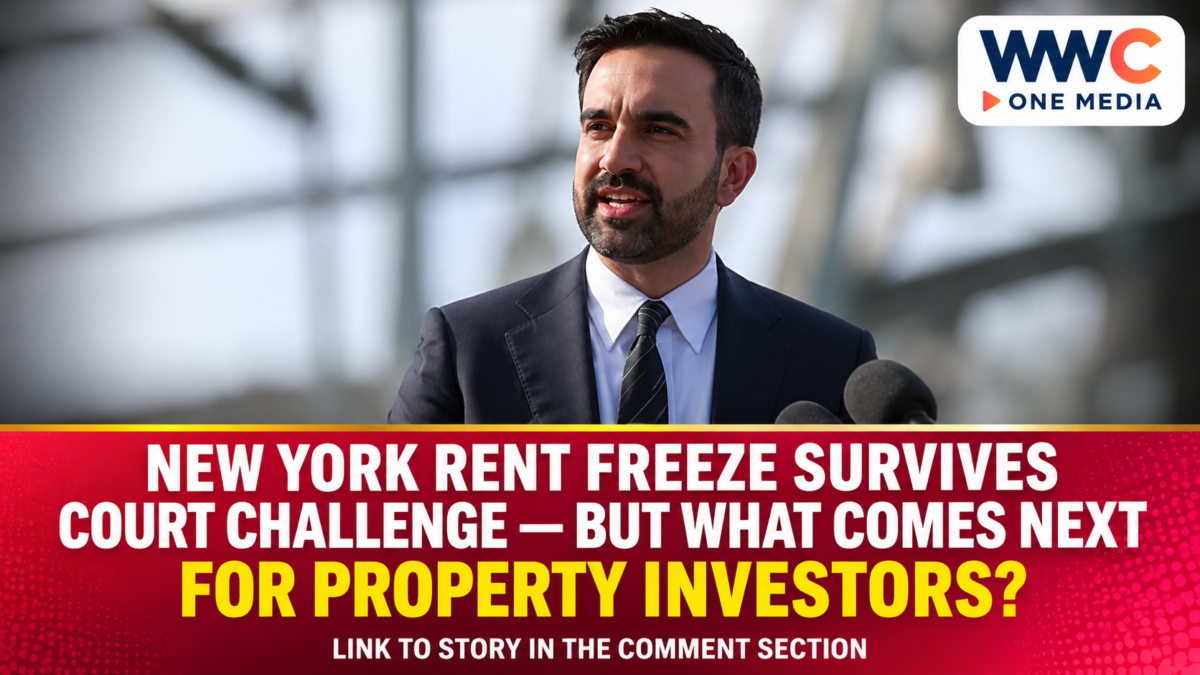
NEW YORK, UNITED STATES — The New York rent freeze has survived a major legal challenge after a Manhattan judge dismissed a lawsuit seeking to overturn restrictions on rent increases affecting more than one million rent-stabilised apartments.
New York Supreme Court Justice Brendan T. Lantry issued the decision on Nov. 25, 2026, preserving a landmark housing affordability measure supported by Mayor Zohran Mamdani.
The ruling represents a significant victory for tenants while leaving property owners and real estate investors facing important questions about operating expenses, financing and future investment returns.
New York rent freeze protects more than one million apartments
The New York City Rent Guidelines Board adopted Apartment and Loft Order No. 58 on June 25, 2026, establishing a zero-percent rent adjustment for qualifying one-year and two-year leases.
The measure covers eligible leases commencing from Oct. 1, 2026, through Sept. 30, 2027.
It marks the first time the board has simultaneously frozen guideline increases for both lease durations.
The policy applies across New York City’s five boroughs: Manhattan, Brooklyn, Queens, the Bronx and Staten Island.
However, it does not impose a blanket rent freeze on every privately rented property in New York City. The order primarily governs apartments and qualifying lofts covered by the city’s rent regulation framework, subject to other adjustments permitted by law.
For eligible tenants, the measure provides greater certainty over housing expenses when entering qualifying rental agreements.
Why the court rejected the landlords’ challenge
A coalition of property owners initiated legal proceedings on July 22, 2026, seeking to invalidate the Rent Guidelines Board’s decision.
The landlords questioned the process through which the rent freeze was adopted, arguing that the board had failed to exercise sufficient independence and properly consider economic conditions affecting residential property owners.
The court ultimately determined that the available evidence did not establish grounds for invalidating the order.
Justice Lantry explained that judicial review was concerned with whether the board had acted within the applicable legal framework and whether its decision had a rational basis.
The court was not responsible for determining whether the rent freeze represented the best economic policy for New York City.
The distinction is important. A government regulation can survive judicial scrutiny without resolving every economic concern raised by affected businesses.
Judge raises concerns over Mamdani’s campaign promise
Although the ruling preserved the rent freeze, the court also criticised Mamdani’s previous campaign commitments concerning regulated rents.
Justice Lantry characterised the guarantees as “reckless and irresponsible”, emphasising that the mayor does not possess unilateral authority to determine rent adjustments.
That responsibility belongs to the Rent Guidelines Board.
The court also expressed concern about communications involving the board and the mayor’s office before the final vote. Nevertheless, it found insufficient evidence to establish that the board’s decision was unlawfully dictated by the administration.
Mamdani welcomed the ruling, describing it as a victory for housing affordability and the more than two million New Yorkers living in rent-stabilised apartments.
The outcome highlights the distinction between political commitments, independent regulatory authority and judicial oversight.
New York’s housing shortage remains a major challenge
The city’s affordability problems extend beyond annual rent adjustments.
New York’s 2023 Housing and Vacancy Survey recorded a citywide rental vacancy rate of 1.41%, compared with 4.54% in 2021.
The 2023 figure represented the lowest recorded rental vacancy rate since 1968.
In March 2024, the New York City Council voted to maintain the city’s rent stabilisation framework following findings of a continuing housing emergency.
The historical figures illustrate the supply pressures underlying New York’s affordability debate. They should not, however, be interpreted as updated vacancy measurements for November 2026.
Rent regulation can provide immediate financial stability to eligible households, but it does not automatically create additional apartments.
The broader challenge is maintaining existing residential buildings while expanding housing availability.
Property investors face a different financial equation
For real estate investors, the court ruling reinforces the importance of assessing regulatory exposure alongside traditional investment risks.
When rental income cannot increase through ordinary annual adjustments, property owners may face tighter operating margins if maintenance, insurance, financing and other expenses rise.
The impact will vary depending on the financial position of individual buildings, their existing rental income and outstanding debt.
The situation reflects a broader investment challenge: the relationship between operating income, asset valuation and regulatory conditions, a subject also explored in WWC ONE MEDIA’s coverage of Starbucks Japan’s business network and valuation.
Property owners must also evaluate whether retaining, refinancing or disposing of assets makes financial sense under changing market conditions.
Asset disposal as a financial strategy is another issue examined in India’s BSNL and MTNL asset monetisation programme.
However, the court ruling does not establish that all rent-stabilised buildings will become financially unviable or that investors will necessarily abandon the market.
What the ruling means for APEC property investors
New York’s housing policy presents an important regulatory consideration for international investors evaluating residential real estate opportunities in the United States.
For investment managers across Asia-Pacific economies, the case illustrates why government policies, income restrictions and long-term operating expenses must be incorporated into investment assessments.
Diversification and the ability to adapt to changing business conditions remain important considerations, as illustrated by Qualcomm’s strategy to diversify beyond Apple.
The New York ruling does not directly change housing regulations elsewhere in the Asia-Pacific region. Its relevance lies in demonstrating how local regulatory decisions can influence the financial assumptions behind internationally accessible investments.
What happens next?
The immediate effect of the court decision is that Apartment and Loft Order No. 58 remains valid.
The next major consideration will be how tenants, landlords and financial institutions respond to the existing rental guidelines.
Building maintenance expenditure, financing arrangements, housing availability and future Rent Guidelines Board decisions will remain important indicators.
For tenants, the ruling provides protection against ordinary guideline increases for qualifying leases.
For property owners, the challenge is maintaining financially sustainable operations within the existing regulatory framework.
New York’s rent freeze has survived its legal challenge. Whether it can deliver lasting affordability while supporting the long-term condition of the city’s housing stock remains an open economic question.