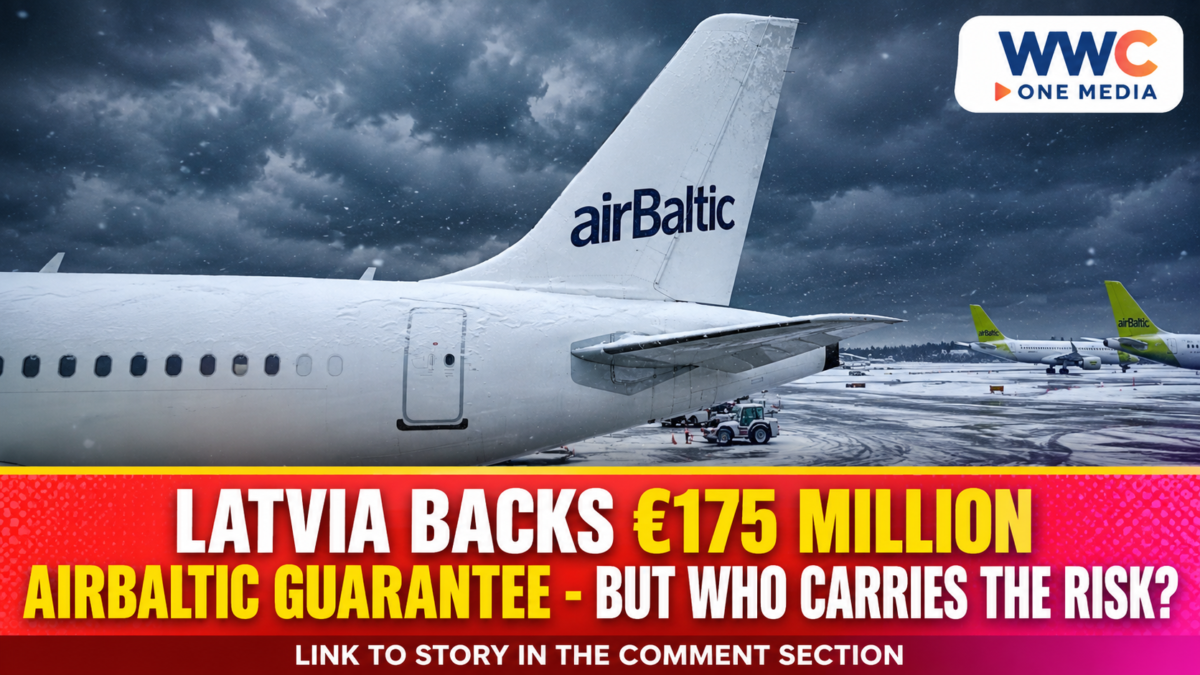
RIGA, Latvia — Latvia’s parliament has backed a legal framework allowing the government to guarantee up to €175 million in obligations linked to national airline airBaltic, giving the financially troubled carrier another route to secure private financing while it undergoes court-supervised restructuring in the United States.
The decision, announced by the Saeima on November 26, 2026, is intended to help airBaltic maintain operations and continue its financial reorganisation. But the approval does not mean the government has immediately transferred €175 million to the airline.
Instead, the arrangement would allow private lenders to provide financing while the Latvian state guarantees specified obligations, subject to further government decisions and regulatory approvals.
That distinction is crucial. A state guarantee is not the same as a direct cash injection, but it can expose taxpayers to financial losses if the borrower fails to meet the obligations covered by the guarantee.
For Latvia, the decision puts a strategic question at the centre of its aviation policy: how much financial risk should the state accept to preserve an airline considered important to the country’s international connectivity?
What Latvia’s Parliament Actually Approved
The Saeima supported urgent amendments to the law governing financial stabilisation measures for Air Baltic Corporation AS.
The amendments establish the possibility of a state guarantee of up to €175 million for obligations connected with maintaining the airline’s operations during its restructuring.
The stated objective is to help airBaltic attract private financing rather than immediately fund the airline through a direct government loan.
Latvia’s Cabinet of Ministers had already given conceptual approval to the guarantee on November 24 and instructed that the proposed legal changes be submitted to parliament through an expedited process.
The government said the arrangement could address airBaltic’s short-term financing needs while allowing the restructuring to continue.
However, the parliamentary decision does not automatically activate the guarantee. The government must still make the required decisions, and the necessary approvals must be secured.
The Latvian government has specifically said that the guarantee can be issued only after parliamentary authorisation and the required approvals, including approval from the European Commission under European Union state-aid rules.
That means the €175 million figure represents the maximum proposed guarantee, not money already paid out by the Latvian treasury.
Why airBaltic Needs Another Financing Lifeline
The guarantee comes as airBaltic works through a Chapter 11 financial reorganisation in the United States.
The airline voluntarily initiated the process on September 14, 2026, under the US Bankruptcy Code. Chapter 11 allows a company to reorganise its financial obligations under court supervision while continuing business operations, rather than automatically shutting down.
The airline has secured commitments for up to €350 million in debtor-in-possession financing, a type of funding designed to provide liquidity during a restructuring.
The financing is divided into three tranches: €175 million for the first tranche, €125 million for the second and €50 million for the third, subject to the financing documents and court-approved conditions.
The additional Latvian guarantee is intended to support the private financing needed during this process. It should not be confused with the entire €350 million financing facility or treated as a separate €175 million cash payment to the airline.
Latvia’s government has said the restructuring is expected to continue into 2027. It also stated on November 24 that airBaltic was continuing normal operations, with flights operating as scheduled and tickets and reservations remaining valid.
The Financial Figures Behind the Guarantee
The airline’s own interim financial statements help explain why the government is treating the financing issue as urgent.
For the six months ended June 30, 2026, airBaltic reported:
- €399.2 million in operating revenue, up 14.2% from the first half of 2025.
- €128.2 million in losses for the period, compared with €1.7 million in the same period a year earlier.
- €309.3 million in negative equity as of June 30.
- €452.4 million by which current liabilities exceeded current assets.
- €23.1 million in unrestricted cash, alongside €3.4 million held in a restricted bond-service reserve account.
The figures show a complicated financial picture. Revenue increased, but the company still recorded a substantially larger loss and faced significant balance-sheet pressure.
The airline’s interim report also identified a material uncertainty that could cast significant doubt on its ability to continue as a going concern. Its ability to maintain operations depended in part on the funding available through the Chapter 11 process.
These figures are historical snapshots ending June 30, not a statement of the airline’s current cash position in late November. Nevertheless, they explain why continued access to financing is central to the restructuring.
Why the Guarantee Is Not a Conventional Bailout
The difference between a direct bailout and a state guarantee matters for public finances.
A direct government injection requires the state to provide money to the company. A guarantee instead supports a borrowing arrangement by promising that the state will meet specified obligations if the borrower fails to do so under the guarantee’s terms.
The government says the proposed structure would allow private lenders to supply the financing without an immediate payment from the state budget.
But the arrangement is not risk-free.
If airBaltic cannot meet the guaranteed obligations, Latvia could be required to honour the guarantee. The eventual public cost would depend on the amount covered, the conditions of the guarantee, the airline’s ability to repay and any recovery from the restructuring.
The parliamentary amendments also provide for scrutiny of the financial risks and the conditions under which the guarantee may be issued.
For taxpayers, the central question is therefore not simply whether the government pays €175 million today. It is whether the airline can emerge from restructuring strongly enough to avoid turning a contingent state obligation into an actual public expense.
What the airBaltic Restructuring Means for Baltic Aviation
airBaltic is more than a commercial airline operating from Riga. Its network contributes to Latvia’s international connections, tourism, exports, employment and the competitiveness of Riga Airport.
The Latvian government has explicitly identified international accessibility and Riga’s role as a regional aviation centre as strategic interests behind the proposed guarantee.
That gives the decision a wider economic dimension. Disruption at a national carrier can affect passengers, tourism operators, airport businesses and companies that depend on reliable international connections.
However, strategic importance does not remove the need for financial accountability. The airline must still demonstrate that its restructuring can produce a sustainable business model.
The broader aviation sector is also confronting difficult financing and operating conditions. WWC has examined how higher jet-fuel costs are putting aircraft and fleet plans under pressure, showing why liquidity and financing decisions have become increasingly important for carriers.
Elsewhere in Southeast Asia, AirAsia’s liability burden and debate over possible government support illustrate the difficult balance governments face when an airline’s commercial problems intersect with national connectivity.
The question of fair competition also arises when governments consider supporting strategically important carriers. WWC’s coverage of Malaysia Airlines’ concerns over potential assistance for AirAsia examines how public support can affect the competitive environment.
These cases are not directly comparable to Latvia’s guarantee, but they highlight a common challenge: preserving aviation connectivity while ensuring that financial risks are not transferred to the public without clear conditions.
What Happens Next?
The next stage is implementation, not simply the parliamentary vote.
Latvia’s Cabinet of Ministers must determine whether and how to issue the guarantee, while the required European Commission approval and other conditions must be satisfied.
The airline must also continue its Chapter 11 restructuring, negotiate with creditors and work towards a more sustainable financial position.
The guarantee alone does not guarantee a successful recovery. Its effectiveness will depend on the financing terms, the airline’s operating performance, creditor support and the outcome of the US court process.
For now, Latvia has opened a path for up to €175 million in state-backed financing support. The immediate objective is to keep airBaltic operating while its debts and capital structure are reorganised.
The longer-term test will be whether the airline can emerge from restructuring without repeatedly relying on public financial protection.
Latvia has backed the guarantee framework. Whether it becomes a successful bridge to recovery — or a costly risk for taxpayers — remains to be seen.
Frequently Asked Questions
How much is Latvia’s proposed guarantee for airBaltic?
The guarantee framework allows state backing of up to €175 million for specified obligations connected with the airline’s operations during restructuring.
Did Latvia give airBaltic €175 million in cash?
No. The arrangement is intended to support private financing through a state guarantee. It is not an immediate €175 million cash transfer from the government.
Has the guarantee already been issued?
The parliamentary decision establishes the legal framework. The Latvian government says the guarantee can be issued only after the required authorisation and approvals, including European Commission approval.
Why is airBaltic undergoing Chapter 11?
The airline voluntarily entered Chapter 11 proceedings in the United States on September 14, 2026, to reorganise its financial obligations under court supervision while continuing operations.
Is airBaltic still operating flights?
The Latvian government stated on November 24 that flights were operating as scheduled and tickets and reservations remained valid.
What is the risk to Latvian taxpayers?
If airBaltic fails to meet obligations covered by the guarantee, the state could have to honour the guaranteed amount under the applicable terms. The final exposure depends on the guarantee’s conditions and the airline’s ability to repay.