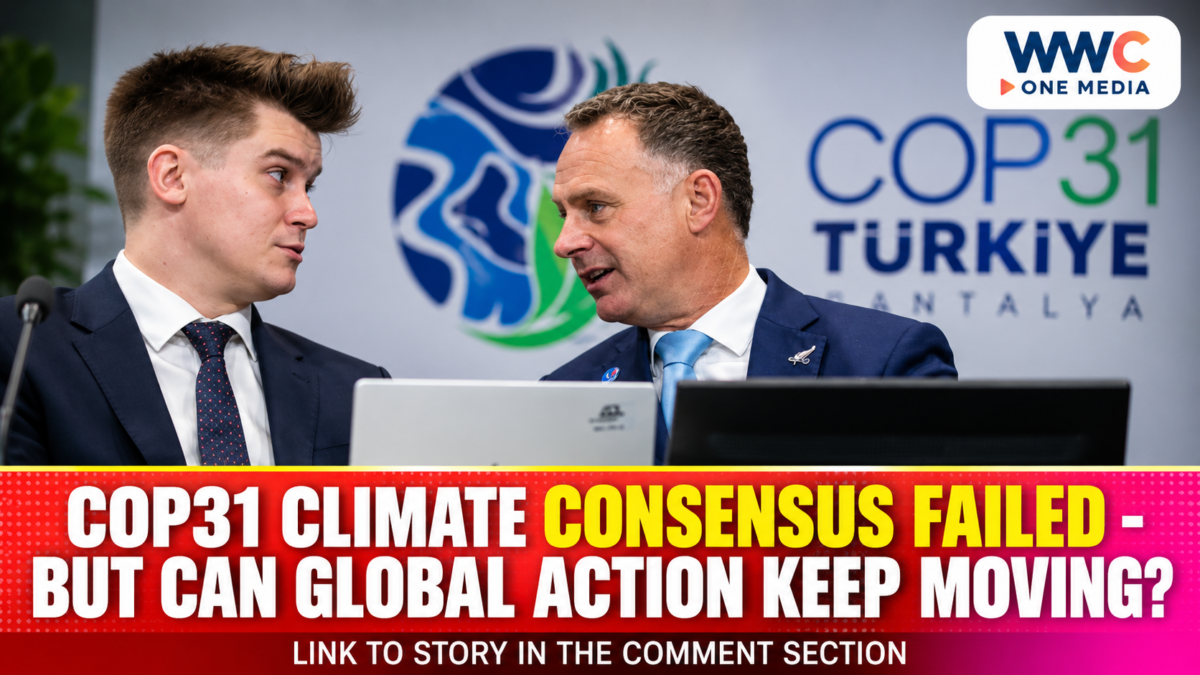
ANTALYA, Türkiye — The failure to secure an overarching climate agreement at the United Nations’ COP31 summit has exposed deep divisions among governments, but it has not brought global climate action to a standstill.
The conference concluded in Antalya on November 22, 2026, without consensus on the presidency-led political decision intended to provide a common direction for international climate action. The disagreement left major questions unresolved, particularly over the transition away from fossil fuels, climate finance and the level of ambition required to address global warming.
Yet the summit produced separate agreements on just transition, climate finance and adaptation. Outside the formal negotiations, governments, cities and businesses also advanced initiatives involving electricity networks, renewable energy, transport and industrial electrification.
The result is a divided picture: international climate diplomacy suffered a setback, while practical efforts to change how economies produce and use energy continued.
The question now is whether those initiatives can maintain momentum without the stronger political consensus that governments had hoped to secure.
COP31 Failed to Deliver Its Overarching Climate Deal
COP31 brought nearly 200 governments together in Antalya to negotiate the next steps in implementing the Paris Agreement and responding to the climate crisis.
The central political problem emerged during negotiations over the presidency-led cover decision, also associated with the proposed Antalya Pact.
Countries could not agree on the final text. The disagreement included whether the outcome should provide a stronger direction on moving away from fossil fuels and how the international response should address the scale of climate finance and emissions reductions required.
The United Nations climate process operates through consensus. That means a proposed decision can fail even when a large number of countries support it, if participating governments cannot agree on the final wording.
The failure did not cancel the Paris Agreement or remove commitments adopted at earlier climate conferences. It meant that COP31 could not secure a new overarching political decision to address the unresolved issues.
The distinction matters. The summit did not produce the comprehensive agreement many governments wanted, but it also did not end international cooperation on climate change.
Climate Science Is Moving Faster Than Political Agreement
The diplomatic setback comes as the scientific evidence continues to point to rising climate risks.
The World Meteorological Organization’s State of the Climate Update 2026 reported that the global average surface temperature from January to September was approximately 1.47°C above the 1850–1900 pre-industrial average.
The WMO expects 2026 to be one of the four warmest years on record. It also reported that the past 12 years, from 2015 to 2026, are set to be the warmest 12-year period recorded.
The agency highlighted record-high global mean sea levels and ocean heat, alongside the growing influence of a strengthening El Niño.
El Niño is expected to increase the risk of extreme heat, drought and heavy rainfall well into 2027.
These findings do not mean that every location will experience the same effects or that a single year’s temperature determines whether the Paris Agreement’s long-term temperature goals have been reached. They do show why governments face growing pressure to reduce emissions while preparing communities for climate impacts that are already occurring.
The gap between scientific urgency and political agreement remains one of the central challenges of international climate policy.
The Progress That Continued Despite the Deadlock
Although COP31 failed to agree on its overarching political decision, negotiations continued in several areas.
Governments agreed to extend the United Arab Emirates Just Transition Work Programme for another three years, with strengthened arrangements for its work.
A just transition addresses how countries can move towards lower-emission economies while considering workers, communities, livelihoods and economic development. It recognises that the costs and benefits of changing energy systems are not distributed equally.
The conference also advanced climate-finance discussions, including efforts to improve access to funding for adaptation and support climate-resilient development.
These areas matter because lower-emission development requires more than targets. Countries need financing, technology, infrastructure and institutions capable of turning commitments into projects.
The summit’s separate decisions did not resolve every dispute. They did, however, preserve work programmes and negotiating channels that governments can continue developing after Antalya.
Businesses and Cities Are Building Another Climate-Action Track
One of the clearest signs that climate action can continue beyond diplomatic negotiations came through COP31’s Global Climate Action Agenda.
The UN climate body reported that the conference’s Electrification Delivery Package involved more than 150 countries plus the European Union, 37 cities and more than 260 businesses across six continents.
The initiatives covered electricity access, power grids, renewable energy, transport and industrial electrification.
The package also highlighted more than 21,000 kilometres of grid deployment reported by members of the Utilities for Net Zero Alliance in 2025. The alliance announced combined annual investment plans of at least US$156 billion across grids, renewables and storage.
These figures are important because electrification depends on reliable infrastructure. Electric vehicles, industrial equipment and other technologies cannot deliver their full potential without sufficient electricity supply, modern transmission networks and storage capacity.
The wider initiative includes a goal of raising the global electrification rate to 35% by 2035.
The target is not a completed result. It is a shared ambition that requires investment, policy support and implementation by governments and businesses.
For more context on the negotiations that failed and the separate agreements that survived, WWC previously examined what countries actually agreed on at COP31.
The 2026 Climate Action Record Shows Both Progress and Gaps
The United Nations’ 2026 Yearbook of Global Climate Action provides another way to assess progress outside formal negotiations.
The yearbook reports progress across 44 global indicators aligned with the first global stocktake under the Paris Agreement.
It identifies increasing renewable energy capacity, slowing deforestation and growth in several adaptation measures. It also highlights continuing gaps, including oil and gas methane emissions and food loss.
The report draws on 83 Cooperative Climate Initiatives that submitted more than 200 actions. It also found that 84% of Plans to Accelerate Solutions reported progress after one year of implementation.
These indicators demonstrate that governments are not the only actors influencing the climate transition. Cities, businesses, investors and civil society groups can implement projects, change infrastructure and support lower-emission technologies.
However, voluntary initiatives have limits. Announced investments are not necessarily completed projects, and reported progress does not replace the need for stronger national policies and international agreements.
The distinction between a commitment and a measurable result remains essential.
WWC has also examined how the Philippines’ climate partnership with international networks is intended to help local governments develop projects. The broader issue is relevant across countries: national climate targets must eventually translate into funded local infrastructure, services and measurable outcomes.
Why the 1.5°C Goal Still Matters
The Paris Agreement established the objective of holding the increase in global average temperature to well below 2°C above pre-industrial levels while pursuing efforts to limit the increase to 1.5°C.
The prospect of temporarily exceeding 1.5°C has become a major concern in climate negotiations.
A temporary overshoot does not automatically mean the Paris Agreement has been abandoned. But higher temperatures increase risks, and returning global temperatures to lower levels would require substantial emissions reductions and additional action.
The challenge is not only to expand renewable energy. Governments also need to address fossil-fuel dependence, industrial emissions, transport, land use and the financing required for vulnerable communities.
WWC’s earlier analysis of the 1.5°C overshoot challenge and the emissions cuts required explains why implementation is becoming more urgent as the world moves further from the desired temperature pathway.
What Happens Next?
The next major international climate conference is COP32, scheduled for 2027 in Addis Ababa, Ethiopia.
Before then, governments and institutions must continue work on the decisions reached in Antalya while addressing the disagreements that prevented a broader agreement.
The immediate tests will include whether climate-finance commitments become accessible funding, whether electrification initiatives attract the necessary investment, and whether governments can strengthen their emissions policies.
Cities and businesses can help maintain momentum, but their actions cannot substitute for national commitments or international cooperation.
COP31 demonstrated both the strengths and weaknesses of the current climate process. Consensus remains difficult when countries have different energy systems, economic priorities and expectations of financial support.
But the failure to agree on one overarching decision does not erase the work already underway.
The real measure of climate momentum will be whether the initiatives announced in Antalya produce lower emissions, stronger infrastructure and better protection for communities before the next summit begins.
Frequently Asked Questions
Did COP31 fail to reach a climate agreement?
COP31 ended without consensus on its presidency-led cover decision. However, countries reached separate agreements on issues including just transition, climate finance and adaptation.
Does the COP31 outcome cancel the Paris Agreement?
No. The Paris Agreement remains in force, and previously agreed commitments continue to apply.
What was the main disagreement at COP31?
Countries failed to agree on the overarching political decision. Disputes included the transition away from fossil fuels, climate ambition and climate finance.
Did climate action continue outside the negotiations?
Yes. The UN climate body reported initiatives involving more than 150 countries plus the European Union, 37 cities and more than 260 businesses through the COP31 Electrification Delivery Package.
What is the 35-by-35 electrification goal?
It is an initiative to raise the global electrification rate to 35% by 2035. Achieving it will require investment in electricity networks, clean power, storage and electrified technologies.
When is COP32?
COP32 is scheduled for 2027 in Addis Ababa, Ethiopia.