
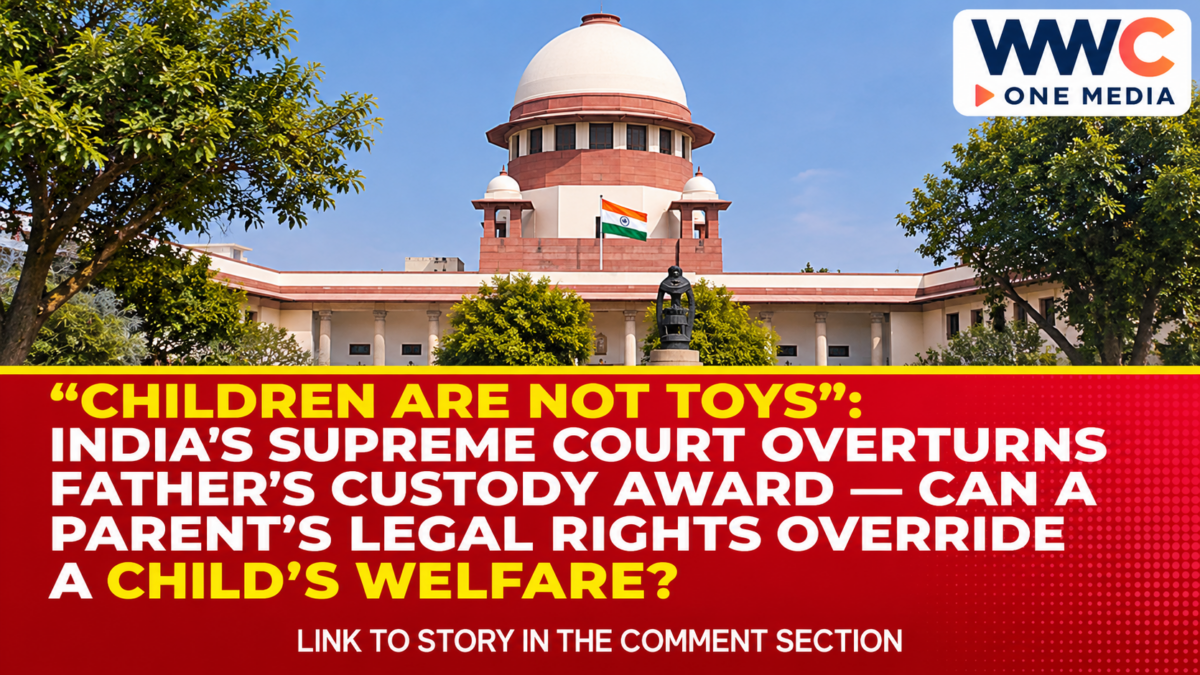
NEW DELHI, INDIA — India’s Supreme Court has overturned a lower court decision awarding custody of two teenage boys to their father, reaffirming that children’s welfare, emotional security and personal preferences must take precedence over competing parental claims.
In its Nov. 23, 2026 judgment, the court allowed the brothers, aged 16 and 14, to continue living with their mother while establishing arrangements for regular contact with their father.
The ruling was delivered by Justices Vikram Nath and Aparesh Kumar Singh.
The decision addresses a fundamental question in family law: should parental entitlement determine where a child lives, or should courts prioritise the circumstances most conducive to the child’s development?
The Supreme Court made its position clear.
“It is often said that children are not mere chattels, nor are they toys for their parents.”
India Child Custody Ruling Places Children’s Welfare First
The dispute followed the parents’ separation in 2014 and the subsequent dissolution of their marriage in 2018.
A family court in Madurai awarded custody of the children to their father on Nov. 19, 2018. The Madras High Court subsequently upheld that decision.
However, the children continued living with their mother throughout the proceedings.
The Supreme Court granted an interim stay of the High Court judgment on Jan. 24, 2025, before ultimately deciding the mother’s appeal.
The latest ruling establishes that a parent’s legal eligibility to assume custody does not necessarily determine whether transferring a child into that parent’s care would serve the child’s best interests.
The court examined the children’s existing living arrangements, educational circumstances, emotional relationships and expressed preferences.
Its decision prioritised their overall well-being rather than treating custody as an entitlement awarded solely on the basis of parental status.
Supreme Court Listens to the Children Without Their Parents Present
An important aspect of the proceedings was the judges’ decision to interact directly with both children without their parents being present.
The teenagers expressed a clear preference to continue living with their mother, with whom they had developed a longstanding emotional connection.
The judges considered the brothers sufficiently mature to communicate their preferences.
Section 17(3) of India’s Guardians and Wards Act, 1890, permits courts to consider a child’s preference when the child possesses sufficient maturity to form an informed view.
However, this does not mean that children can independently determine the outcome of every custody proceeding.
Their preferences must be evaluated alongside other circumstances affecting their welfare.
The importance of recognising children’s distinct legal needs also appears in other areas of India’s judicial system, including the separate juvenile justice framework discussed in WWC ONE MEDIA’s coverage of age-related legal protections for minors involved in criminal proceedings.
Civil custody disputes and criminal proceedings involve different laws, but both require courts to recognise that children have legal interests distinct from those of adults.
Why the Father Was Not Automatically Entitled to Custody
The Supreme Court did not find the father unfit to care for his children.
It also recognised his willingness to contribute to their upbringing and future education.
Nevertheless, the court concluded that transferring the children away from their established home environment would not sufficiently serve their interests.
The judgment explained that both parents are recognised as natural guardians under the amended Section 19(b) of the Guardians and Wards Act.
The father’s eligibility as a guardian did not eliminate the court’s responsibility to examine whether granting him physical custody would benefit the children.
The distinction is significant.
A decision allowing children to remain with one parent does not automatically establish that the other parent is incapable of providing appropriate care.
The ruling was based on the particular circumstances of the brothers rather than a universal preference for mothers over fathers.
Children’s Emotional Security and Education Remain Central
The Supreme Court emphasised that custody decisions involve more than determining where children will physically reside.
Their health, education, emotional relationships and broader development must also receive consideration.
In assessing the present dispute, the judges found that the mother had adequately supported the children’s upbringing and education over the years.
The court concluded that removing the brothers from their familiar environment could adversely affect their well-being.
The decision reinforces an established legal principle that material resources alone cannot determine the most suitable custody arrangement.
This broader understanding of children’s welfare also informs efforts to improve awareness of legal protections, including community programmes educating families about children’s rights.
For family courts, evaluating a child’s circumstances requires attention to both practical needs and personal relationships.
Supreme Court Preserves Father’s Visitation Rights
Although the Supreme Court allowed the brothers to remain with their mother, it also recognised the importance of maintaining a meaningful relationship with their father.
The judges acknowledged the father’s concerns regarding his limited contact with the children despite previous judicial orders.
The court established regular monthly visitation arrangements, additional opportunities during specified school and festival holidays, and an obligation for the mother to facilitate the visits.
The father was also directed to be prepared to share future educational expenses if requested by the mother.
These arrangements demonstrate that physical custody and continuing parental involvement are distinct matters.
The court’s objective was not to remove the father from the children’s lives but to protect their existing living arrangements while creating opportunities to develop their relationship with him.
Specific visitation arrangements in this judgment apply to the family involved and should not be interpreted as a mandatory schedule for unrelated custody cases.
Child Protection Extends Beyond Custody Decisions
The judgment also highlights why discussions involving children should avoid unnecessary public speculation about private family circumstances.
The legal findings concern the children’s welfare and the arrangements necessary to support their development.
Public reporting does not require publishing their names, photographs, school details or precise residential information.
WWC ONE MEDIA has applied similar privacy-conscious reporting principles in its coverage of child protection and welfare procedures following an incident in Ameenpur, India.
That incident involved different circumstances and legal procedures. Its relevance is the broader importance of protecting children’s identities while accurately explaining matters of public interest.
For international audiences, India’s custody ruling reinforces the distinction between children’s rights and disputes concerning the legal interests of adults.
The precise application of family law nevertheless varies across jurisdictions.
What Happens Next Following the Supreme Court Judgment?
The Supreme Court has allowed the mother’s appeal and set aside the challenged High Court judgment.
The children will remain in their mother’s custody under the arrangements established by the court.
The next stage involves implementing the visitation provisions and maintaining appropriate cooperation concerning the children’s education and development.
The judgment does not introduce a new custody statute or automatically reverse previous custody awards in unrelated cases.
Instead, it reinforces existing judicial principles requiring courts to assess the individual circumstances of children affected by family disputes.
The central message remains that custody proceedings are not simply contests between parents. Their primary purpose is to protect the interests of the children whose lives will be affected by the outcome.
Frequently Asked Questions
What did India’s Supreme Court decide in the November 2026 custody case?
The Supreme Court allowed two teenage boys to remain with their mother and overturned the challenged judgment granting custody to their father.
Can a child express a preference about which parent to live with in India?
Yes. Section 17(3) of the Guardians and Wards Act allows courts to consider the preferences of children who possess sufficient maturity.
Did the Supreme Court find the father unfit?
No. The judgment expressly recognised that the father had not been found unfit to have custody of his children.
Does the father retain visitation rights?
Yes. The Supreme Court established regular visitation arrangements and additional opportunities for contact during specified holidays.
Does this judgment mean mothers automatically receive custody?
No. The decision reinforces the principle that custody must be determined by the child’s welfare and the circumstances of each case.










