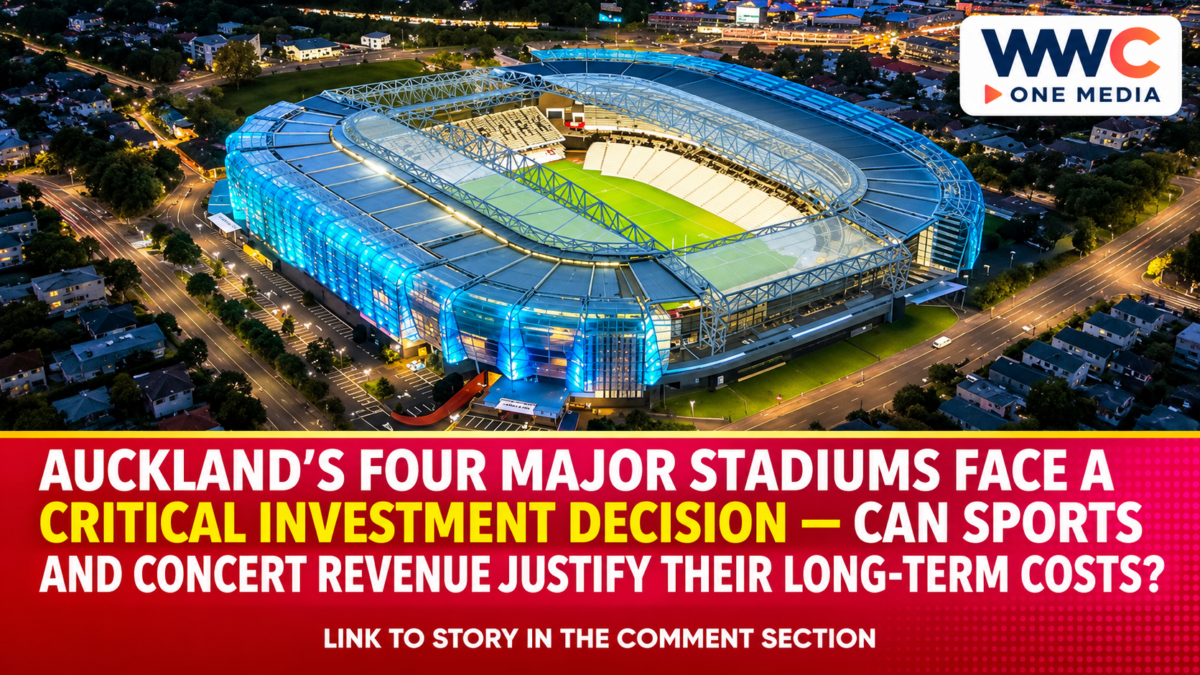
AUCKLAND, NEW ZEALAND — Auckland faces a significant infrastructure investment challenge as the city works to maintain its major stadiums while strengthening its position as an international destination for sporting competitions, concerts and cultural events.
Auckland Council’s stadium investment strategy seeks to coordinate the development and operation of Eden Park, Go Media Stadium, North Harbour Stadium and Western Springs Bowl, with each venue serving a distinct purpose within the region’s entertainment network.
The challenge extends beyond repairing ageing facilities. Auckland must balance infrastructure expenditure, commercial opportunities, community access and the financial interests of ratepayers.
With major international events capable of generating millions of dollars in economic activity, the question is whether a more coordinated stadium network can deliver sufficient long-term public value.
Auckland Stadium Investment Faces Growing Financial Challenges
In March 2025, Auckland Council identified NZ$150 million in operating and maintenance costs associated with its existing stadium network as part of discussions surrounding a regional investment framework.
Councillors also endorsed the staged redevelopment of Eden Park in principle, identifying the existing national stadium as the most feasible option for Auckland’s principal sporting venue.
At the time, the council stated that it had no plans to provide ratepayer funding for the proposed Eden Park redevelopment.
The distinction between maintaining existing infrastructure and financing major redevelopment projects remains important.
Maintenance and asset renewal generally involve preserving the functionality of facilities, while redevelopment can include substantial changes to capacity, design and commercial capabilities.
A stadium investment strategy must account for both requirements without assuming that funding for one automatically covers the other.
Four Stadiums, Four Different Roles
Auckland’s major stadium network includes four venues with different sporting and entertainment functions.
Eden Park serves as New Zealand’s national stadium and has a capacity of approximately 50,000 spectators.
Go Media Stadium hosts professional sporting competitions and entertainment events, including Auckland FC football fixtures and rugby league matches.
North Harbour Stadium, located in Albany, serves Auckland’s northern communities and provides facilities for rugby, football and other activities.
Western Springs Bowl combines outdoor entertainment, music festivals, sporting activities and community use within its natural amphitheatre.
Coordinating these facilities could help Auckland avoid unnecessary duplication of infrastructure and provide event organisers with venues suited to different audience sizes and production requirements.
The importance of flexible entertainment infrastructure has also featured in WWC ONE MEDIA’s coverage of Singapore EXPO’s expansion into large-scale concert facilities.
Eden Park Opens the Door to More International Concerts
New Zealand’s government announced significant changes to Eden Park’s planning restrictions on Feb. 16, 2026, intended to expand the stadium’s ability to accommodate major entertainment events.
Under the announced arrangements, Eden Park can host up to 12 large concerts and 20 medium-sized concerts annually as permitted activities without requiring separate resource consent.
The changes also accommodate a broader range of exhibitions, markets, trade fairs and community events.
Expanding the number of permitted events could improve the stadium’s commercial opportunities by allowing organisers greater flexibility when planning international tours.
However, regulatory permission does not guarantee that every available concert date will attract a promoter or generate sufficient revenue.
The government reported that 14 Auckland concerts over three years generated NZ$33.7 million in local economic activity and attracted approximately 490,000 attendees.
Such figures demonstrate the broader commercial opportunities associated with major entertainment events, although regional economic activity should not be confused with stadium operating profits.
North Harbour Stadium Faces Questions Over Long-Term Utilisation
North Harbour Stadium presents a different infrastructure challenge.
During consultation on Auckland’s Long-term Plan 2024–2034, the council identified the main stadium as the least-utilised facility in its regional outdoor stadium network.
Low attendance and substantial operating and renewal expenses were among the factors prompting a review of its future.
One option presented during that consultation involved NZ$33 million in essential renewals over a decade to preserve existing service levels.
Alternative proposals considered redevelopment, operational changes and improvements to community access.
That historical NZ$33-million estimate should not be interpreted as the latest confirmed funding allocation.
The broader financial question is whether public infrastructure delivers sufficient benefits relative to its maintenance and operating costs.
Similar questions surrounding public assets and competing infrastructure priorities have been explored in WWC ONE MEDIA’s reporting on Christchurch’s potential sale of its publicly owned fibre broadband network.
Western Springs Concerts Generate NZ$10 Million in Economic Activity
Western Springs provides an example of how entertainment events can contribute to Auckland’s wider economy.
On March 20, 2026, Tātaki Auckland Unlimited reported that two major summer music events generated an estimated NZ$10 million in regional economic activity.
The February 2026 Laneway Festival attracted more than 36,000 attendees, with almost half travelling from outside Auckland.
The operator estimated that festival visitors generated 49,680 visitor nights, while individual visitors spent an average of NZ$470 during their stay.
A separate Rüfüs Du Sol concert attracted more than 25,000 ticket buyers and generated an estimated 18,689 visitor nights.
On March 31, Auckland Council endorsed the revised Western Springs Bowl concept, including investment of up to NZ$2.5 million from existing Tātaki Auckland Unlimited budgets.
The investment is intended to improve the venue’s ability to accommodate concerts, festivals, boutique sporting events and community activities.
However, the reported economic benefits from concerts represent activity across the wider region, rather than income retained exclusively by the stadium operator.
NZ$10 Million Committed to a New Domestic Cricket Home
Auckland’s stadium strategy also involves reorganising the facilities used by its major sporting organisations.
In April 2026, Auckland Council, the Crown, Eden Park, Auckland Cricket and Auckland Rugby Union signed a Foundation Agreement establishing a pathway towards more suitable long-term sporting facilities.
The agreement followed a regional development announcement that included NZ$5 million each from Auckland Council and the Crown, providing NZ$10 million towards developing Colin Maiden Park as Auckland’s new domestic cricket home.
The initiative aims to improve the allocation of sporting facilities while reinforcing Eden Park’s national stadium role.
Across the Asia-Pacific, governments and venue operators face similar questions about how sporting infrastructure can accommodate multiple activities efficiently.
WWC ONE MEDIA previously examined this issue through its coverage of Nagoya’s IG Arena and its role in hosting international sporting events.
What Happens Next for Auckland’s Stadium Network?
Future stadium investment decisions will require detailed assessments of infrastructure condition, maintenance requirements, expected commercial income and community benefits.
Auckland must also consider whether greater coordination between venues could improve scheduling, reduce unnecessary operating expenses and attract additional international events.
Concert ticket sales and visitor spending offer economic opportunities, but these benefits must be evaluated alongside the long-term cost of maintaining public infrastructure.
The city’s stadium strategy ultimately presents a public investment question: how can Auckland maintain internationally competitive venues without imposing disproportionate financial burdens on residents?
Frequently Asked Questions
What are Auckland’s four major stadiums?
Eden Park, Go Media Stadium, North Harbour Stadium and Western Springs Bowl form Auckland’s major stadium network.
How many concerts can Eden Park accommodate annually under the announced rules?
The government announced provisions allowing up to 12 large concerts and 20 medium-sized concerts annually as permitted activities.
How much economic activity did Western Springs summer concerts generate?
Tātaki Auckland Unlimited estimated that two major summer music events generated NZ$10 million in regional economic activity.
How much investment was approved for Western Springs Bowl?
Auckland Council endorsed a concept involving up to NZ$2.5 million from existing Tātaki Auckland Unlimited budgets.
How much funding has been committed to Colin Maiden Park?
Auckland Council and the Crown committed a combined NZ$10 million towards developing the facility as Auckland’s new domestic cricket home.