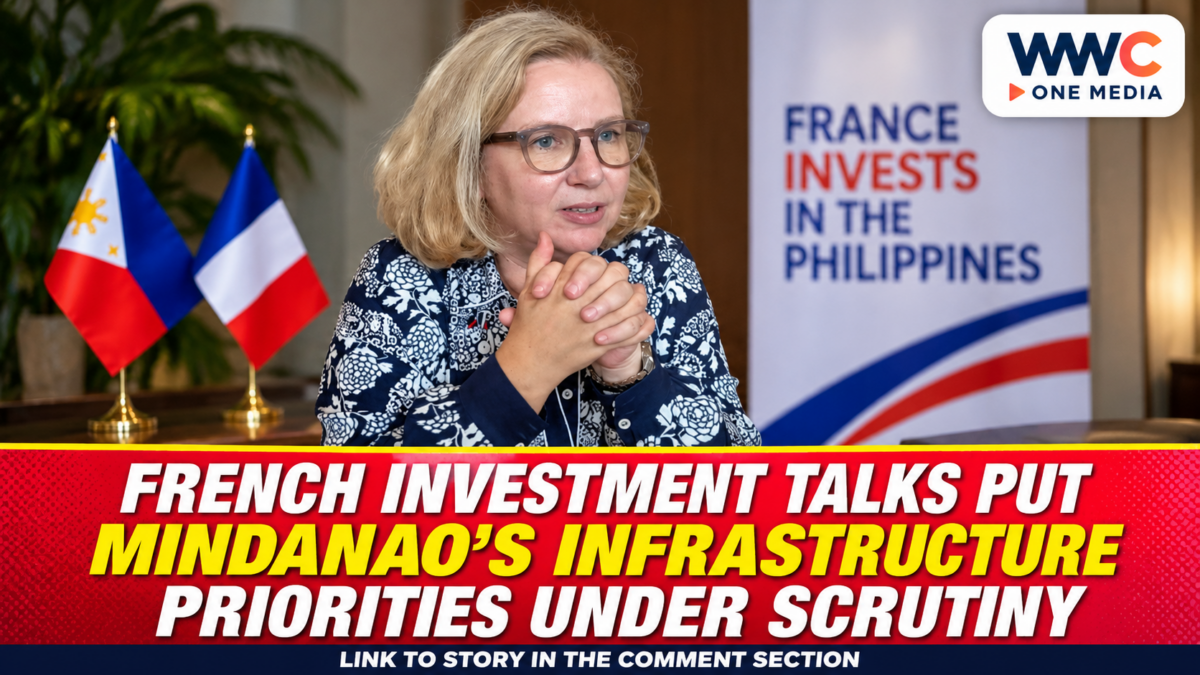
French investment discussions involving Mindanao’s development priorities have brought infrastructure, transport, agriculture and energy back into focus, following a visit by the French ambassador and representatives of French companies to Davao. The discussions come as a major French-supported farm-to-market bridge programme moves through the Philippine government’s procurement process.
The distinction matters: the visit signals interest in possible cooperation, not confirmation that new projects have been financed or that companies have committed fresh capital to Mindanao. However, a separate Department of Agriculture procurement notice shows that one French company has already received an award for a nationwide bridge project worth more than ₱20.5 billion.
The next question is whether the latest discussions can connect foreign technical expertise and financing with projects that are sufficiently prepared, approved and supported by local requirements. For Mindanao, the value of the engagement will ultimately depend on implementation, not the number of investment opportunities presented.
What the French delegation’s discussions covered
The Embassy of France to the Philippines and Micronesia publicly described a meeting in Davao between Ambassador Donatienne Hissard, Mindanao Development Authority (MinDA) Chairperson and Secretary Leo Tereso Magno, and representatives of French companies.
The embassy said the discussions explored potential cooperation in agriculture, transport, energy and infrastructure, including opportunities for French companies to contribute expertise to Mindanao’s development. Its statement described the engagement as part of efforts to deepen economic ties and explore opportunities for French and Filipino businesses.
That is a broad agenda, but each sector has different requirements. Transport projects need technical studies, right-of-way arrangements and coordination with implementing agencies. Energy proposals must address generation, grid connections, permits and financing. Agricultural investments need to consider production capacity, processing facilities, logistics and access to markets.
For MinDA, the challenge is to help translate regional priorities into proposals that companies can properly assess. For prospective investors, the challenge is determining whether a project has a workable commercial and regulatory structure.
A French-backed bridge programme has moved beyond the discussion stage
One concrete example of French-Philippine economic cooperation is the Farm-to-Market Bridges Development Program, which is being implemented through the Department of Agriculture.
The department announced in June 2025 that the Economy and Development Council had approved a ₱27.7-billion programme to build 300 modular steel panel bridges across the country. The programme is financed through official development assistance from the Government of France and is intended to improve rural connectivity between farming communities and markets.
The procurement record provides a more recent milestone. In a notice dated October 28, 2026, the Department of Agriculture said the contract for the design, supply and construction of the 300 bridges had been awarded to MATIÈRE SAS.
The notice listed an award amount of ₱20,558,265,017.22, equivalent to €324,777,684.14. This is the value stated in the procurement award; it should not be confused with the programme’s separately announced total cost.
The bridge programme is significant because weak rural connectivity can raise the cost and difficulty of moving agricultural goods. Bridges that connect farm-to-market roads with trading centres may help address physical transport barriers, although their actual benefits will depend on site selection, construction quality, maintenance and the roads connected to them.
The programme is nationwide. Its 300-bridge target should not be presented as a Mindanao-only allocation.
Why transport and logistics matter to the region
Infrastructure is not limited to large roads or railways. For agricultural producers, a bridge, an accessible road and a reliable route to a processing or trading centre can determine how easily goods reach buyers.
The Department of Agriculture’s programme was designed around this connection. Its announcement said the 300 bridges would be distributed across 52 provinces in 15 regions, with sites selected from proposals submitted by local government units.
For Mindanao, the broader issue is how transport links can support agricultural production and industrial activity. A region may have strong agricultural resources, but businesses still need dependable routes to move raw materials, finished products, machinery and workers.
This is also why infrastructure discussions should be assessed alongside the wider development pipeline. WWC previously examined the Department of Energy’s planned additional power capacity for Mindanao, illustrating how electricity supply is another part of the investment environment.
The government’s identification of production forest areas in the Davao Region for potential investment also shows the need to balance economic development with environmental safeguards and responsible land use.
Energy cooperation has an existing exploratory precedent
French-Philippine energy cooperation also has a documented history beyond the latest Davao discussions.
The National Development Company (NDC), a government-owned and controlled corporation under the Department of Trade and Industry, announced that it signed a memorandum of understanding with French company HDF Energy on December 11, 2025.
The agreement was intended to begin exploratory work on hydrogen-based power solutions in the Philippines. NDC identified areas facing significant development challenges, including communities served by the Small Power Utilities Group and Mindanao, as initial areas of focus.
An important qualification remains: an MOU for exploratory work is not the same as a completed power project. The announcement did not establish that a hydrogen facility had been financed, built or placed into commercial operation.
The distinction is particularly relevant as the region considers additional energy sources. Renewable generation, storage and transmission infrastructure must work together if new power capacity is to translate into dependable electricity for households and businesses.
WWC’s recent examination of the Philippine solar and battery-storage expansion discusses why installed capacity alone does not guarantee that electricity will be available when consumers need it.
Investment interest still has to pass through project development
The Philippines has a legal framework for private participation in infrastructure. Republic Act No. 11966, or the Public-Private Partnership Code of the Philippines, provides rules for public-private partnership projects and emphasizes value for money, public welfare, fair competition and transparency.
That framework is relevant when a proposed project moves beyond initial discussions. Depending on the project structure, it may require feasibility assessment, approvals, competitive selection, financing arrangements and a formal contract.
Not every foreign investment proposal will be a PPP. Some may involve private commercial investments, technical cooperation or official development assistance. The appropriate process depends on the project and the parties involved.
For Mindanao, the practical test is whether the discussions lead to clear project pipelines, named implementing agencies, defined responsibilities and timelines that can be monitored publicly.
It is also important to distinguish between a company exploring a market and a company committing funds. An exploratory visit can help identify opportunities and establish contacts, but it does not establish project cost, construction schedules, employment numbers or expected economic returns.
What happens next
The next milestones to watch are formal project proposals, feasibility studies, agreements with implementing agencies and publicly documented financing arrangements.
For the farm-to-market bridge programme, the procurement award to MATIÈRE SAS is a concrete step. The public will still need progress information on implementation, construction schedules, completed sites and the distribution of bridges among provinces.
For other areas discussed with French representatives, the public record should eventually show which proposals move forward and which remain under evaluation. Details such as project ownership, funding sources, local partners, regulatory approvals and implementation dates will help distinguish viable investments from preliminary interest.
The latest engagement gives Mindanao another channel to present its infrastructure and development needs to foreign businesses. Whether it produces lasting economic benefits will depend on how effectively the region turns those conversations into projects that are transparent, financially workable and useful to local communities.
Frequently asked questions
1. What sectors are being discussed for French cooperation in Mindanao?
The Embassy of France identified agriculture, transport, energy and infrastructure as areas discussed with MinDA and representatives of French companies.
2. Have French companies already committed new investments in Mindanao?
The embassy’s public statement described discussions about potential cooperation and investment opportunities. It did not announce a new investment amount or confirm that the November discussions had resulted in signed project commitments.
3. Which French company received the farm-to-market bridge contract?
The Department of Agriculture’s October 28, 2026 notice named MATIÈRE SAS as the awardee for the design, supply and construction of 300 farm-to-market bridges.
4. How much is the bridge contract worth?
The Department of Agriculture listed the award amount as ₱20,558,265,017.22, or €324,777,684.14. The department separately announced a total programme cost of ₱27.7 billion in June 2025.
5. Does the HDF Energy agreement mean Mindanao already has a hydrogen power project?
No. The National Development Company described its December 2025 MOU with HDF Energy as the beginning of exploratory work on hydrogen-based power solutions. The announcement did not confirm a completed or operating facility.