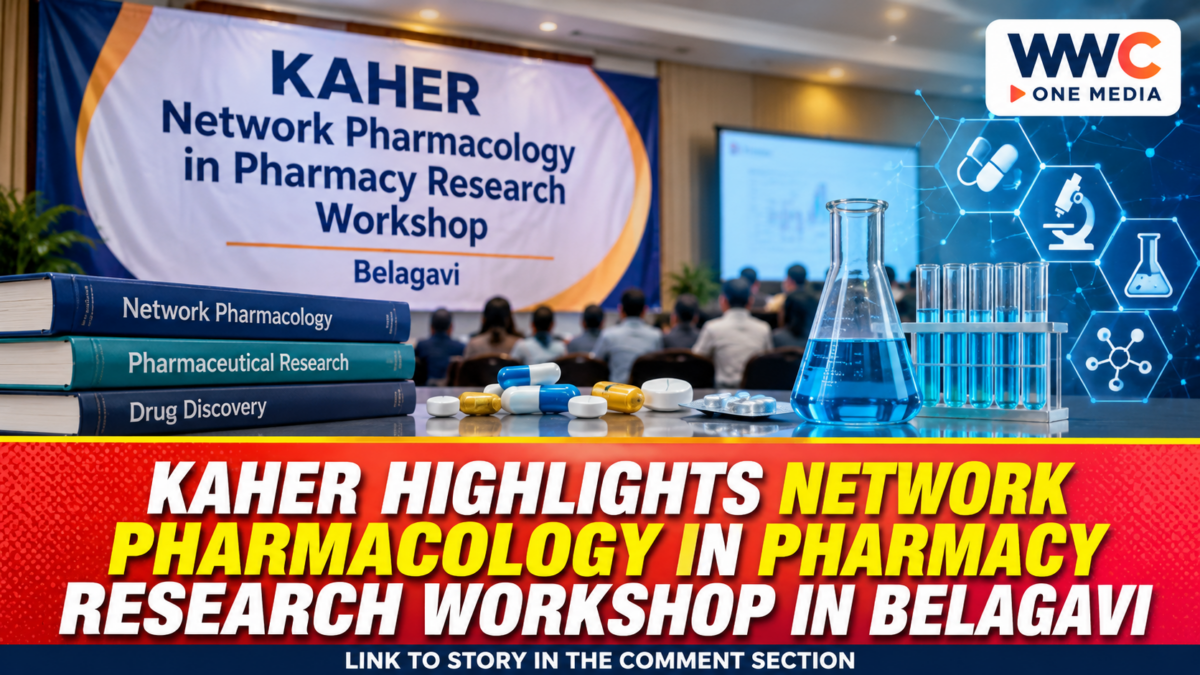
KLE Academy of Higher Education and Research (KAHER) listed a workshop on network pharmacology, molecular docking and molecular dynamics in its institutional calendar for November 18, 2026, at KLE College of Pharmacy in Belagavi, Karnataka. The entry identifies the Department of Pharmacology as the organising department, placing computational approaches to drug research among the institution’s scheduled academic activities. kaher.edu.in+1
The calendar confirms that the workshop was scheduled, but the institutional material reviewed for this report does not independently confirm that it took place or disclose attendance, speakers, training modules or participant outcomes. The distinction matters because the significance of this subject lies not simply in holding a workshop, but in how researchers use computational methods to develop and test scientific questions before moving into laboratory and clinical research.
Network pharmacology brings multiple biological targets into one research picture
Traditional drug research often examines how a particular compound interacts with a specific biological target. Network pharmacology takes a broader approach by examining relationships among compounds, proteins, biological pathways and disease-related processes.
This approach can be useful when researchers are studying complex conditions involving several biological mechanisms. Instead of asking only whether one compound interacts with one target, researchers can investigate a wider network of possible interactions and identify relationships that may deserve further testing.
KAHER’s Department of Pharmacology and Toxicology identifies network pharmacology and molecular docking among its research areas under in-silico studies. Its departmental information also describes facilities for cellular and molecular research, computational modelling and data analysis. klepharm.edu
That institutional research profile gives context to the November calendar entry. It suggests the scheduled workshop was connected to areas already identified within the department’s research interests, although the calendar does not provide a detailed syllabus or confirm which software platforms were used.
Molecular docking and molecular dynamics answer different questions
The workshop title also names two computational methods that are commonly used alongside network pharmacology.
Molecular docking is a technique used to estimate how a molecule may fit and interact with a biological target, such as a protein. Researchers use it to compare possible binding arrangements and prioritise candidates for additional investigation. A favourable computer-generated docking result, however, does not establish that a compound will work in a living organism.
Molecular dynamics simulations examine how molecular systems behave over time under a computational model. They can help researchers explore the stability and movement of molecular interactions rather than relying on a single predicted structure.
Together, these methods can help organise early-stage research. They can narrow the number of hypotheses researchers may wish to test experimentally, but they do not replace laboratory validation, safety assessment, clinical trials or regulatory review.
A published research study in the journal Plants illustrates how the three approaches can be combined. Researchers investigated compounds from Melissa officinalis using network analysis, molecular docking and molecular dynamics to examine predicted targets related to type 2 diabetes. The authors described their findings as a basis for further study, not proof that the plant or its compounds constitute an approved treatment. University of Strathclyde
KAHER’s research profile provides context for the scheduled training
KAHER’s institutional calendar identifies the Department of Pharmacology at KLE College of Pharmacy, Belagavi, as responsible for the November 18 workshop entry. The college’s official departmental profile says it was established in 1968 and is a constituent unit of KAHER. It lists undergraduate, postgraduate and doctoral study in pharmacology and toxicology, alongside research facilities and areas of investigation. kaher.edu.in+1
The department’s stated research interests include cancer pharmacology, cardiovascular pharmacology, central nervous system pharmacology and other areas. Its inclusion of computational methods within its research thrust areas provides a wider academic setting for training in network-based and molecular modelling approaches.
For pharmacy students and early-career researchers, practical familiarity with these methods may help build skills relevant to computational research and drug-development workflows. But the public calendar does not identify the intended participants or establish whether the programme was designed for undergraduate students, postgraduate students, doctoral researchers or faculty members.
Computational drug discovery still faces the evidence test
Interest in computational drug discovery has grown as biotechnology companies use software, biological datasets and predictive models to support early research. Yet the distance between a computer-generated prediction and a medicine that can be prescribed remains substantial.
WWC ONE MEDIA has examined this distinction in its report on AI-assisted drug design and the evidence needed before research can produce a medicine. The central issue is that computational predictions must be tested through reproducible experiments and, where appropriate, the stages of clinical development.
The same caution applies to network pharmacology. A network may identify a possible relationship between a compound and a disease-associated pathway, but that prediction alone cannot establish effectiveness, dosage, safety or patient benefit.
The commercial biotechnology sector faces similar hurdles. WWC’s coverage of a clinical-stage biotechnology company raising capital for experimental treatments examines why funding and scientific promise do not remove the need for clinical evidence and regulatory approval.
Why pharmaceutical research skills matter beyond the laboratory
Research methods are part of a larger pharmaceutical ecosystem that includes universities, laboratories, biotechnology companies, manufacturers, regulators and healthcare providers. Skills in computational modelling may support early discovery work, but research must still be connected to experimental facilities, quality systems, trained personnel and appropriate oversight.
India’s pharmaceutical sector also has an international dimension. WWC has previously covered regional cooperation involving India’s pharmaceutical products and medical technology. That broader relationship concerns access, supply and cooperation rather than this particular KAHER workshop, but it highlights why research capacity and dependable pharmaceutical systems are important across the region.
For institutions, the challenge is to ensure that technical training develops into sound research practice. That includes choosing appropriate datasets, documenting computational methods, recognising limitations and validating predictions before making claims about potential medicines.
What happens next
The next information needed from KAHER is confirmation of whether the November 18 workshop was held, together with any post-event report identifying the resource persons, participant groups, practical exercises and tools covered.
Those details would help establish the programme’s actual scope and educational outcomes. Without them, the public record supports reporting the scheduled activity and the department’s wider research interests, but not claims about the workshop’s attendance, success or impact.
For now, the institutional calendar provides a clear indication that network pharmacology, molecular docking and molecular dynamics were included in KAHER’s scheduled pharmacy research activities. Their value will ultimately depend on how researchers apply the methods, validate their findings and connect computational predictions with evidence from experiments.
Frequently asked questions
1. What is network pharmacology?
Network pharmacology is a research approach that examines relationships among compounds, biological targets and disease-related pathways, rather than focusing only on one compound and one target.
2. What is molecular docking used for?
Molecular docking is a computational method used to estimate how a molecule may interact with a biological target, often to help prioritise candidates for further research.
3. What is molecular dynamics in drug research?
Molecular dynamics uses computer simulations to study how atoms and molecules move and interact over time under a defined model.
4. Did KAHER hold the workshop on November 18, 2026?
KAHER’s institutional calendar listed the workshop for that date. The official material reviewed for this report does not independently confirm that it was completed.
5. Do computational drug-discovery results prove that a medicine works?
No. Computational predictions are early research evidence. Potential medicines require further experimental testing, safety assessment and, where applicable, clinical trials and regulatory review.