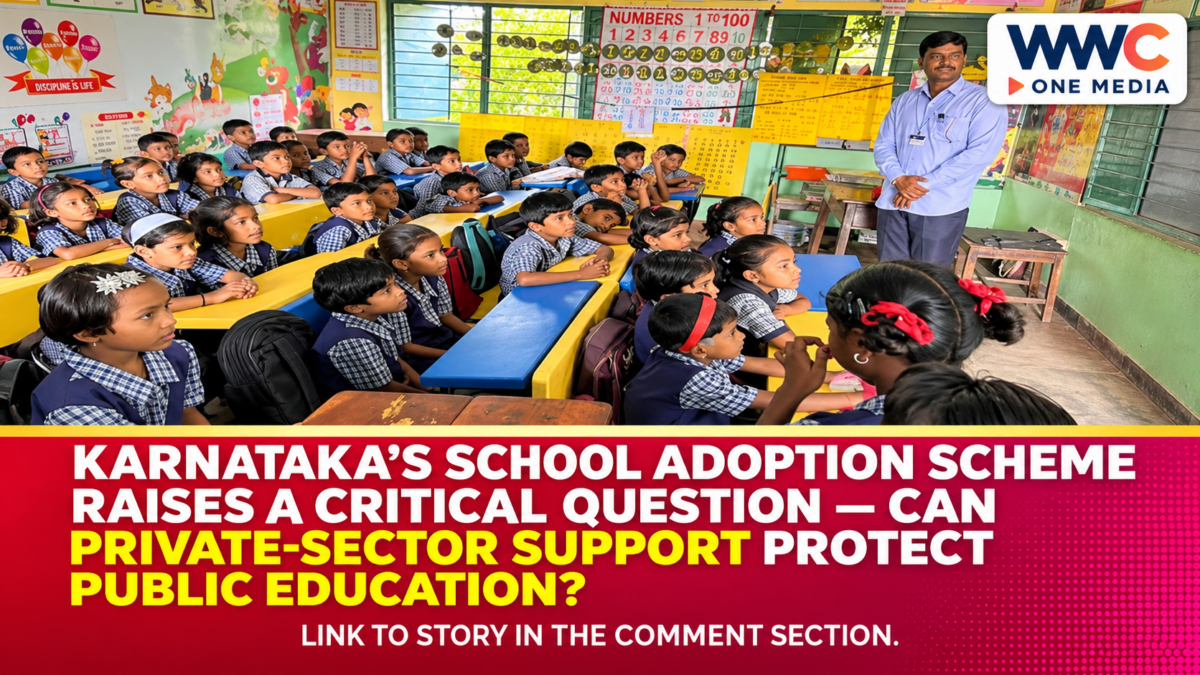
BENGALURU, INDIA — The debate surrounding private-sector participation in Karnataka’s government schools raises a fundamental question about the future of public education: can corporate and institutional partnerships improve learning opportunities without weakening the government’s responsibilities?
The issue comes against the backdrop of a major international financing commitment to strengthen Karnataka’s public education system.
On July 1, 2026, the Asian Development Bank (ADB) announced the approval of a US$182.89-million loan, in Japanese yen equivalent, to support educational improvements benefiting more than one million students.
While additional financial resources could help address infrastructure and learning challenges, the structure of public-private partnerships requires careful examination to ensure that children’s educational rights remain protected.
Karnataka school adoption scheme: Where should government responsibility end?
School adoption arrangements can involve private organisations contributing resources, equipment, infrastructure, technical expertise or professional support to government institutions.
Such partnerships could potentially help schools acquire facilities and learning materials that would otherwise require additional public expenditure.
However, providing assistance to a government school is fundamentally different from acquiring authority over its administration.
Any arrangement involving private participation should clearly establish who controls admissions, educational standards, staffing decisions and the management of public assets.
Corporate participation could complement government spending, but it should not automatically replace existing public funding obligations.
This distinction is especially important when assistance is provided through corporate social responsibility programmes, which may operate according to particular funding cycles and organisational priorities.
A sustainable education partnership requires long-term commitments rather than improvements that disappear when sponsorship arrangements conclude.
India’s Right to Education Act establishes government obligations
India’s Right of Children to Free and Compulsory Education Act, 2009, establishes educational entitlements for children between six and 14 years of age.
Section 7 assigns funding responsibilities to both the central and state governments.
Section 8 establishes government duties relating to educational access, infrastructure, staffing and learning standards.
These provisions are central to evaluating any initiative that increases private-sector involvement in government schools.
Financial contributions from businesses or other educational institutions do not, by themselves, remove statutory government responsibilities.
The broader policy question is whether partnership agreements can introduce additional resources while maintaining the educational protections established under national law.
Transparent agreements could help prevent uncertainty concerning responsibility for recurring expenses, infrastructure maintenance and the continued provision of accessible education.
Karnataka’s US$182.89-million education investment
Karnataka’s public school transformation efforts extend beyond discussions about private-sector adoption.
The Strengthening Karnataka Public Schools Program, supported by ADB financing, aims to establish 500 integrated public school clusters.
The programme will connect educational provision across pre-primary and secondary levels while strengthening teaching capabilities, school administration and learning assessment.
Additional priorities include science, technology, engineering, arts and mathematics education, alongside employment-related skills development.
The financing package is complemented by a US$10-million grant and a US$25-million guarantee from the International Finance Facility for Education.
These financial instruments serve different purposes. A loan creates repayment obligations, a grant provides financial assistance without equivalent repayment requirements, and a guarantee supports financing by addressing specified financial risks.
The ADB-supported programme is separate from the disputed school adoption initiative. Its financial commitments should not be presented as the budget of that scheme.
The existence of this substantial public education investment also raises an important policy question: how can Karnataka coordinate its government-funded improvements with additional assistance from private organisations?
Parents must retain a meaningful role in school management
An essential consideration in public education reform is the involvement of families in decisions affecting their children’s learning environment.
Section 21 of India’s Right to Education Act establishes a framework for school management committees in applicable schools.
For government schools covered by the provision, parents or guardians must account for at least three-quarters of committee membership, with women representing half of committee members.
The committees have responsibilities involving school monitoring, development planning and oversight of financial grants.
These provisions provide an important mechanism for community participation.
Any school adoption arrangement should clarify how private-sector representatives interact with existing school management committees.
For example, a business providing classroom equipment should not automatically acquire decision-making authority over curriculum development or student admissions.
Maintaining clearly defined responsibilities could help ensure that external assistance supports community priorities rather than displacing them.
Infrastructure improvements must translate into better learning
School development cannot be measured exclusively through the number of new classrooms, computers or renovated buildings.
Physical infrastructure matters, but students also require effective teaching, safe learning environments and appropriate educational support.
The relationship between school facilities and student welfare is examined in WWC ONE MEDIA’s coverage of clean water, sanitation and essential school infrastructure.
Corporate education programmes can also contribute material resources and institutional support, as explored in McDonald’s education partnerships and classroom furniture initiatives.
However, the effectiveness of individual partnerships should be assessed against measurable educational outcomes rather than publicity or the initial value of donations alone.
School attendance, student achievement, teacher availability and the continued usability of donated facilities could provide more meaningful indicators of success.
Why educational safeguards matter across Asian economies
Education systems across Asia are considering different approaches to improving teaching quality, strengthening institutional capacity and preparing students for changing economic conditions.
These reforms include reviewing classroom structures and teacher responsibilities, as illustrated by Singapore’s pilot programme for smaller classes and redesigned teaching roles.
For Karnataka, the central consideration is whether additional private-sector resources can support improvements without creating unequal opportunities between schools.
A school located near a major commercial centre might attract potential sponsors more easily than an institution in a remote rural community.
Without appropriate safeguards, differences in sponsorship availability could produce uneven development.
A transparent allocation framework could help direct additional resources towards schools with the greatest educational needs rather than those with the strongest commercial connections.
What happens next for Karnataka’s public education system?
The long-term effectiveness of school adoption arrangements will depend on their detailed implementation framework.
Important considerations include the duration of partnerships, ownership of donated assets, financial accountability, parental participation and the protection of existing educational entitlements.
Clear public reporting could also help communities distinguish between announced commitments and improvements that have actually been delivered.
For Karnataka, private participation offers potential opportunities to expand educational resources, but meaningful reform requires more than attracting external funding.
The decisive question is whether such partnerships can strengthen public education while preserving its accessibility, accountability and long-term financial sustainability.
Frequently asked questions
What is the Karnataka school adoption scheme?
School adoption generally involves external institutions supporting the development of government schools. Karnataka’s precise implementation terms require confirmation through its official programme documents.
Does school adoption automatically mean privatisation?
No. Financial or infrastructure assistance does not necessarily transfer school ownership or management authority. The actual legal and administrative arrangements determine the extent of private involvement.
What is India’s Right to Education Act?
The Right of Children to Free and Compulsory Education Act, 2009, establishes educational rights for children aged six to 14 and assigns implementation responsibilities to public authorities.
How much financing has ADB approved for Karnataka public schools?
ADB announced approval of a US$182.89-million loan, in yen equivalent, on July 1, 2026, under the separate Strengthening Karnataka Public Schools Program.
How many public school clusters will the ADB programme establish?
The programme aims to establish 500 integrated Karnataka public school clusters and improve educational opportunities for more than one million students.