TELANGANA — November 26, 2026
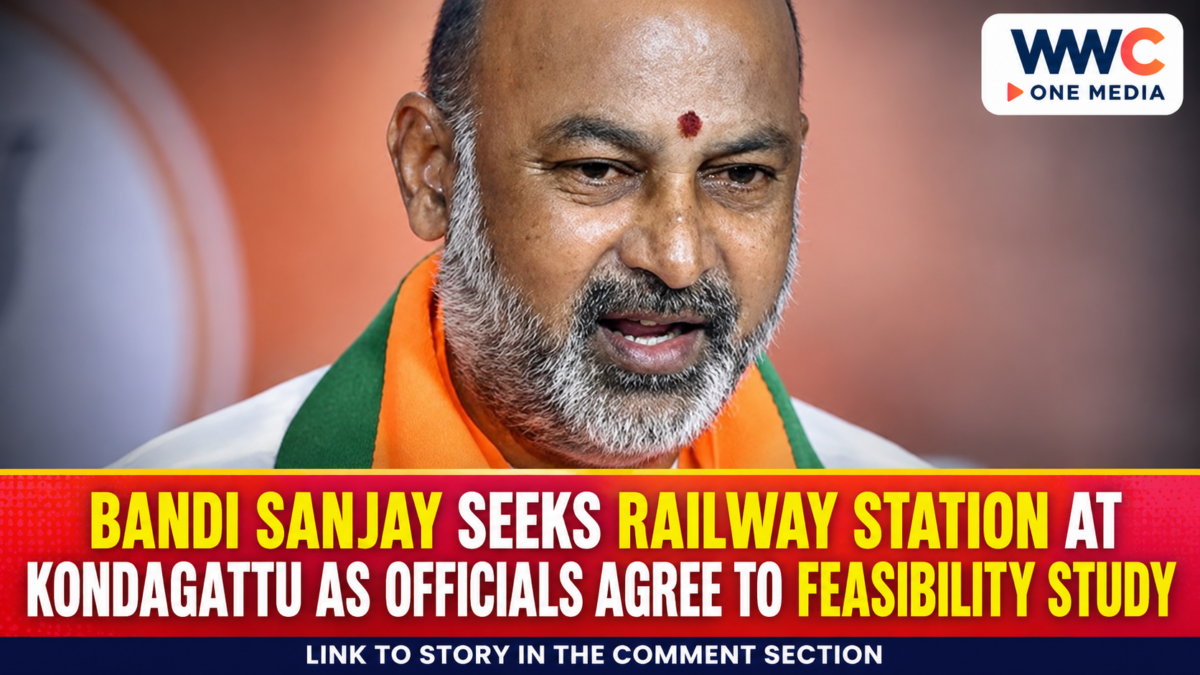
A proposal to establish a railway station closer to the Kondagattu Anjaneya Swamy temple in Telangana has moved toward further examination following a meeting between Union Minister of State for Home Affairs Bandi Sanjay Kumar and senior South Central Railway (SCR) officials.
During the reported meeting at Rail Nilayam in Secunderabad on November 25, the minister urged railway authorities to examine the possibility of establishing a station near the pilgrimage centre. The request was based on the distance between the temple and the existing Nookapalli-Malyala railway station, which reports placed at approximately five kilometres.
According to published reports, railway officials agreed to examine the proposal through a feasibility study. The review is expected to help determine whether a station near Kondagattu can be considered from an engineering, operational and passenger-demand perspective.
The development is relevant to devotees and residents who rely on road transport to reach the temple after travelling by train. However, the reported agreement to study the proposal should not be interpreted as a final railway approval. No confirmed construction schedule, project cost, funding allocation or formal sanction for a Kondagattu station has been established in the available official records.
For now, the proposal remains at an early assessment stage.
Kondagattu’s importance as a pilgrimage destination
Kondagattu is located in Muthyampet village under Mallial Mandal in Jagtial district, Telangana. The area is widely known for the Sri Anjaneya Swamy temple, a religious destination that draws devotees from different parts of the state and beyond.
The Jagtial District administration identifies the temple as one of the district’s important places of religious interest. Its official district profile notes that thousands of devotees visit the temple.
That visitor activity makes transport access an important consideration, particularly during busy pilgrimage periods. Travellers arriving from outside the immediate area may need to combine rail travel with a road journey to reach the temple.
A railway station closer to the destination could potentially make that journey more convenient. It could also provide another public-transport option for visitors who prefer rail travel over longer road journeys.
Those potential benefits, however, would need to be assessed rather than assumed. A new station would have to be located where it can be safely connected to the existing railway network, serve a sufficient number of passengers and operate without creating unacceptable disruption to other train services.
The proposal therefore involves more than identifying a convenient point on a map. It requires railway authorities to examine whether a station can be built and operated effectively.
The distance issue behind the proposal
The reported five-kilometre distance between the existing Nookapalli-Malyala station and the Kondagattu temple is central to the request.
For a passenger travelling to a religious destination, the railway journey is only one part of the trip. The distance between the station and the final destination can affect travel time, transport costs and the convenience of the overall journey.
This is particularly relevant for families, older passengers and visitors travelling in groups. During major temple occasions, demand for local transport may also increase, although the actual scale of that demand would need to be established through passenger data and field assessment.
A closer railway stop could potentially shorten the road portion of the journey. But whether it would produce a meaningful improvement depends on the location selected, road access around the proposed site and the train services that could realistically stop there.
A station that is physically closer to the temple would not automatically guarantee frequent trains or direct connections to major cities. Train halts and service patterns are separate operational decisions that would need to be considered by the railway authorities.
That is why the feasibility process matters. It should establish not only whether a station can be developed, but also whether it would provide a practical transport benefit.
What happened during Bandi Sanjay’s meeting with railway officials?
According to news agency UNI, Bandi Sanjay met South Central Railway General Manager Sanjay Kumar Srivastava and other senior railway officials at Rail Nilayam in Secunderabad on November 25.
The meeting reportedly covered railway infrastructure and passenger-service concerns in the Karimnagar parliamentary constituency. The Kondagattu station proposal was among several issues raised.
The discussion was not limited to one religious destination. Reports also described requests concerning the development of Jammikunta and Uppal railway stations, additional passenger facilities, freight-related infrastructure and improvements to train services.
The minister reportedly called for better station facilities, including platform extensions, passenger shelters, modern waiting halls and drinking-water arrangements.
He also raised the proposed development of a wagon loading and unloading point and a road underbridge at Jammikunta, along with a reservation counter at Uppal.
These requests reflect different infrastructure needs. Passenger facilities are intended to improve the experience of people using existing stations, while freight facilities can support the movement of goods. A road underbridge, meanwhile, is a separate infrastructure requirement that can affect local road and rail movement.
The reported meeting indicates that these concerns were brought before senior railway officials. It does not establish that every requested improvement has received final approval or that construction has started.
Why a feasibility study is an important first step
A feasibility study is an assessment used to determine whether a proposed infrastructure project can be developed under practical conditions.
For a proposed station near Kondagattu, the assessment would need to consider several issues.
1. Site and engineering suitability
Railway engineers would need to identify a suitable location and determine whether the existing track alignment and surrounding railway infrastructure can accommodate a station. Track geometry, signalling, safety requirements and the space needed for platforms and other facilities would all be relevant.
2. Land availability and access
A proposed station requires sufficient land for railway facilities and safe passenger movement. Authorities would need to examine land ownership, acquisition requirements where applicable, road connections and the surrounding development.
3. Passenger demand
The railway would need to estimate how many passengers could use the station. Temple visitation, local population, seasonal travel patterns and the number of people who currently use nearby stations could help inform that assessment.
A destination may attract substantial visitors, but a station still needs a realistic estimate of regular and seasonal demand.
4. Train operations
A new station must fit into the wider railway network. Authorities would need to assess whether trains could stop there without creating operational problems, and what services could potentially use the facility.
The existence of a station does not automatically mean every train passing through the area would stop there. Decisions on train halts and schedules involve separate operational considerations.
5. Cost and public benefit
The assessment would also need to consider the likely cost of development and the expected benefits for passengers and the surrounding community. Any eventual funding decision would depend on the relevant railway planning and approval processes.
These considerations explain why a reported agreement to study a proposal is not the same as a commitment to construct it.
Telangana’s wider railway investment programme
The Kondagattu request comes amid broader railway infrastructure activity in Telangana.
In a February 2, 2026 release, the Ministry of Railways reported that the average annual railway budget allocation for Telangana had increased to ₹5,454 crore in 2026–27, compared with ₹886 crore during 2009–14.
The ministry also reported that railway projects worth ₹47,984 crore were under execution in the state.
The same release said that 40 railway stations in Telangana had been identified for redevelopment under the Amrit Station Scheme, with an estimated investment of ₹2,015 crore. It also listed completed redevelopment work at Begumpet, Karimnagar, Warangal and Sri Bala Brahmeswara Jogulamba stations.
The ministry’s release provides a picture of the scale of railway investment and station redevelopment across Telangana. It does not, however, identify Kondagattu as an approved station project or confirm that the proposed facility is included in the Amrit Station Scheme.
That distinction is important. Statewide investment figures cannot be used as evidence that a separate local proposal has secured funding.
For wider context on railway development and cross-border infrastructure cooperation, WWC ONE MEDIA has also reported on India’s role in major Philippine railway projects.
Existing rail connectivity in Jagtial district
The official Jagtial District profile provides additional context for the region’s transport network.
The district administration states that railway connectivity is available from Jagtial to Peddapalli through Karimnagar. It also describes connectivity from Jagtial to Nizamabad as being under process on the page.
This information demonstrates that rail access is already part of the district’s transport network, while also showing why further connectivity proposals remain relevant to local development.
The proposed Kondagattu station would be a separate question from the district’s existing railway connections. Its feasibility would depend on the specific site, the railway network and the expected passenger benefit.
For residents and visitors, the issue is not simply whether a railway line exists somewhere in the district. It is whether available services provide convenient access to the places people need to reach.
That is the practical question the Kondagattu proposal seeks to address.
Other railway requests raised during the review
The reported November 25 meeting also included matters beyond Kondagattu.
UNI reported that the Kothapalli-Manoharabad railway line was discussed, with officials providing progress targets for sections toward Sircilla and Vemulawada. The overall line was reportedly targeted for completion by the end of 2028.
The minister also reportedly sought more frequent Karimnagar-Tirupati train services and seasonal services for Sabarimala pilgrims.
Additional train halts at Peddapalli and Jammikunta were among the other requests reported. Passenger concerns involving toilet maintenance and reservation-centre facilities at Karimnagar station were also raised.
These requests cover several aspects of railway service: new infrastructure, station development, train frequency, additional stops and the maintenance of passenger facilities.
They also demonstrate that local railway concerns can involve both large capital projects and relatively practical improvements to existing services.
However, each request has its own approval and implementation requirements. A discussion at a review meeting does not by itself establish a completion date or guarantee that a particular service change will be implemented.
What would need to happen before construction?
For Kondagattu, the next significant development would be an official outcome from the reported feasibility review.
If railway authorities proceed with the assessment, the public would need information on the proposed location, engineering findings, land requirements, passenger-demand estimates and likely cost.
A positive feasibility finding would be an important development, but it would not necessarily mean construction could begin immediately. Further technical examination, administrative approval, funding decisions and formal project sanction may still be necessary.
The stages should be understood separately:
- Request: A representative or stakeholder asks the railway authorities to consider a station.
- Feasibility assessment: Officials examine whether the proposal is technically and operationally practical.
- Project preparation: A detailed proposal may be developed, including design, cost and land requirements.
- Formal approval and funding: The competent authorities decide whether the project will proceed and how it will be financed.
- Construction and commissioning: Work begins, followed by the necessary inspections and arrangements before passenger operations.
The available reporting places the Kondagattu proposal at the request and reported feasibility-review stage. It does not establish that the later stages have been completed.
What passengers and residents should watch for
For devotees and residents of Jagtial district, the most useful next information will be whether South Central Railway publishes or confirms the outcome of its assessment.
An official statement could clarify whether a site has been identified, whether a field inspection has taken place and whether the proposal has been forwarded for further consideration.
Residents would also benefit from clear information about how a proposed station would connect with the temple and nearby communities. A station’s usefulness depends not only on its railway facilities but also on the availability of safe and convenient onward transport.
The expected train services would be another important consideration. If a project advances, passengers will want to know which routes could serve the station, whether additional halts would be required and how services might accommodate peak pilgrimage periods.
Until those details are available, claims about a confirmed station, construction timetable or guaranteed passenger services would be premature.
A proposal to monitor, not a construction announcement
Bandi Sanjay’s reported request has brought the question of rail access to Kondagattu before senior South Central Railway officials. If the feasibility review proceeds, it could provide a clearer basis for deciding whether a station near the temple is practical and worthwhile.
The proposal also sits within a broader discussion about railway access, station facilities and passenger services in Telangana.
But the central point remains unchanged: a reported agreement to examine feasibility is an early administrative step, not a final project sanction.
For Kondagattu’s devotees and the surrounding communities, the next milestone will be evidence of what the railway assessment actually concludes—and whether the proposal advances through the formal approval process.
WWC ONE MEDIA will continue to distinguish between requests, feasibility findings, formal approvals and construction developments as further documentation becomes available.
Editorial note: Details of the November 25 meeting and the reported agreement to examine the Kondagattu proposal are attributed to published news reports. The official Jagtial District and Ministry of Railways material provides independently verifiable background on the temple, district connectivity and Telangana’s railway investment. Those official sources do not establish that a Kondagattu station has been sanctioned.