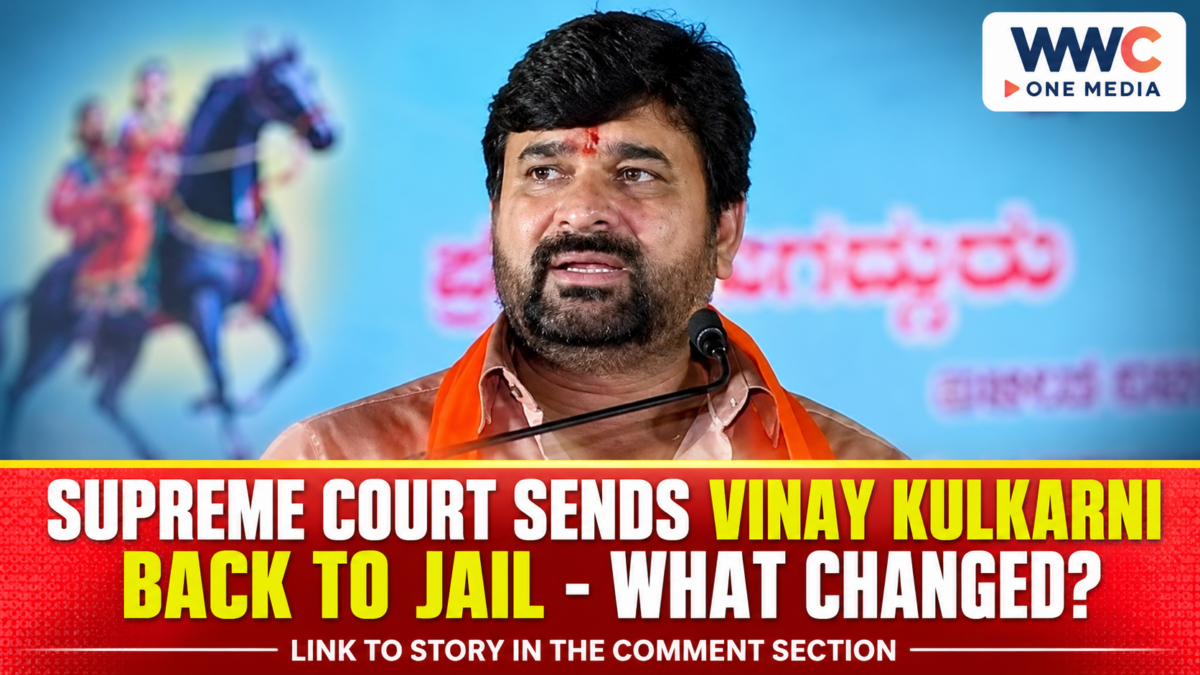
NEW DELHI, India — A major legal reversal has put former Karnataka minister Vinay Rajashekharappa Kulkarni back under an order to serve his life sentence in the 2016 murder of Bharatiya Janata Party leader Yogesh Goudar.
India’s Supreme Court on Nov. 25, 2026, overturned the Karnataka High Court orders that had suspended the sentences of several convicted individuals and stayed Kulkarni’s conviction while their appeals were pending.
The two-judge bench, comprising Justices Prashant Kumar Mishra and Shree Chandrashekhar, cancelled the bail bonds of the convict-respondents and directed them to surrender before the appropriate court within two weeks.
The ruling also addressed a wider legal question: when can a court suspend a criminal conviction, particularly when the person convicted is an elected legislator facing disqualification?
The Supreme Court said the possibility of losing a legislative seat cannot, by itself, justify staying a conviction.
Supreme Court Reverses the Karnataka High Court’s Relief
The case reached the Supreme Court after the Karnataka High Court issued a series of orders on July 31, 2026, granting relief to convicted individuals while their criminal appeals remained pending.
Kulkarni had obtained two forms of relief: suspension of his life sentence and a stay on the operation of his conviction.
The distinction is important. Suspending a sentence can allow a convicted person to remain outside prison while an appeal is pending. Staying a conviction goes further because it temporarily prevents the conviction itself from operating for relevant legal consequences.
The High Court had considered the possible consequences for Kulkarni’s membership in the Karnataka Legislative Assembly. Without a stay on the conviction, he faced disqualification under Section 8(3) of the Representation of the People Act, 1951.
The Supreme Court rejected the idea that the possibility of disqualification could serve as the primary reason for staying a conviction.
It said such relief is exceptional and requires a much higher legal threshold, including an obvious and serious error in the conviction that can be identified from the record.
The Court also overturned the suspension of sentences granted to other convicted individuals in the case.
The ruling does not decide the final outcome of the pending appeals. It means the High Court’s interim protection has been removed, leaving the convictions and sentences operative while the appeals continue.
Why the Court Rejected the Stay of Conviction
The Supreme Court focused on the legal difference between an ordinary request to suspend a sentence and an application to stay a conviction.
Under Indian criminal procedure, an appellate court can suspend a sentence while an appeal is pending. However, a stay of conviction is an exceptional remedy because it can affect legal consequences beyond imprisonment.
The Supreme Court said a person seeking a stay must demonstrate more than a reasonable argument that the conviction could be challenged. The alleged error must be sufficiently obvious and serious to undermine the conviction.
The Court found that the Karnataka High Court’s order did not adequately explain why the trial court’s conviction was legally unsustainable.
It also rejected the proposition that a legislator should automatically receive a stay because conviction could trigger disqualification.
The judgment stressed that disqualification under Section 8(3) is a statutory consequence of conviction and cannot simply be avoided by presenting an arguable appeal.
The decision is significant beyond Kulkarni’s case because it reinforces the distinction between protecting a person’s right to appeal and suspending the legal consequences of a conviction.
The 2016 Killing That Triggered the Case
Yogesh Goudar, a BJP Zilla Panchayat member from Dharwad, was attacked near Uday Gym and Fitness Centre in Saptapura, Dharwad, on June 15, 2016.
The initial investigation was conducted by Dharwad police. A charge sheet was filed against six accused in September 2016.
The Karnataka government later ordered further investigation by the Central Bureau of Investigation in September 2019.
The CBI filed supplementary charge sheets that expanded the list of accused and presented a broader conspiracy theory. Kulkarni was named as accused No. 15, while Chandrashekar Indi, also known as Chandu Mama, was identified as accused No. 16.
The prosecution alleged that the killing was organised through a conspiracy involving several participants, including individuals accused of carrying out the attack and others alleged to have helped arrange logistics or conceal the crime.
Those allegations were tested during the trial. The Supreme Court’s November judgment discusses the prosecution’s case and the evidence considered by the Special Court; its account should not be confused with a fresh trial or a separate conviction.
What the Supreme Court Said About the Evidence
A central issue in the appeals concerned the testimony of an accused person who became an approver and testified for the prosecution.
The defence challenged the reliability of that testimony, arguing that it should not be relied upon to sustain the convictions.
The Supreme Court explained that Indian law permits courts to consider evidence from an accomplice who has become an approver. It also discussed the importance of judicial caution when evaluating such testimony.
The judgment noted that the trial record included other material, including witness testimony, documentary evidence, medical evidence and forensic evidence.
The Court was not conducting the final appeal hearing or issuing a new verdict on every disputed evidentiary issue. It was examining whether the High Court had applied the correct legal standards when it suspended the sentences and stayed the conviction.
The justices concluded that the High Court had not identified the serious errors required to justify the relief it granted.
For readers following other high-profile legal proceedings, the distinction between an interim court order and a final judicial outcome is equally important. WWC has examined similar procedural questions in its coverage of the Supreme Court’s dismissal of the Duterte family’s habeas corpus petitions.
The Investigating Officer’s Sentence Was Also Affected
The Supreme Court’s decision was not limited to Kulkarni and the other individuals sentenced to life imprisonment.
It also overturned the suspension of the sentence imposed on Channakeshava B. Tingarikar, the investigating officer in the initial Dharwad police case.
Tingarikar had been convicted of offences involving the handling of evidence and the investigation. The Special Court imposed seven years of rigorous imprisonment and a fine of Rs. 30,000.
The Karnataka High Court had suspended his sentence, taking into account factors including the fixed-term punishment and the expected time needed to decide his appeal.
The Supreme Court held that the High Court had not adequately considered the seriousness of the offences and the responsibilities attached to the investigating officer’s role.
It emphasised that an investigating officer’s duty to preserve the integrity of an investigation is central to the administration of criminal justice.
The order therefore removed the interim suspension of Tingarikar’s sentence as well.
What Happens Next for Kulkarni and the Other Convicts?
The immediate consequence is clear: the bail bonds of the convict-respondents stand cancelled, and they must surrender before the court concerned within two weeks of the Supreme Court’s Nov. 25 order.
The Supreme Court allowed the appeals challenging the Karnataka High Court’s orders. It did not dismiss the underlying criminal appeals against the convictions.
That means the convicted individuals retain the right to pursue their appeals, but they cannot rely on the overturned High Court orders to remain outside prison.
Kulkarni’s conviction-stay protection has also been removed. The statutory consequences connected to the conviction, including the disqualification issue discussed by the Court, are no longer shielded by that interim order.
The next significant development will be the handling of the pending appeals before the Karnataka High Court.
WWC has also examined how courts distinguish between established convictions and unresolved allegations in its report on the Nikhil Gupta sentencing in the United States.
A Ruling With Wider Consequences for Criminal Appeals
The Supreme Court’s decision sends a clear message about the limits of interim relief after a conviction.
A pending appeal does not automatically entitle a person serving a life sentence to suspension of that sentence. Nor does the possibility of losing elected office automatically justify staying a conviction.
The judgment also underlines why courts must examine the relevant legal standards and the record before granting exceptional relief.
The case remains subject to the appeal process, but the immediate position has changed sharply: the High Court’s protection has been set aside, the bail bonds have been cancelled, and the convicted respondents have been ordered to surrender.
For Kulkarni, the next legal battle will now proceed without the interim protection that had allowed him to remain outside prison.
What Happens Next?
The two-week surrender period is the immediate deadline established by the Supreme Court. The next major legal question is how the pending criminal appeals will proceed and whether the convictions will ultimately be upheld, modified or overturned.
The November 25 ruling does not end the appeal process. It restores the operation of the convictions and sentences while that process continues.
Frequently Asked Questions
Who is Vinay Kulkarni?
Vinay Rajashekharappa Kulkarni is a former Karnataka minister and a convicted individual in the 2016 murder case involving BJP leader Yogesh Goudar.
Why did India’s Supreme Court cancel his bail?
The Supreme Court set aside the Karnataka High Court orders suspending the sentences and staying Kulkarni’s conviction, finding that the required legal standards for such relief had not been met.
What happened to Yogesh Goudar?
Goudar, a BJP Zilla Panchayat member from Dharwad, was attacked near Uday Gym and Fitness Centre in Saptapura, Dharwad, on June 15, 2016.
How long must the convicted individuals wait before surrendering?
The Supreme Court directed the convict-respondents to surrender before the court concerned within two weeks of its Nov. 25, 2026 order.
Has the Supreme Court ended Kulkarni’s appeal?
No. The Supreme Court overturned the interim High Court orders. The criminal appeals against the convictions remain separate proceedings.
What is the significance of Section 8(3) of India’s Representation of the People Act?
Section 8(3) provides for disqualification following conviction and a qualifying sentence. The Supreme Court said the possibility of disqualification cannot, by itself, be the primary reason to stay a conviction.