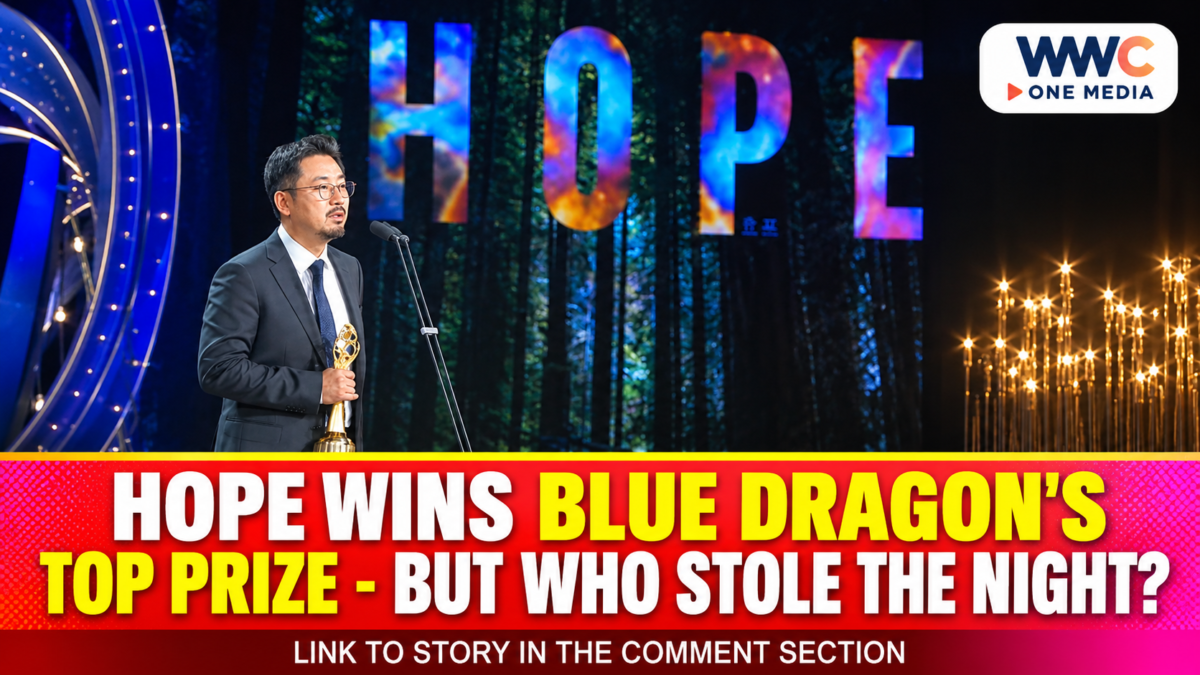
SEOUL, South Korea — Na Hong-jin’s science-fiction thriller Hope claimed Best Picture at the 47th Blue Dragon Film Awards, but it was Lee Chang-dong’s Possible Love that dominated the ceremony with four major wins, including the two leading acting prizes.
The awards ceremony took place on Nov. 25, 2026, at KBS Hall in Yeouido, Seoul, bringing together some of South Korea’s most prominent filmmakers and performers. The evening delivered a major milestone for veteran actor Sul Kyung-gu, who became the first performer to win the Blue Dragon Best Actor award four times.
For Korean cinema, the results offered two major stories: the recognition of Hope as the year’s top picture and the strong performance of Possible Love, whose cast and creative team collected awards across several major categories.
Hope Takes Best Picture After Leading the Nominations
Directed by Na Hong-jin, Hope secured the ceremony’s Best Picture award, adding one of the most prestigious honours in South Korean cinema to its list of achievements.
The film also won the Cinematography and Lighting award, credited to Hong Kyung-pyo and Park Jeong-woo. It entered the ceremony with 10 nominations, the highest number among the competing films.
The result placed Hope among the evening’s leading winners, although it did not collect as many trophies as Possible Love.
Na acknowledged the cast and production team during his acceptance speech, recognising the people who helped bring the film to the screen. His reaction also drew attention to the competitive nature of the awards season, particularly after the film’s international festival exposure.
The Best Picture result gives Hope a significant domestic award milestone, while its cinematography recognition adds another distinction for the production team.
Possible Love Sweeps the Major Acting Categories
While Hope received the top film award, Possible Love emerged as the ceremony’s biggest winner by total trophies.
The film collected four awards: Best Actor, Best Actress, Best Supporting Actress and Best Screenplay.
Sul Kyung-gu won Best Actor for his performance in the film, while Jeon Do-yeon received Best Actress. Their co-star Cho Yeo-jeong won Best Supporting Actress, and Lee Chang-dong shared the Best Screenplay award with Oh Jung-mi.
The four wins gave the film a strong presence across both performance and writing categories. Rather than relying on a single award, Possible Love was recognised for its central performances and the screenplay behind the story.
The result also places the film among the most discussed Korean releases of the awards season, particularly for audiences following the work of established actors and directors.
The film’s success adds to the growing international attention surrounding South Korean cinema. WWC previously examined that wider appeal in its coverage of Michelle Yeoh’s praise for Korean cinema at the Busan International Film Festival.
Sul Kyung-gu Makes Blue Dragon History
Sul’s Best Actor victory was one of the evening’s defining moments.
The actor became the first person to win the Blue Dragon Best Actor award four times. His previous wins came for Peppermint Candy, Public Enemy and The Book of Fish, before his latest recognition for Possible Love.
The achievement gives Sul a record that sets him apart in the history of the awards. It also reflects a career spanning multiple generations of South Korean filmmaking.
During his acceptance remarks, Sul thanked his co-stars and director Lee Chang-dong, acknowledging the difficulty and value of working with the filmmaker. He also expressed gratitude for being given the opportunity to continue pursuing challenging roles.
Jeon Do-yeon added another milestone of her own. Her win marked her third Blue Dragon Best Actress award, following previous victories for My Heart and Secret Sunshine.
The two lead acting awards going to the same film gave Possible Love an especially strong result, recognising both performers at the centre of its story.
Other Winners Recognised Across Korean Cinema
The ceremony also recognised achievements in directing, supporting performances, technical work and emerging talent.
Yoon Ga-eun won Best Director for The World of Love. Koo Kyo-hwan received Best Supporting Actor for Colony, while Park Ji-hoon won Best New Actor for The King’s Warden. Seo Su-bin took Best New Actress for The World of Love.
Kim Mi-jo received Best New Director for The Journey to Gyeongju.
Other awards went to production and creative teams across several films. Good News won Best Editing for Kim Sang-bum and Best Art Direction for Han Ah-reum. Lee Min-hwi received Best Music for Pavane, while Yoo Sang-seob and Lee Won-haeng were recognised for stunt work in Humint.
The Audience Choice Award for Most Popular Film went to The King’s Warden. Park Ji-hoon also received a Popular Star Award, alongside Park Ji-hyun, Shin Min-a and Oh Jung-se.
The awards highlighted the range of productions competing for attention in South Korea, from major commercial releases to films recognised for directing, writing and technical achievement.
That range is also reflected in the broader Korean film landscape, including projects exploring different formats and distribution models. WWC has previously covered director Lee Joon-ik’s move into short-form dramas and the international ambitions surrounding the Korean film franchise Tazza.
A Lifetime Achievement Award for Ahn Sung-ki
The ceremony also paid tribute to veteran actor Ahn Sung-ki, who received a posthumous lifetime achievement award.
His younger son, Ahn Philip, accepted the honour on his behalf. The recognition acknowledged Ahn’s contribution to South Korean cinema and his long-standing place in the country’s film industry.
The tribute added a reflective moment to an evening otherwise focused on current releases, new talent and the achievements of established performers.
South Korean cinema has continued to attract attention beyond its domestic market, with festivals across Asia providing platforms for filmmakers and performers to reach wider audiences. The regional importance of those platforms was also evident in WWC’s coverage of the Busan International Film Festival’s 2026 opening film and the Singapore International Film Festival’s Asian cinema programme.
What Happens Next for the Winning Films?
The Blue Dragon results give Hope and Possible Love fresh recognition in South Korea, but their longer-term impact will depend on how audiences respond to the films beyond awards night.
For Hope, the Best Picture victory strengthens its position among the year’s most recognised productions. For Possible Love, four awards and two leading acting victories give it a particularly strong awards-season profile.
Sul’s fourth Best Actor win may also become one of the ceremony’s most enduring talking points, while Jeon’s third victory reinforces her standing among South Korea’s most recognised performers.
The 47th Blue Dragon Film Awards therefore ended with two films sharing the spotlight: one taking the industry’s top picture prize, and another collecting the largest number of awards.
Frequently Asked Questions
Which film won Best Picture at the 2026 Blue Dragon Film Awards?
Na Hong-jin’s Hope won Best Picture at the 47th Blue Dragon Film Awards on Nov. 25, 2026.
Which film won the most awards?
Lee Chang-dong’s Possible Love won four awards, including Best Actor, Best Actress, Best Supporting Actress and Best Screenplay.
Who won Best Actor and Best Actress?
Sul Kyung-gu won Best Actor, while Jeon Do-yeon won Best Actress. Both received their awards for Possible Love.
What record did Sul Kyung-gu set?
Sul became the first actor to win the Blue Dragon Best Actor award four times.
Who won Best Director?
Yoon Ga-eun won Best Director for The World of Love.
Where were the 2026 Blue Dragon Film Awards held?
The ceremony took place at KBS Hall in Yeouido, Seoul, South Korea, on Nov. 25, 2026.