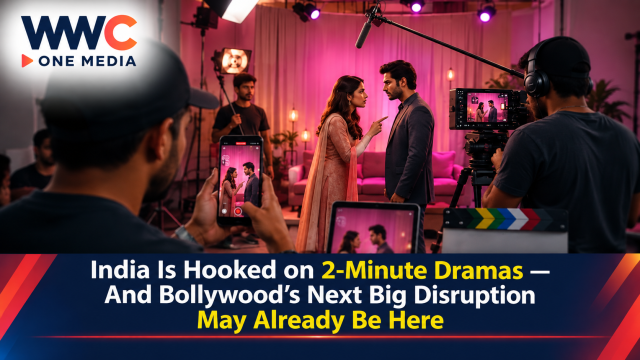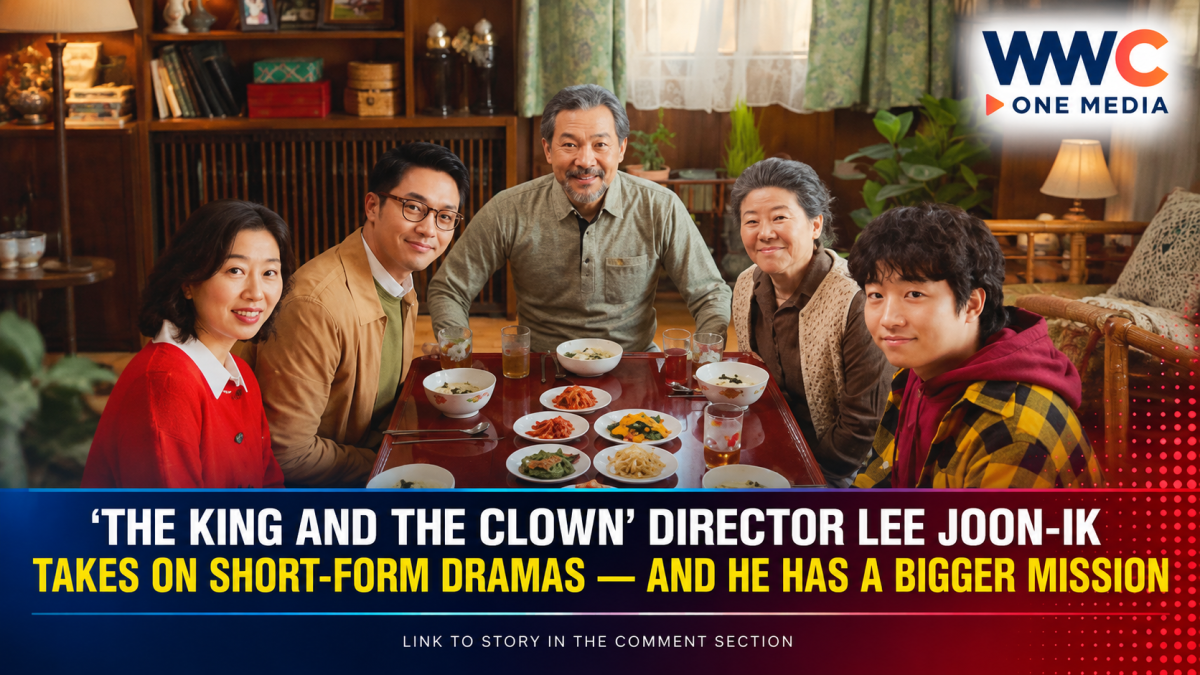
SEOUL — Veteran filmmaker Lee Joon-ik, the director behind the blockbuster Korean film The King and the Clown, is stepping into one of the entertainment industry’s fastest-growing formats: vertical short-form dramas.
His move into the genre is attracting attention not simply because of his reputation, but because Lee is taking on a format that has often been criticized in Korea for relying on exaggerated plots and rapid-fire storytelling.
His latest project, My Father’s Table, is an unusual experiment: a drama originally created for smartphone screens that has now been reassembled into a feature-length theatrical presentation.
From Blockbuster Cinema to the Smartphone Screen
Lee became internationally recognized for films including The King and the Clown, which attracted more than 10 million moviegoers in South Korea in 2005. His filmography also includes The Throne, Dongju: The Portrait of a Poet and The Book of Fish.
His decision to make a short-form drama therefore represents a significant shift in format.
Short-form dramas are generally produced vertically for smartphones, with episodes often lasting only one to three minutes. The format is designed around rapid viewing and encourages audiences to move quickly from one episode to the next.
But Lee said he was initially uncomfortable with the idea.
What changed his mind was seeing younger filmmakers struggle to find opportunities in a Korean film industry facing a prolonged downturn. Lee had encouraged emerging directors to keep creating regardless of the platform, and some later asked him to help challenge the perception that short-form dramas were merely low-end entertainment.
He eventually decided to make one himself.
‘My Father’s Table’ Takes a Different Route
Rather than building the story around revenge, secret identities or sensational twists, Lee chose a family drama centered on food and relationships.
The story follows Ha-eung, played by Jung Jin-young, a man who has depended on his wife Soon-ae, played by Lee Jung-eun, for home-cooked meals for decades.
When Soon-ae develops a condition that prevents her from cooking, Ha-eung is forced to enter the kitchen for the first time.
The family’s changing relationship becomes the heart of the story, with three generations connected through food and memories of Korea’s rapid social transformation. Byun Yo-han is also part of the cast.
That choice reflects Lee’s stated interest in showing that short-form storytelling does not have to depend entirely on shock value.
The Two-Minute Storytelling Challenge
The format has forced even an experienced filmmaker to rethink how stories are constructed.
In conventional cinema, directors can allow scenes to develop gradually. In short-form drama, each episode may have only around two minutes to establish a situation, create an emotional turn and give viewers a reason to continue watching.
Lee described the experience as unfamiliar, saying the scripts required a different storytelling approach because every short episode needed its own narrative momentum.
That constraint is becoming one of the defining characteristics of the emerging genre.
At the recent BCWW 2026 industry event, other established creators also discussed how short-form production requires dramatically different pacing and production techniques. Director Lee Byung-hun, another established Korean filmmaker who has entered the sector, described the experience as a major adjustment from conventional filmmaking.
Korea’s Short-Form Market Is Growing Fast
Lee’s experiment comes as Korea’s entertainment industry increasingly embraces vertical storytelling.
The Korea Times reported that Korea’s domestic short-form drama market reached approximately 650 billion won ($467 million) in 2025, while global short-form drama revenue grew rapidly in recent years.
The format originated in China and has expanded across Asia and other international markets. Korean companies are now developing their own productions, with platforms such as Lezhin Snack attempting to connect webtoon intellectual property with short-form video.
Lezhin Entertainment launched Lezhin Snack internationally in February 2026, with productions involving established directors including Lee Joon-ik and Lee Byung-hun.
The Korea Creative Content Agency’s 2025 Content Usage Behavior Survey also found that 58.6% of respondents regularly consumed short-form video content, underscoring how deeply mobile viewing has become embedded in Korean media habits.
From Phone Screen to Movie Theater
Perhaps the most surprising part of Lee’s project is what happened after production.
My Father’s Table was filmed vertically as a short-form drama, with 61 episodes of roughly two minutes each. Those episodes were subsequently edited together into a 146-minute theatrical feature.
The movie opened at Lotte Cinema on Sept. 9, making it the first known Korean theatrical release of a short-form drama in this format, according to the Korea Times report.
The project had also been showcased at the 30th Bucheon International Fantastic Film Festival, which introduced a dedicated short-form cinema strand this year.
That journey — from smartphone vertical video to a cinema screen — captures the larger experiment taking place across Korea’s entertainment industry.
Why Lee’s Move Matters
Lee Joon-ik’s involvement could help challenge the idea that short-form dramas are inherently disposable or limited to sensational stories.
At the same time, the growing participation of established directors does not mean the format has abandoned its mobile-first identity. Its strongest advantage remains the ability to deliver compact stories to audiences accustomed to consuming entertainment in short bursts.
For younger filmmakers, the format could also provide a comparatively accessible route into commercial production at a time when traditional film financing and theatrical opportunities remain difficult.
Lee’s project is therefore about more than making a short drama.
It is also an experiment in whether cinematic storytelling can survive — and perhaps evolve — when the screen becomes smaller, the episodes become shorter and audiences expect an emotional payoff almost immediately.
WWC ONE MEDIA G,A