
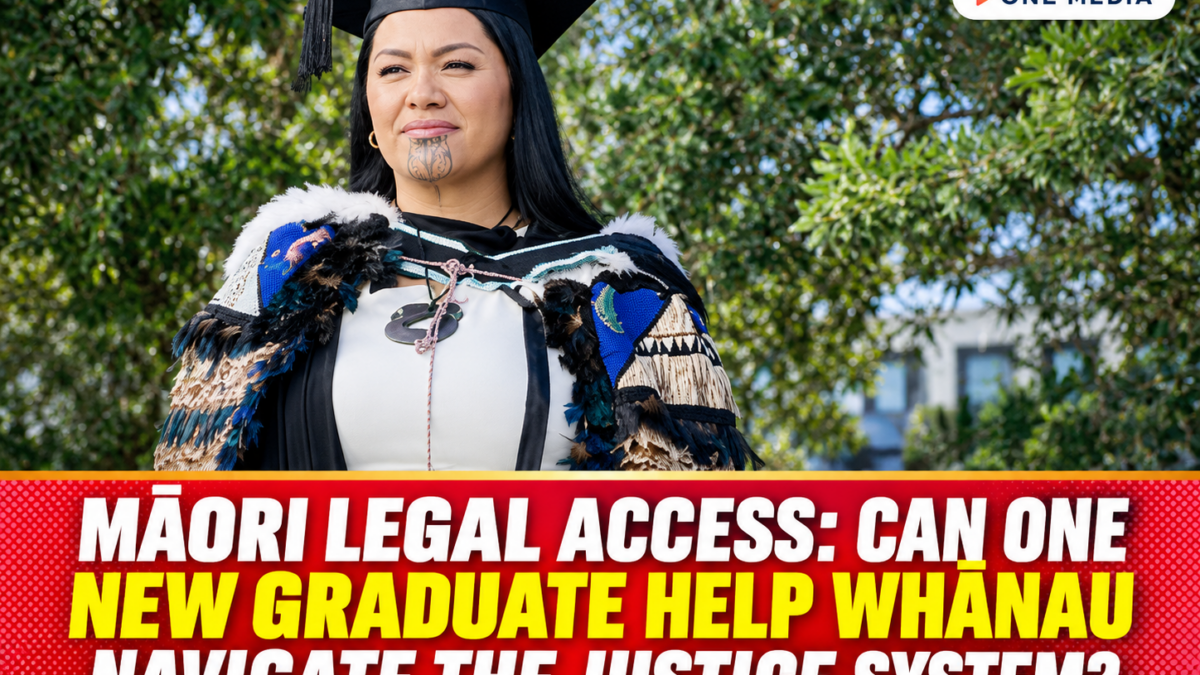
Rahema Hook graduated with a law degree from the University of Auckland on September 24, 2026, completing a goal she first imagined as a teenager. Now 40, the Northland graduate wants to take her legal knowledge back to her community and help Māori whānau better understand a justice system that can be difficult to navigate without guidance.
Her achievement is personal, but the issue behind it is much wider. Māori legal access remains an important public concern in Aotearoa New Zealand, where official justice figures show substantial disparities affecting Māori women and the wider Māori population. Hook’s next step will not, by itself, change those figures. It does, however, highlight the value of people who can connect legal knowledge with the communities they understand.
Māori legal access begins with understanding the system
Hook’s graduation was confirmed by Waipapa Taumata Rau, the University of Auckland. The university said she graduated on September 24 and described her intention to advocate for whānau who have spent years dealing with the criminal justice system.
She grew up in Kawakawa and Te Rāwhiti in the Bay of Islands and identifies with Ngāpuhi, Ngāti Porou, Ngāti Kahungungu and Ngāi Tūhoe. The university profile records that she became a mother at 17, raised her three children and helped raise her brother’s children, while continuing to work and pursue education through other pathways.
Her earlier qualifications included a legal executive diploma and a tourism diploma. The law degree remained an ambition she returned to later in life.
A 2022 Ngāpuhi annual report also lists Rahema Hook among its undergraduate scholarship recipients, identifying her qualification at the time as a Bachelor of Arts/Law. That record provides an independent institutional reference to her studies before the university confirmed her graduation.
The distinction matters: a law degree provides academic training, but it does not automatically make its holder a practising lawyer. Admission and professional requirements are separate steps. The university’s public profile describes Hook’s plans to help people find appropriate legal pathways; it does not establish that she has already been admitted as a barrister and solicitor.
The figures behind the justice-system challenge
The need for accessible legal information is set against persistent disparities in New Zealand’s justice system.
A Ministry of Justice factsheet released on February 24, 2026, reported that wāhine Māori made up 15% of women in Aotearoa New Zealand in the year to June 2025. The same analysis found they accounted for 44% of women proceeded against by police, 49% of women entering court, 66% of women remanded in custody and 71% of women sentenced to imprisonment.
These figures describe different stages of the justice process. They should not be treated as proof that every case is affected by the same cause. The ministry said some disproportionality could be explained by factors such as the seriousness of offending and prior history, while a proportion remained unexplained, particularly at later stages.
The ministry also identified discretionary decisions within the justice system as contributing to some of the unexplained disparity. It said work was under way to improve information available to decision-makers and better align system responses with the needs and circumstances of wāhine Māori.
The broader prison population shows a similar imbalance. The Office of the Inspectorate reported in August 2026 that Māori made up around 52% of the prison population as of July 2, compared with 17.5% of the general population. Those figures do not explain individual cases, but they show why access, fairness and understanding of legal processes remain significant issues.
A qualification shaped by lived experience
The University of Auckland’s profile describes how Hook’s family responsibilities interrupted her plans for university. After her brother Teina died in 2016, she took on the responsibility of helping raise his children alongside her own.
The university account also records that she later decided to pursue law school after working at a coastal estate in the Bay of Islands. Her studies gave her a framework for understanding experiences she had seen within her whānau, including encounters with the criminal justice system.
Hook said she had watched family members struggle to understand what was happening in legal processes and recognised that she had not always known how to advocate for them herself.
That experience is relevant because legal systems are not navigated through statutes alone. People may need to understand their rights, identify the correct agency, meet deadlines, obtain advice and work out whether a matter requires a lawyer or another form of assistance.
A graduate with community knowledge may help explain those pathways, but legal advice and representation still require the appropriate professional qualifications and safeguards.
Why community-based legal knowledge matters
Access to justice is not simply a question of whether courts exist. It also depends on whether people can understand the processes affecting them and find reliable assistance when they need it.
New Zealand’s Ministry of Justice has acknowledged that disproportionality affecting wāhine Māori increases as they move through the justice system. Its analysis points to the importance of better information for decision-makers, while Hook’s stated ambition focuses on helping whānau understand the pathways available to them.
Those are different parts of the problem. Better public understanding can help people ask informed questions and seek assistance, while fair outcomes also depend on institutional decisions, legal representation, resources and the operation of the justice system.
The issue has parallels in other countries. In the Philippines, community legal-aid initiatives are bringing consultations closer to underserved residents. The legal systems are different, but both examples point to the practical importance of connecting people with reliable legal guidance.
WWC has also examined how Indigenous families are being introduced to their rights and available protections. Knowing that a protection exists is only the first step; people also need to know where to seek help and how the relevant process works.
Education can reopen a path, but it cannot replace reform
Hook’s story also raises a wider question about adult education. Her route to a law degree included work, parenting, family responsibilities and earlier qualifications. It was not a straight progression from school to university.
Her experience is a reminder that universities and professional pathways are not used only by young people entering careers for the first time. Adults may return to study with different responsibilities and a clearer sense of the problems they want to address.
A separate WWC profile of Filipina entrepreneur Abby Watabe’s return to university at 49 offers another example of an adult completing a long-held educational goal. The circumstances are different, but both stories show that education can remain relevant well beyond the conventional student years.
For Northland, the significance of Hook’s qualification will depend on what opportunities follow and how she is able to contribute. Her stated intention is to help whānau find legal information and better pathways into the system. Whether that develops into legal practice, community advocacy or another role will depend on the relevant professional and employment requirements.
What happens next
The University of Auckland’s public profile records Hook’s intention to return to Northland and support whānau navigating the justice system. It does not announce a specific appointment, legal practice, employer or programme.
The next stage is therefore practical: completing any applicable professional admission requirements, finding a role that matches her qualifications and identifying where her knowledge can best serve the community.
For the wider justice system, the Ministry of Justice’s work on wāhine Māori disproportionality remains a separate institutional responsibility. Its own analysis points to the need for better information and more informed decisions across the system.
Hook’s graduation is not a policy solution. It is one graduate’s stated commitment to use legal education in a community where the need for accessible information is clear. The longer-term test will be whether that commitment can translate into sustained, qualified support for whānau.
Frequently asked questions
1. Who is Rahema Hook?
Rahema Hook is a Northland graduate who completed a law degree at the University of Auckland and has said she wants to help Māori whānau navigate the criminal justice system.
2. When did Rahema Hook graduate?
The University of Auckland records that she graduated on September 24, 2026.
3. Why does Māori legal access matter in New Zealand?
Official Ministry of Justice figures show that wāhine Māori are disproportionately represented at several stages of the criminal justice system, including court entry, remand and imprisonment.
4. Does graduating with a law degree automatically allow someone to practise as a lawyer?
No. A law degree is an academic qualification. Admission and other professional requirements must be met before someone can practise as a barrister and solicitor.
5. Has Rahema Hook announced a law practice or formal legal role in Northland?
The University of Auckland’s public profile records her intention to help whānau in Northland, but it does not announce a specific appointment or law practice.










