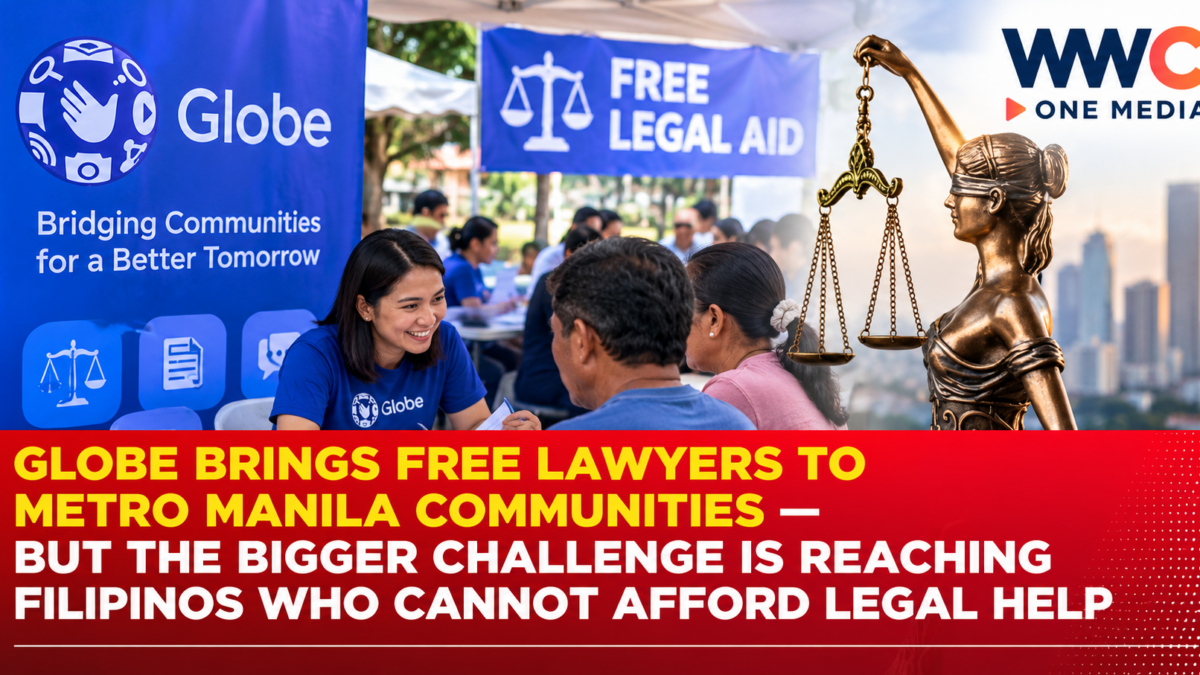
MANILA, Philippines — Globe Telecom is taking its commitment to connecting Filipinos beyond mobile phones and internet services, launching a free legal assistance program that brings professional lawyers directly to underserved communities across Metro Manila.
The telecommunications company has partnered with the Integrated Bar of the Philippines (IBP) Rizal-RSM Chapter to roll out Konek kay Attorney, an initiative providing free one-on-one legal consultations to qualified beneficiaries.
The program mobilizes Globe’s own legal professionals to help residents better understand their rights, evaluate legal concerns and identify possible courses of action.
Community outreach has already reached partner barangays in Taguig, Mandaluyong and Pasig, with assistance intended for underserved individuals referred by Globe’s local government and nongovernment organization partners, as well as eligible members of the Globe community.
But the initiative also highlights a bigger social problem.
For Filipinos without the resources to hire an attorney, even understanding a legal problem can be difficult.
Can a corporate-led legal aid program help close that gap — and turn free consultations into meaningful access to justice?
Globe Turns Corporate Lawyers Into Community Legal Advocates
Globe introduced Konek kay Attorney as part of a broader effort to use its employees’ professional expertise for community development.
Rather than limiting corporate social responsibility activities to financial donations or material assistance, the telecommunications company is allowing its legal professionals to contribute directly through their skills.
Through the program, qualified participants can meet with lawyers for individual consultations.
The discussions are intended to help beneficiaries understand their legal rights and the options available when dealing with concerns that may require professional advice.
For communities with limited access to legal practitioners, such assistance can provide an important starting point.
Understanding which government office, legal process or professional service is appropriate can sometimes be the first obstacle faced by someone seeking help.
Globe Chief Compliance Officer and Senior Vice President for Legal and Compliance Marisalve Ciocson-Co said the initiative recognizes how professional guidance can make a difference when people face unfamiliar legal situations.
She emphasized that the company wants employees to use their professional capabilities for public benefit beyond Globe’s commercial activities.
The program also provides corporate lawyers with an opportunity to apply their expertise in a setting focused on individual needs and community welfare.
Free Legal Consultations Reach Three Metro Manila Cities
Konek kay Attorney has reached partner communities in Taguig, Mandaluyong and Pasig, according to Globe’s October 14 announcement.
The initiative involves consultations delivered directly through community outreach arrangements.
Eligible participants include underserved individuals referred by Globe’s local government partners and nongovernment organizations.
Members of the Globe community may also qualify under the initiative’s requirements.
This approach allows organizers to connect with people through established community partners rather than expecting all potential beneficiaries to find legal services independently.
For residents unfamiliar with available legal aid services, community-based outreach may make the process less intimidating.
However, Globe has not publicly announced a permanent legal clinic operating in every barangay of the three cities.
It has also not disclosed a complete schedule of future consultations, a universal walk-in arrangement or a nationwide application mechanism.
Interested beneficiaries should therefore seek confirmation from participating local government units, community organizations or official program channels before making plans to visit a consultation site.
Integrated Bar of the Philippines Supports the Initiative
The IBP Rizal-RSM Chapter is the program’s main professional legal partner.
The chapter’s president, Eric Paul I. Fetalino, stressed that access to the law must go beyond the existence of legal rules and procedures.
For legal rights to have practical value, people need to understand those rights and have a realistic way to exercise them.
The partnership combines Globe’s corporate legal resources with the IBP chapter’s professional legal network and community-service role.
Such collaborations can help expand the reach of legal guidance, particularly where the cost of obtaining professional advice discourages individuals from seeking assistance.
The program is also an example of how private companies can contribute to public-interest initiatives without replacing government agencies or established legal institutions.
But its effectiveness will depend on execution, not simply the signing of an agreement.
Questions remain about how frequently consultations will be held, how beneficiaries will be selected and how participants with more complicated concerns will receive additional assistance.
Supreme Court Justice Alfredo Benjamin Caguioa Joins Launch
Supreme Court Associate Justice Alfredo Benjamin S. Caguioa, who chairs the Unified Legal Aid Service Board, delivered the keynote address during the initiative’s launch.
He also joined representatives of Globe and the IBP during a ceremonial signing formalizing the collaboration.
His participation connected the corporate initiative with the country’s broader efforts to improve access to legal services.
The Supreme Court has been advancing the Unified Legal Aid Service, or ULAS, framework to encourage lawyers to provide professional assistance to people who cannot afford adequate legal representation.
Under the ULAS rules, covered lawyers generally must render at least 60 hours of qualifying pro bono legal assistance during each three-year compliance period.
The requirement reflects the judiciary’s efforts to expand access to professional legal services for financially disadvantaged individuals.
However, the Globe initiative and the Supreme Court’s ULAS framework should not be treated as identical programs.
Globe’s announcement did not establish that every Konek kay Attorney consultation automatically qualifies as ULAS compliance or that participants will receive the same range of services available under other legal aid arrangements.
Why Free Legal Guidance Matters for Low-Income Communities
A person may have legal rights but still find it difficult to exercise them.
Professional legal services can involve fees, transportation expenses, documentary requirements and unfamiliar procedures.
These obstacles can discourage low-income individuals from seeking advice until a problem becomes more complicated.
Community-based legal consultations may help people identify potential issues earlier.
A beneficiary might need help understanding a document, clarifying the nature of a dispute or determining which government agency or legal institution can provide further assistance.
Legal professionals can also explain that some concerns require specialized services or formal representation beyond an initial consultation.
The value of accessible advice is therefore not limited to resolving a case immediately.
It may also help prevent misunderstandings, support informed decisions and improve awareness of legal rights.
But the program’s announced scope is free legal consultation and guidance.
It should not be interpreted as a blanket promise of free courtroom representation, litigation expenses, document processing or guaranteed case outcomes.
Online Scams and Deepfakes Become Part of the Conversation
Beyond traditional legal concerns, the Konek kay Attorney launch also addressed digital safety.
The event featured a discussion on deepfakes, emerging online threats and government initiatives intended to protect internet users.
Participants included:
- Angel Aquino, actress and advocate.
- Juan Paolo F. Fajardo, deputy commissioner of the National Privacy Commission.
- Renato “Aboy” Paraiso, executive director of the Cybercrime Investigation and Coordinating Center.
- Joseph Malcontento, Globe legal counsel.
The discussion highlighted the importance of recognizing online threats, safeguarding personal information and understanding rights in digital spaces.
This is particularly relevant as Filipinos increasingly use digital platforms for communication, financial transactions, employment applications and other daily activities.
Deepfake technology can be used to create convincing but fabricated images, audio recordings or videos.
Fraudulent messages and impersonation attempts can also expose individuals to financial loss or misuse of personal information.
For a telecommunications company, helping customers understand digital risks complements existing efforts to promote safer connectivity.
However, the online safety discussion should not be confused with a promise that Konek kay Attorney will automatically investigate cybercrime incidents or recover stolen funds.
Such concerns may require referrals to law enforcement or other authorized agencies.
Program Forms Part of Globe of Good
Konek kay Attorney falls under Globe of Good, the company’s broader social responsibility and employee volunteerism initiatives.
The program illustrates an approach in which employees contribute their specialized expertise to community welfare.
While traditional volunteer activities may involve donations, environmental programs or direct service projects, professional volunteerism focuses on transferring useful skills.
For Globe’s legal team, that means applying knowledge of legal processes, rights and compliance to situations faced by community members.
The company describes this effort as part of its goal of creating a positive impact beyond business targets.
It also demonstrates how a corporate department normally focused on internal legal matters can support public-interest activities.
Still, evaluating a program of this kind requires more than assessing the intentions of its organizers.
Its impact should eventually be measured through the number of consultations delivered, communities reached, appropriate referrals made and improvements in access to assistance.
Free Legal Aid Is Also Expanding Through Government Programs
Globe’s initiative comes as Philippine government and legal institutions pursue other efforts to make legal services more accessible.
In March 2026, the Supreme Court partnered with the Commission on Human Rights, National Anti-Poverty Commission, National Commission on Indigenous Peoples and Presidential Commission for the Urban Poor to strengthen the implementation of the Unified Legal Aid Service.
The collaboration seeks to make pro bono legal assistance more accessible to indigent and vulnerable Filipinos.
The Supreme Court also launched the first phase of the ULAS Portal to support reporting and coordination under the program.
Separately, the Department of Labor and Employment moved in June to establish a Labor Attorneys’ Office and related mechanisms to strengthen access to free legal assistance for qualified workers.
In September, the Department of Justice reported that its participation in the nationwide Handog ng Pangulo activities brought free legal and related services to more than 4,000 beneficiaries.
These initiatives demonstrate that expanding access to justice involves multiple institutions.
Government agencies, professional associations, law schools, legal aid organizations and private-sector employers can all contribute.
Globe’s Konek kay Attorney program adds another channel of assistance within that wider legal support ecosystem.
The Challenge: Consultations Are Only the First Step
While the launch has received positive attention, several important questions remain unanswered.
Globe has not disclosed the total number of lawyers participating in the initiative.
It has also not published a verified count of beneficiaries served or the number of cases that have received follow-up assistance.
No nationwide expansion timetable has been announced.
These gaps do not diminish the potential usefulness of the initiative, but they limit conclusions about its scale and impact.
Legal concerns can also be complex.
A short consultation may be enough to clarify a basic question, but other matters may require document preparation, prolonged advice, specialized legal representation or court proceedings.
For underserved communities, the availability of referrals and continued assistance can be just as important as an initial conversation with a lawyer.
That means meaningful access to justice requires a broader support system capable of helping people beyond the first consultation.
Can Corporate Legal Aid Become a Model for Other Businesses?
Konek kay Attorney could offer a practical model for professional volunteerism in the Philippines.
Large companies employ lawyers, accountants, engineers, information technology professionals and other specialists whose expertise could benefit underserved communities.
When organized responsibly, professional outreach can help connect people with services they might otherwise struggle to obtain.
But programs must also consider confidentiality, potential conflicts of interest, appropriate supervision and realistic service limits.
Legal assistance in particular requires safeguards to protect the interests and information of beneficiaries.
The role of professional legal organizations such as the IBP is therefore important in maintaining standards and supporting responsible delivery.
If Globe’s initiative demonstrates measurable results, it could encourage similar partnerships among other corporations and legal institutions.
At present, however, any future expansion remains an opportunity rather than a confirmed plan.
The Bigger Story: Connecting Communities to Justice
Globe has built its business around connecting people through telecommunications.
Through Konek kay Attorney, the company is applying that idea to a different need: connecting underserved Filipinos with professional legal guidance.
Its partnership with the IBP Rizal-RSM Chapter brings free one-on-one consultations to qualified beneficiaries, while its community outreach has already reached areas of Taguig, Mandaluyong and Pasig.
The initiative is also part of a larger national movement toward wider pro bono legal assistance.
For those who cannot afford professional advice, such programs can make the legal system easier to understand and navigate.
But the greatest measure of success will be whether the assistance reaches people who need it most and provides useful pathways to resolving their concerns.
Globe is offering free legal guidance through its own lawyers, but the bigger challenge goes beyond a successful program launch: Can community-based legal aid help more Filipinos move from knowing their rights to being able to exercise them?