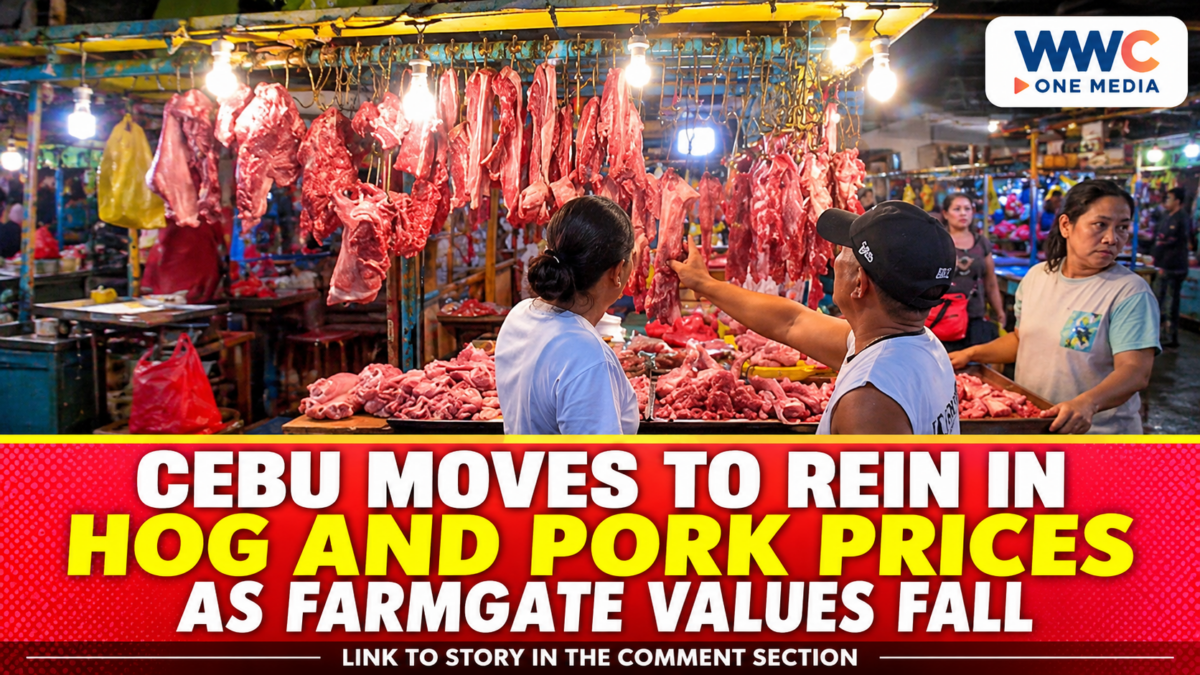
CEBU, Philippines — Cebu’s hog industry is entering the holiday season under growing pressure, with local price-setting efforts unfolding against a wider national problem: falling farmgate prices are squeezing livestock producers even as pork remains an essential food item for consumers.
The issue is particularly important in Cebu, where hog raising, pork retailing and the lechon trade all depend on a reliable supply of market-ready animals. As Christmas and Sinulog demand approaches, the challenge is not simply how much pork reaches the market, but whether local raisers can sell their animals at prices that allow them to stay in business.
Farmgate prices fall 19% nationwide
The pressure on hog producers is reflected in the latest available Philippine Statistics Authority figures.
The PSA’s July-to-September 2026 livestock bulletin placed the national average farmgate price of slaughter hogs at ₱155.06 per kilogram, liveweight. That was 19% lower than the ₱191.51 recorded during the same quarter in 2025.
The monthly figures also showed continued weakness. The national average declined from ₱157.68 per kilogram in July to ₱155.15 in August and ₱152.35 in September.
Farmgate prices represent what raisers receive at the farm. They are not the same as retail pork prices, which also reflect processing, transport, distribution and other costs.
The distinction matters because a low buying price for live hogs does not automatically mean consumers will see an equivalent reduction at the market. The gap between what farmers receive and what households pay can become a major source of tension across the supply chain.
Government steps in as the hog industry struggles
The national government has also moved to address the pressure on domestic producers.
The Department of Agriculture issued Department Order No. 33 on November 7, 2026, imposing a provisional 60-day suspension on imports covered by specified pork tariff classifications under the Safeguard Measures Act.
The measure followed a preliminary determination that increased pork imports had substantially injured the domestic industry. Its implementation period is counted from the issuance of a Bureau of Customs order implementing the measure or 15 days after publication in two newspapers of general circulation, whichever comes first.
The department said the provisional action was intended to respond to the threat of further injury while the safeguard process continued.
The DA estimated that hog producers lost ₱27.9 billion between January and July 2026. It also reported that frozen pork inventories reached approximately 121,000 metric tons in July, with imported products accounting for 94% of the stocks.
The intervention highlights a difficult policy balance: protecting domestic producers while avoiding unnecessary disruption to the supply of pork for consumers and meat processors.
Central Visayas remains a significant livestock region
The PSA’s third-quarter bulletin estimated Central Visayas’ swine inventory at 680,520 heads as of September 30, 2026. The region ranked fourth among the country’s regions in the reported inventory.
That regional figure provides useful context for Cebu’s livestock market, but it should not be mistaken for Cebu province’s own inventory. It covers Central Visayas as a whole.
Cebu’s market also has a distinct lechon supply requirement. The pigs used for roasting may differ in size and characteristics from the larger animals commonly sold for ordinary pork consumption.
This distinction has featured in the province’s continuing discussions about livestock movement and the availability of lechon-sized hogs. WWC ONE MEDIA has previously examined why Cebu continues to look to Negros for lechon pigs despite African swine fever restrictions.
The supply question behind the price debate
Price intervention alone cannot solve every problem facing hog raisers.
Farmers must contend with feed, labor, utilities, animal health and the financial risks associated with disease outbreaks. At the same time, restrictions on livestock movement can affect where buyers obtain animals, particularly when a market requires specific sizes or breeds.
Cebu’s efforts to manage incoming hog shipments from Negros Oriental have therefore become part of a wider discussion about producer protection, supply availability and animal-health safeguards.
The province’s proposed shipment controls and the concerns raised by local raisers were examined in WWC ONE MEDIA’s report on Cebu’s plan to limit live hog shipments from Negros.
The challenge is to prevent unfair pressure on local producers without creating unnecessary shortages or making it harder for legitimate businesses to obtain the animals they need.
Cebu’s lechon supply concerns have also been shaped by African swine fever restrictions, as explored in the province’s struggle to secure lechon-sized pigs.
What happens next?
The effectiveness of price-setting measures will depend on implementation, market monitoring and whether the buying prices provide meaningful relief to raisers without placing unreasonable pressure on consumers.
The national safeguard measure is also temporary and provisional. Its longer-term effect will depend on the formal investigation and any subsequent government decision.
For Cebu, the coming weeks will test whether local producers, traders and authorities can maintain a dependable supply of hogs during the holiday period while keeping the livestock business financially viable.
The central question is no longer just how much pork costs. It is whether the people raising the animals can afford to keep doing so — and whether the market can protect both producers and consumers.