
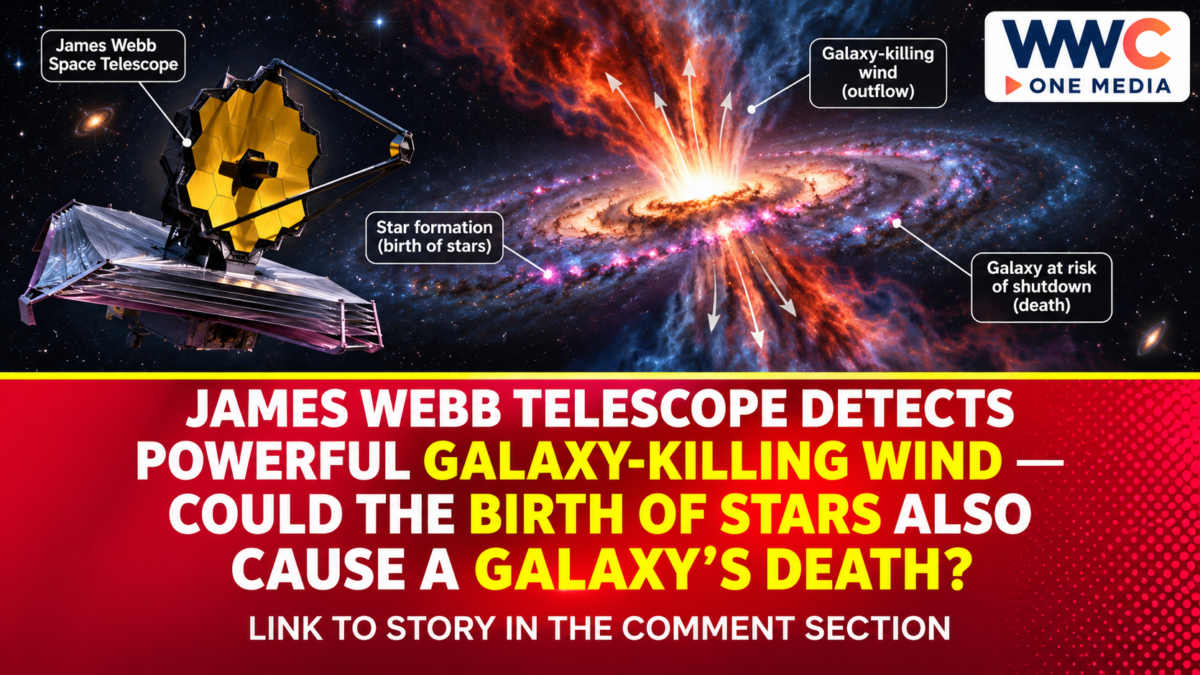
One of the most extraordinary discoveries involving the James Webb Space Telescope suggests that the same processes responsible for creating stars could eventually prevent an entire galaxy from producing new ones.
An international team of astronomers has identified a powerful galaxy-killing wind surrounding CRISTAL-02, a massive galaxy system observed as it existed approximately 1.1 billion years after the Big Bang.
The system is converting gas into stars at an estimated rate equivalent to 260 times the Sun’s mass annually. However, its cold-gas outflow is removing material at approximately twice that rate.
If these conditions persist without substantial replenishment, the galaxy could exhaust its molecular gas reserves within approximately 50 million years.
The findings, originally published on June 10, 2026, in Monthly Notices of the Royal Astronomical Society, provide an important observational clue to one of astronomy’s most challenging questions: why did some of the universe’s earliest massive galaxies stop forming stars so quickly?
Galaxy-killing wind reveals a surprising cosmic contradiction
CRISTAL-02 represents a galaxy system undergoing an unusually intense period of growth.
Its estimated star formation rate is approximately three times the average for comparable galaxies at the same stage of cosmic history.
Under normal circumstances, abundant cold gas supports the development of new stars as material accumulates into sufficiently dense regions.
However, rapid star formation can also generate powerful feedback.
Massive stars evolve quickly and release substantial energy through processes that include supernova explosions. When numerous such events occur within a galaxy, their combined effects can accelerate surrounding material and push gas away from star-forming regions.
This mechanism may explain the enormous outflow observed around CRISTAL-02.
Instead of simply growing larger through continued star formation, the system may be creating conditions that eventually suppress its own development.
The extraordinary consequences of stellar evolution have also featured in WWC ONE MEDIA’s coverage of the Betta Fish Nebula and the cosmic structures produced by a massive star’s violent end.
Although CRISTAL-02 involves processes occurring on a vastly larger scale, both discoveries demonstrate how energy released by stars can reshape their surroundings.
Astronomers detect a wind reaching hundreds of kilometres per second
The researchers combined observations from the James Webb Space Telescope and the Atacama Large Millimeter/submillimeter Array, commonly known as ALMA.
Their measurements reveal an enormous outflow containing an estimated 1.5 billion solar masses of cold gas.
The maximum projected outflow velocity measured from ionised carbon emissions reached approximately 640 kilometres per second.
The researchers also estimated that the cold-gas outflow was removing material at a rate equivalent to 521 solar masses annually.
That substantially exceeds the estimated star formation rate of 260 solar masses per year.
The distinction between solar masses and individual stars is important. These measurements describe quantities of material relative to the mass of the Sun rather than the exact number of stars being created or destroyed.
The resulting imbalance could significantly reduce the amount of material available for future star formation.
However, the measurements do not establish that all the expelled gas will escape permanently. Some material could remain gravitationally connected to the galaxy or eventually return.
Why a galaxy collision could trigger its own decline
CRISTAL-02 appears to involve multiple interacting galactic components rather than a single isolated galaxy.
When galaxies interact, gravitational forces can redistribute their gas and concentrate material within particular regions.
This can create conditions favourable for intense star formation, a phenomenon commonly described as a starburst.
However, the rapid development of massive stars can also generate substantial amounts of energy as those stars evolve and explode.
The researchers identified ongoing merger activity as a likely trigger for the outflow observed in CRISTAL-02.
This creates a possible sequence in which a galaxy collision accelerates star formation before the resulting stellar activity begins to remove the material needed to sustain that growth.
If similar processes occurred frequently throughout the early universe, they could help explain why some galaxies developed substantial stellar populations before rapidly becoming inactive.
Nevertheless, observations of one galaxy system cannot establish that every massive galaxy followed the same evolutionary pathway.
Could a supermassive black hole be responsible?
Astronomers have long investigated the role of active supermassive black holes in suppressing star formation.
When material accumulates around an active black hole, the resulting energetic processes can influence surrounding gas and potentially generate powerful outflows.
However, the CRISTAL-02 research identifies stellar feedback as a plausible explanation for the observed wind.
The estimated energy released by supernova activity is consistent with the energy required to sustain the measured outflow, within the study’s uncertainties.
The researchers do not establish that an active supermassive black hole is necessary to explain the observations.
Nevertheless, the possibility of previously active or difficult-to-detect black hole activity cannot be completely dismissed.
The distinction matters because different mechanisms may influence different stages of galaxy evolution.
Understanding how scientists distinguish between competing explanations also requires recognising the limitations of observational data and theoretical models.
WWC ONE MEDIA previously examined these considerations through its coverage of asteroid-deflection modelling and the importance of accurately interpreting the physical characteristics of celestial objects.
In astronomy, a plausible explanation becomes more persuasive when multiple independent measurements support it.
What does a dead galaxy actually mean?
Despite the dramatic terminology, a galaxy does not literally disappear when astronomers describe it as dead.
The scientific term is quiescent galaxy, referring to a system in which significant new star formation has largely ceased.
Existing stars can remain within the galaxy even when its ability to produce additional stars becomes severely restricted.
For CRISTAL-02, the researchers estimate that continued outflows could potentially remove its molecular gas reservoir within approximately 100 million years, assuming that the outflow rate remains unchanged and fresh gas does not replenish the system.
When the combined effects of ongoing star formation and gas expulsion are considered, depletion could occur within approximately 50 million years.
These are conditional scientific estimates rather than an observed deadline for the galaxy’s destruction.
International telescopes are changing our understanding of the early universe
The CRISTAL-02 discovery demonstrates the scientific value of combining different astronomical instruments.
ALMA’s observations helped researchers characterise the colder gas component of the outflow, while James Webb’s Near Infrared Spectrograph provided information about ionised material.
Examining these different components enabled the researchers to investigate whether the gas was moving together as part of a larger wind.
The study involved an international collaboration with researchers associated with institutions in Australia, Chile, the United States, Japan and other countries.
Complementary instruments are also central to other scientific programmes, as examined in WWC ONE MEDIA’s coverage of the European-Japanese BepiColombo mission and its coordinated investigation of Mercury.
For astronomy, combining different observational capabilities can provide information that would be difficult to obtain through a single instrument.
What happens next for galaxy evolution research?
The next scientific challenge is determining how frequently powerful stellar-driven winds occurred in the early universe.
Researchers will need to identify additional systems, investigate their gas reserves and assess whether similar outflows consistently lead to reduced star formation.
The CRISTAL-02 findings offer a physically plausible mechanism for explaining the rapid development and subsequent inactivity of some early massive galaxies.
However, they do not establish that dark energy theories are incorrect or that supernova-driven winds explain every unexpectedly mature galaxy discovered by James Webb.
The discovery’s importance lies in providing direct observational evidence that powerful stellar feedback was already operating during an early stage of cosmic history.
The same stellar activity that helps a galaxy grow could also begin removing the resources needed for its future growth.
Frequently Asked Questions
What is a galaxy-killing wind?
A galaxy-killing wind is an outflow of material powerful enough to reduce or potentially halt star formation by removing the gas needed to create new stars.
What galaxy did the James Webb Space Telescope study?
Researchers examined CRISTAL-02, a massive interacting galaxy system observed as it existed approximately 1.1 billion years after the Big Bang.
How fast is the CRISTAL-02 galactic wind?
The maximum projected velocity measured from the cold-gas component was approximately 640 kilometres per second, with additional measurement uncertainties.
Could CRISTAL-02 stop forming stars within 50 million years?
Yes, under the study’s assumptions. Continued gas expulsion and star formation could exhaust its molecular gas reserves within approximately 50 million years if substantial new gas does not enter the system.
Does this discovery mean the Milky Way is about to die?
No. The study examines CRISTAL-02 and does not establish an imminent threat to the Milky Way, Earth or the solar system.










