
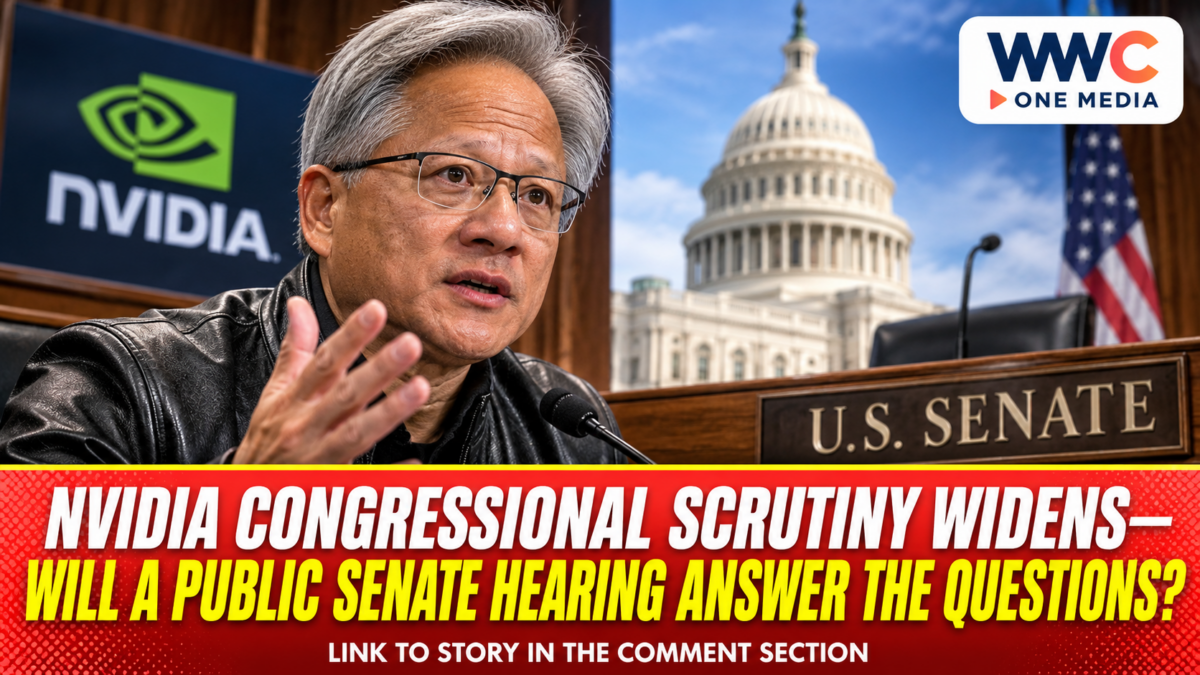
NVIDIA chief executive Jensen Huang is scheduled to face a public US Senate hearing on December 3, 2026, after three House committees confirmed that he and another senior company executive will take part in separate closed-door interviews next week. The proceedings will examine US export controls and national-security concerns involving advanced artificial-intelligence chips.
The new schedule means the congressional examination is continuing despite NVIDIA’s decision to reinstate Huang as chief executive. For the semiconductor industry, the central question is no longer simply who leads the company, but how the United States monitors the movement and potential use of advanced computing technology.
Nvidia congressional scrutiny now has two tracks
The Senate Banking, Housing, and Urban Affairs Committee has listed a full committee hearing titled Protecting America’s AI Advantage: Oversight of U.S. Export Controls for Thursday, December 3, at 10 a.m. The committee identifies Huang as the witness and says the session will be held in open, hybrid format.
That public hearing is separate from the House process. On November 17, the chairmen of the House Permanent Select Committee on Intelligence, House Foreign Affairs Committee and Select Committee on the Chinese Communist Party announced that Huang and NVIDIA General Counsel Tim Teter had voluntarily agreed to transcribed interviews.
The published schedule places Huang’s interview on December 1 and Teter’s on December 2. A November 23 statement from the same chairmen confirmed that both appearances remained scheduled following Huang’s return to the company.
The distinction is important. A transcribed interview conducted behind closed doors is not the same as a public hearing, and neither should be described as a completed investigation. The records establish the planned proceedings, not what the executives will say or what conclusions lawmakers will reach.
Why lawmakers are examining chip exports
The congressional inquiry concerns access to advanced US-made computing products and the effectiveness of export-control safeguards. Such controls are intended to restrict the transfer of sensitive technology to destinations, organisations or end users that fall under US restrictions.
A November 19 disclosure by the House Foreign Affairs Committee added a concrete licensing dimension to the debate. The committee said information released under its authority covered applications involving NVIDIA and AMD chips for China. It reported requests involving 3.4 million AI chips and approvals for more than 879,000.
Those figures should be read carefully. They describe information about export-license applications and approvals, not a confirmed count of chips physically shipped, delivered or used by particular customers. An export licence is an authorisation under specified conditions; it does not by itself prove that a transaction was completed.
WWC has previously examined the congressional disclosure of more than 879,000 approved AI-chip licences, including why approvals and completed deliveries are different measures.
The licensing issue also intersects with NVIDIA’s own business outlook. Its reported China-related sales and forward guidance need to be considered separately from government approvals. A review of NVIDIA’s China chip sales and export outlook explains why an authorised sale, a completed shipment and recognised revenue are not interchangeable.
Huang’s reinstatement did not end congressional questions
NVIDIA disclosed the leadership change in a Form 8-K filed with the US Securities and Exchange Commission. The filing says the board reinstated Jen-Hsun Huang as president, chief executive officer and a member of the board, effective immediately on November 22.
The company’s November 23 announcement said the board voted unanimously after discussions and meetings with Huang. It also stated that the board received input from senior levels of the US government and was confident that his reinstatement posed no national-security risk.
That is the company’s stated position. It does not substitute for the congressional committees’ work, nor does it establish the outcome of any government investigation.
The House committee chairmen made clear in their November 23 statement that the planned interviews would proceed. Their stated concerns include alleged smuggling and diversion of NVIDIA products for Chinese military purposes. Those are investigative concerns expressed by lawmakers, not findings that Huang or NVIDIA has committed an offence.
The leadership decision and the congressional examination therefore answer different questions. The board decided who would lead the company. Lawmakers are seeking information about export controls, access to sensitive technology and the government’s oversight responsibilities.
WWC has also covered NVIDIA’s board decision to restore Huang and its announced compliance changes. That corporate governance story should be kept distinct from the congressional proceedings.
What the proceedings could mean for the semiconductor industry
The hearings matter beyond NVIDIA because export controls affect a wider network of chip designers, manufacturers, distributors, cloud-service providers and customers. Rules governing advanced processors can influence which markets companies serve, how transactions are reviewed and what documentation is required to demonstrate compliance.
For companies operating across borders, uncertainty over licensing and enforcement can complicate sales planning. A stricter review process may affect the timing or availability of certain products in restricted markets. At the same time, clear and consistently enforced rules can help companies understand their obligations and reduce the risk of transactions involving prohibited end users.
The challenge for policymakers is to balance national-security protections with predictable rules for legitimate commercial activity. The challenge for companies is to demonstrate that their compliance systems can identify customers, assess end users and monitor how sensitive products are transferred or accessed.
The wider controversy has also raised questions about the relationship between corporate oversight and government scrutiny. WWC’s earlier examination of the investigation involving Megaspeed and the questions surrounding the chip-security concerns provides background, while keeping allegations separate from established findings.
What happens next
The next scheduled milestones are Huang’s House committee interview on December 1, Teter’s interview on December 2 and the Senate Banking Committee’s public hearing on December 3.
The Senate notice identifies Huang as the witness and lists the session for 10 a.m. in the Dirksen Senate Office Building. The committee says the hearing will be webcast live when it begins.
The House interviews are scheduled as transcribed proceedings, but the public records reviewed do not establish that transcripts or substantive findings will be released immediately afterward. Any further conclusions should be based on official testimony, committee reports, regulatory actions or company disclosures once they become available.
For now, the clearest development is that congressional scrutiny is continuing on two fronts: private House interviews and a scheduled public Senate hearing. The results—not the existence of the hearings—will determine whether lawmakers identify gaps in export-control enforcement or recommend changes to the rules.
Frequently asked questions
1. When will Jensen Huang appear before the US Senate?
The Senate Banking Committee has scheduled Huang for a public hearing on December 3, 2026, at 10 a.m. Eastern Time.
2. Why are House committees interviewing Jensen Huang?
Three House committees have scheduled a transcribed interview to examine national-security concerns involving advanced NVIDIA chips, export controls and possible access by restricted Chinese actors.
3. Will NVIDIA General Counsel Tim Teter also appear?
Yes. The House committees announced that Teter agreed to a separate transcribed interview scheduled for December 2, one day after Huang’s interview.
4. Does an approved export licence prove that chips were shipped to China?
No. A licence authorises a specified transaction under applicable conditions. It does not independently prove that the chips were shipped, delivered or used by the intended buyer.
5. Does Huang’s reinstatement mean the congressional inquiry is over?
No. The House committee chairmen confirmed on November 23 that the scheduled interviews would proceed after NVIDIA reinstated Huang. The public records reviewed do not show that the congressional examination has concluded.










