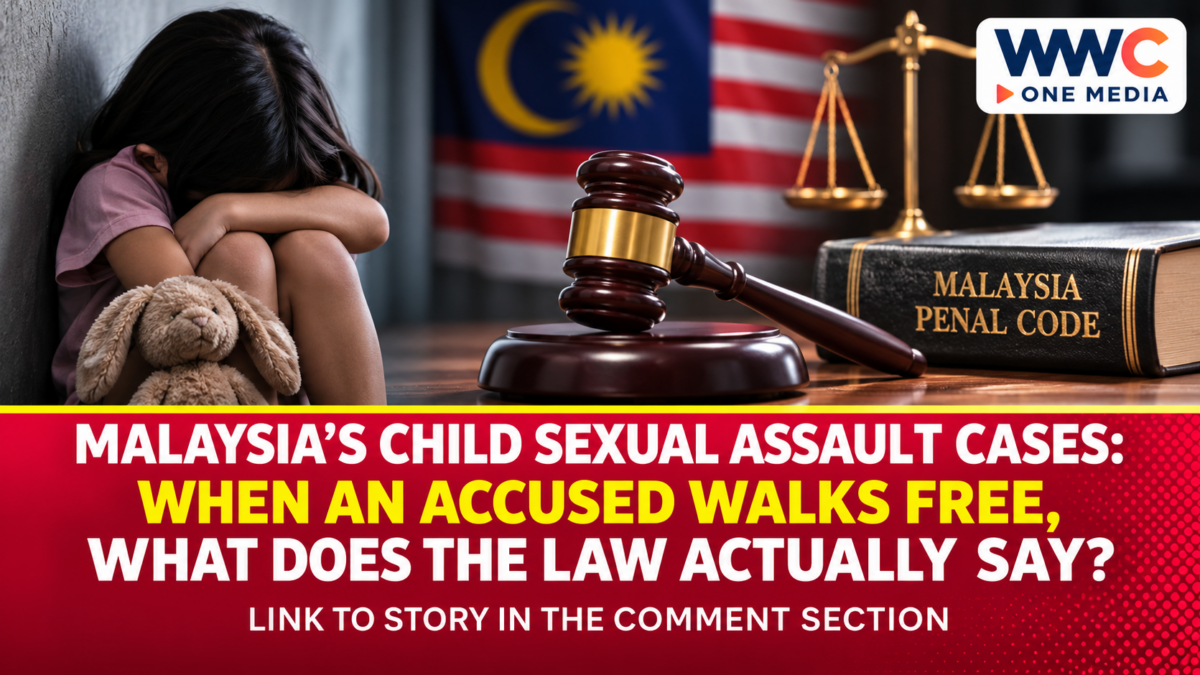
MALAYSIA — Malaysia’s child protection law involves two fundamental responsibilities within the criminal justice system: safeguarding vulnerable children and ensuring that individuals accused of criminal offences receive fair legal proceedings.
When a criminal case ends without a conviction, the precise wording of the court’s decision becomes particularly important.
An acquittal and a discharge not amounting to an acquittal (DNAA) are legally different outcomes under Malaysia’s Criminal Procedure Code, with different implications for possible future proceedings.
Understanding these distinctions is essential when evaluating cases involving alleged sexual offences against children, particularly those requiring additional care and protection.
Beyond the courtroom, questions surrounding institutional safeguarding, confidential reporting and the welfare of children remain important public concerns.
Malaysia Child Protection Law: Why the Court’s Exact Decision Matters
Malaysia’s Criminal Procedure Code, also known as Act 593, establishes procedures for determining whether criminal charges are sufficiently supported by evidence.
Under Section 173, the court must assess whether the prosecution has established a prima facie case at the conclusion of its evidence in applicable proceedings.
A similar requirement is established under Section 180 for trials governed by that provision.
A prima facie case requires credible evidence supporting the essential elements of an alleged offence that could justify a conviction if left unanswered.
If the prosecution fails to meet the applicable threshold, the court must record an acquittal.
If that threshold is satisfied, the accused may be called upon to present a defence.
However, requiring an accused person to enter a defence does not establish criminal guilt.
The prosecution must ultimately satisfy the applicable standard of proof before a conviction can be recorded.
These procedural safeguards are particularly important in sensitive criminal cases where public reactions may develop before the evidence has been fully examined.
Acquittal and DNAA: What Is the Difference?
Section 254 of Malaysia’s Criminal Procedure Code allows the prosecution to discontinue proceedings against an accused person before judgment, subject to the applicable procedures.
A resulting discharge does not constitute an acquittal unless the court specifically directs otherwise.
This distinction can determine whether criminal proceedings may subsequently resume.
| Legal outcome | General meaning |
|---|---|
| Acquittal | The court records an outcome in favour of the accused without conviction. |
| Discharge not amounting to an acquittal | Proceedings end at that stage without a final acquittal, leaving open the possibility of renewed prosecution. |
| Conviction | The accused is found guilty through the applicable legal process. |
| Prosecution discontinued | The prosecution elects not to continue, with the legal consequences depending on the resulting court order. |
Section 254A also provides for the reinstatement of a trial in specified circumstances when a discharged individual is subsequently charged again with the same offence.
The precise court order must therefore be examined before determining whether a case has permanently concluded or whether further proceedings remain possible.
It is equally important not to portray a person who has been acquitted as someone who has committed the alleged offence.
Public suspicion cannot substitute for a judicial determination.
Why Protecting Children Remains Essential
The outcome of criminal proceedings should not be confused with the broader responsibilities of institutions involved in child welfare.
Malaysia’s Child Act 2001 establishes protections for children involved in specified criminal investigations, judicial proceedings and welfare-related circumstances.
A particularly important provision is Section 15, which restricts the publication of information capable of revealing the identity of a child involved in covered cases.
These restrictions extend beyond publishing the child’s name.
Residential addresses, educational institutions, photographs and other identifying details may also fall within the prohibition.
The law additionally restricts publication of images of other individuals, locations or objects when those images could lead to identification of the child.
The broader responsibilities surrounding suspected abuse have previously been examined in WWC ONE MEDIA’s coverage of Malaysia’s child protection rules and institutional responses to suspected abuse.
Protecting a child’s privacy should remain a priority regardless of whether criminal proceedings result in an acquittal, conviction or another procedural outcome.
Publishing a Child’s Identity Could Carry Serious Penalties
Under Section 15 of Malaysia’s Child Act 2001, a person convicted of violating the applicable reporting and publication restrictions may face a fine of up to RM10,000, imprisonment for up to five years, or both.
The legislation also provides limited circumstances in which an authorised court may dispense with certain restrictions.
For journalists and social media publishers, removing a child’s name is not necessarily sufficient to prevent identification.
A combination of details involving family relationships, educational institutions, residential locations or recognisable photographs could still reveal the child’s identity.
Responsible reporting requires consideration of how separate pieces of information might be combined.
The same principle applies to headlines, social media captions, photographs and public comments.
The role of responsible journalism in child welfare has also been examined in regional initiatives bringing journalists and government institutions together to strengthen child protection.
Public interest in a criminal case does not require exposing a vulnerable child’s personal information.
An Acquittal Does Not Establish That a Child Fabricated an Allegation
One of the most important distinctions in criminal reporting concerns the difference between insufficient evidence and a proven false allegation.
A court may acquit an accused person because the prosecution has failed to establish its case at the required evidentiary threshold.
That outcome must be respected.
However, an acquittal does not automatically establish that a complainant deliberately provided false information.
Such a conclusion would require its own evidentiary basis.
Similarly, the existence of a criminal allegation does not establish that the accused committed the alleged offence.
Both principles can coexist within a fair criminal justice system.
For children requiring additional communication or accessibility support, safeguarding arrangements should be responsive to their individual circumstances.
Disability should not be treated as an automatic indication of unreliability, nor should vulnerability be used as a substitute for examining the evidence.
Institutional Safeguarding Extends Beyond Criminal Proceedings
Organisations responsible for children should distinguish criminal liability from their broader safeguarding responsibilities.
Appropriate preventive arrangements may include clear reporting procedures, staff training, suitable supervision and confidential mechanisms through which concerns can be raised.
Any institutional response must also respect applicable laws and fair treatment requirements.
Comparable policy questions have emerged elsewhere in Asia-Pacific, including Japan’s development of a child-safety screening framework for specified education and childcare roles.
Different jurisdictions have different legal requirements, but the wider policy challenge involves strengthening preventive safeguards without treating unresolved allegations as convictions.
Criminal proceedings determine liability for alleged offences. Institutional safeguarding addresses the broader responsibility of reducing risks and supporting children appropriately.
Neither function should be confused with the other.
What Happens Next After a Criminal Case Ends?
The next legal steps depend on the precise court order, the applicable procedural requirements and any subsequent action by the relevant parties.
Where an acquittal has been recorded, its legal effect must be respected, subject to any lawful appeal process.
Where a DNAA has been granted, further proceedings may remain possible under applicable legal provisions.
Without the original judgment or court order, it would be inappropriate to speculate about why a particular accused person was released or whether prosecutors intend to pursue additional legal action.
The broader responsibility remains clear: criminal justice must be grounded in evidence, accused individuals must receive fair treatment, and children’s dignity and privacy must be protected.
These objectives are complementary foundations of a responsible justice system.
Frequently Asked Questions
What is the difference between an acquittal and a DNAA in Malaysia?
An acquittal is a judicial outcome without conviction in favour of the accused. A DNAA ends proceedings at that stage without necessarily preventing renewed prosecution.
What happens if the prosecution fails to establish a prima facie case?
Under the applicable provisions of Malaysia’s Criminal Procedure Code, the court must record an acquittal.
Can the media identify a child involved in a sexual assault case?
Section 15 of Malaysia’s Child Act 2001 restricts publication of information and images that could identify children involved in covered cases, subject to authorised exceptions.
What is the penalty for violating Malaysia’s child identity protection rules?
Upon conviction, a person may face a fine of up to RM10,000, imprisonment for up to five years, or both.
Does an acquittal prove that a complainant lied?
No. An acquittal does not automatically establish that a complainant fabricated an allegation. Such a claim requires separate evidence.