
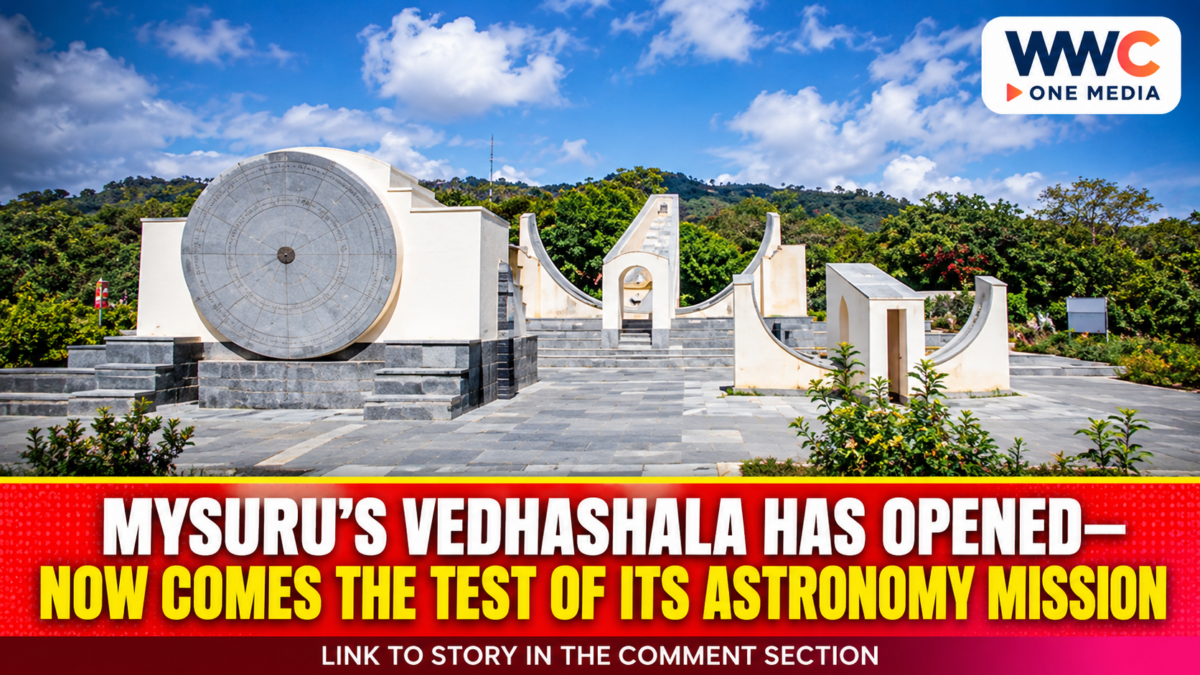
MYSURU, Karnataka — An Indian-style astronomical observatory known as Vedhashala is being developed at Bharati Yogadhama in Uttanahalli, Mysuru, as a centre for studying celestial movements through traditional instruments and mathematical methods. The institution’s own website records the inauguration of the observatory’s first publicised stage on December 7, 2025, making its next challenge less about announcing a new attraction and more about demonstrating what the facility can deliver.
The project offers a distinctive approach to astronomy education: bringing visitors into contact with instruments inspired by historical Indian observatories while presenting the calculations and observations associated with traditional astronomical knowledge. Its stated ambitions include research, public education and work on the Indian calendar. But those ambitions should be distinguished from independently verified scientific outcomes.
Mysuru observatory builds on a different model of astronomy learning
Bharati Yogadhama identifies the facility as Vedhashala – Jantar Mantar, describing it as an astronomical observatory. Its public project page says the institution is researching methods to calculate tithi, or lunar days, with the broader aim of developing a Panchanga, an Indian calendar and almanac.
The organisation also lists educational presentations, access to traditional texts and research material, a museum and theatre, and assessments involving ancient and modern astrophysics among the project’s intended activities.
That combination gives the site a broader purpose than simply displaying historic-looking structures. It is being presented as a place where visitors and learners can encounter the relationship between observation, mathematics, calendars and cultural practice.
However, the project description is an account of the organisation’s objectives. It does not, by itself, demonstrate that the observatory has completed a validated research programme or that its calendar calculations have been independently tested.
What the institution says visitors and students can explore
The Vedhashala project is presented as a learning environment for students, researchers and members of the public. Bharati Yogadhama says its plans include audio-visual material explaining the relationship between astrology and Indian life, as well as access to older astronomical and astrological texts.
The institution also identifies Aryabhata, Bhaskaracharya and Varahamihira as historical figures whose contributions it wants to bring into public discussion.
For learners, the value of an observatory depends not only on the presence of instruments but also on how those instruments are explained. A visitor should be able to understand what a device measures, what mathematical principle it uses, how observations are recorded and where its limitations lie.
That educational distinction matters. A facility can preserve historical techniques and encourage interest in mathematics without every traditional claim automatically becoming an established result of modern astrophysics.
WWC has also covered how astronomy can be made more accessible to audiences through practical skywatching, including its guide to the November Beaver Moon and Leonid meteor shower. The two initiatives operate in different ways, but both show how public engagement can begin with helping people understand what they are observing.
The Jantar Mantar comparison needs context
The name connects the Mysuru project with India’s historic Jantar Mantar observatories. That comparison is useful as a reference to the tradition of large-scale instruments designed to observe and calculate astronomical phenomena.
But a modern visitor should not assume that a new observatory is identical in age, purpose, design or historical status to the established Jantar Mantar complexes. Bharati Yogadhama describes its facility as a Jaipur-style observatory; its public description does not establish that the Mysuru site is a replica of any one historic complex.
The distinction is important for accurate interpretation. Historical instruments can demonstrate how earlier scholars approached questions involving time, celestial positions and mathematical relationships. Their value can be explained without suggesting that every historical method is interchangeable with contemporary scientific equipment.
A useful visitor experience would therefore identify the origin and function of each instrument, explain the calculations involved and make clear which activities are historical demonstrations, educational exercises or active research.
How it fits into Mysuru’s wider science landscape
Vedhashala is not the only astronomy-focused facility in Mysuru. The Indian Institute of Astrophysics operates the COSMOS-Mysuru project, a planetarium and education centre developed with the University of Mysore. Its official description presents a modern LED-dome facility alongside exhibitions, public programmes and student and teacher activities.
The two projects have different institutional descriptions and approaches. COSMOS-Mysuru is presented as a contemporary planetarium and training centre, while Bharati Yogadhama describes Vedhashala around traditional instruments, calendar calculations and the study of historical knowledge.
That difference could give the city a wider range of educational experiences. One facility can introduce visitors to immersive astronomical presentations, while another can invite them to examine how observation and geometry were used in earlier traditions.
The opportunity, however, depends on the quality of interpretation and access. Schools and visitors benefit most when a facility provides clear explanations, trained educators, reliable schedules and transparent information about what participants can actually see or do.
WWC’s coverage of Davao students developing a CubeSat experiment offers another example of how space science can be brought closer to learners through hands-on work. The projects are not directly comparable, but both raise the question of how institutions can turn interest in space into meaningful learning opportunities.
The scientific distinction: preserving methods and testing claims
One of Vedhashala’s stated aims is to examine astronomical calculations through observation and mathematical methods. That goal makes transparency especially important.
A strong research programme would explain its procedures, identify the data used, document how observations are taken and make its results available for scrutiny. Where calculations are compared with modern astronomical references, the method and differences should be clearly reported.
This does not diminish the historical importance of traditional instruments. It gives the public a way to understand both their original context and what can be learned from using them today.
The distinction is relevant beyond Mysuru. WWC has reported on the DOST’s science and technology activities in the Zamboanga Peninsula, where public exhibits and student activities were part of a wider effort to bring science closer to communities. Across different settings, educational value is strengthened when demonstrations are supported by accurate explanations and opportunities for learners to ask questions.
What happens next
Bharati Yogadhama’s public pages confirm that Vedhashala is an established project and that the institution identifies December 7, 2025, as the date of its inauguration. The same pages outline its aims, but the records reviewed do not provide a complete, independently verifiable account of the facility’s current operating schedule, total project cost, final completion date or published research results.
Those are the practical details that would help the public assess its development. Clear information on visitor access, school programmes, instrument demonstrations, research activities and the status of remaining facilities would make the project easier to evaluate.
For Mysuru, Vedhashala’s significance will ultimately depend on more than its resemblance to historic observatories. Its lasting contribution will be measured by how effectively it teaches visitors to understand observation, mathematics and the history of astronomy—and by whether its research claims are documented in a way that can be examined.
Frequently asked questions
1. What is Vedhashala in Mysuru?
Vedhashala is an astronomical observatory project at Bharati Yogadhama in Uttanahalli, Mysuru. The institution describes it as a Jantar Mantar-style facility focused on traditional astronomical instruments, observation and calendar-related research.
2. When was Vedhashala inaugurated?
Bharati Yogadhama’s website identifies December 7, 2025, as the inauguration date of its Vedhashala-Jantar Mantar facility.
3. Where is the observatory located?
The observatory is associated with Bharati Yogadhama at Vijayagiri, Uttanahalli, Mysuru, Karnataka, India.
4. What is the observatory intended to study?
The institution says its work includes calculating tithi or lunar days, studying traditional astronomical knowledge and developing a Panchanga, an Indian calendar and almanac.
5. Is Vedhashala the same as the COSMOS-Mysuru planetarium?
No. They are separate projects. COSMOS-Mysuru is an LED-dome planetarium and education centre associated with the Indian Institute of Astrophysics and the University of Mysore. Vedhashala is Bharati Yogadhama’s traditional-instrument observatory project.










