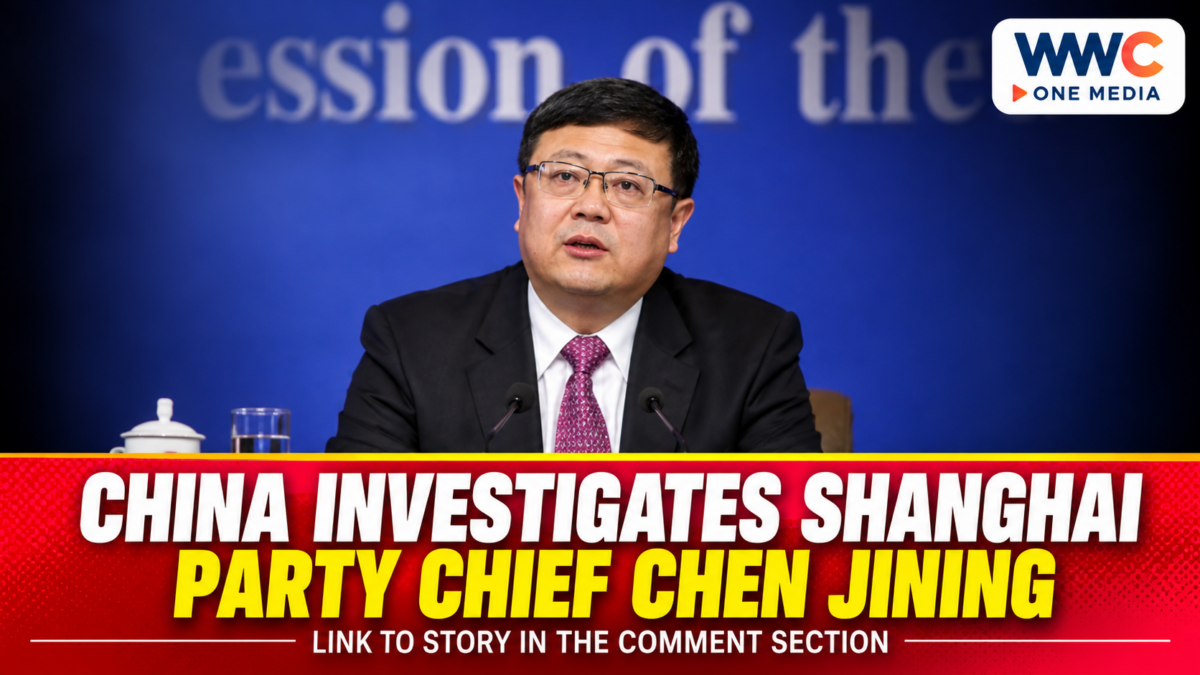
SHANGHAI / BEIJING — November 25, 2026 — China’s anti-corruption campaign has reached one of the country’s most strategically important political positions after Shanghai Communist Party Secretary Chen Jining was placed under disciplinary and supervisory investigation, making him the latest member of the ruling party’s top leadership to face scrutiny.
The announcement was made on November 24 by China’s Central Commission for Discipline Inspection and the National Commission of Supervision. Chen is being investigated for suspected serious violations of discipline and law, an official formulation commonly used in high-level Chinese disciplinary cases.
No specific allegations were disclosed in the announcement. Authorities have not publicly detailed the conduct under investigation, identified any alleged financial transactions or announced criminal charges.
Chen’s case is particularly significant because he is a member of the Communist Party’s 24-member Politburo and heads the party organisation in Shanghai, China’s leading financial and commercial centre.
The investigation makes him the fourth member of the Politburo elected in 2022 to face a publicly announced investigation since 2025, following He Weidong, Zhang Youxia and Ma Xingrui.
The development adds another major uncertainty to China’s political establishment as the Communist Party approaches its 2027 leadership cycle.
CHEN JINING: A POWERFUL POLITICAL FIGURE NOW UNDER INVESTIGATION
Chen Jining, born in February 1964, built his career through academia, environmental policy and government administration before entering China’s highest political ranks.
He studied civil and environmental engineering at Imperial College London, where he completed graduate studies in environmental systems analysis and earned a Doctor of Engineering degree.
He later became president of Tsinghua University, one of China’s most prominent universities, before moving into central government.
In 2015, Chen became China’s minister of environmental protection. He subsequently served as mayor of Beijing before joining the Politburo in 2022.
He became Shanghai’s Communist Party secretary in 2022, placing him in charge of the party’s political leadership in a city central to China’s financial markets, international trade, advanced manufacturing and technology industries.
His career made him one of China’s prominent technocratic political figures. His investigation now places that position under extraordinary scrutiny.
The distinction between his role and the city’s mayoralty is important. The party secretary leads the Communist Party organisation in Shanghai, while the mayor heads the municipal government. The two offices are not interchangeable.
SHANGHAI’S PARTY LEADERSHIP BACKS THE CENTRAL INVESTIGATION
The announcement was followed by an expanded meeting of the Shanghai Municipal Party Committee Standing Committee on the evening of November 24.
The committee expressed firm support for the central leadership’s decision to investigate Chen and pledged to follow the direction set by the Communist Party’s Central Committee.
Its statement framed the investigation as part of the party’s continuing effort to enforce strict internal governance and maintain its anti-corruption campaign.
The response is politically important because it demonstrates that Shanghai’s senior party leadership has publicly aligned itself with the central disciplinary decision.
However, the statement did not provide details of the allegations against Chen, announce a replacement or establish the outcome of the investigation.
As of November 25, the public announcement confirms that Chen is under investigation. It should not be treated as a final criminal judgment or as confirmation that all formal procedures for removing him from office have been completed.
WHY CHEN’S INVESTIGATION IS THE FOURTH MAJOR POLITBURO CASE
Chen’s case follows a series of investigations involving other members of the Politburo formed after the Communist Party’s 20th National Congress in 2022.
The earlier cases involved senior figures from both the civilian political establishment and the military leadership.
He Weidong: In October 2025, Chinese authorities announced that He, a Politburo member and vice chairman of the Central Military Commission, had been expelled from the Communist Party and military service following an investigation.
Zhang Youxia: In January 2026, China’s Ministry of National Defense announced that Zhang, a Politburo member and vice chairman of the Central Military Commission, was under investigation alongside senior military official Liu Zhenli. Zhang was subsequently expelled from the party and military in September.
Ma Xingrui: In April 2026, authorities announced an investigation into Ma, a Politburo member and former senior regional official. He was expelled from the Communist Party and dismissed from public office in July. In November, prosecutors formally indicted him on bribery charges.
Chen is the latest member of that same 2022 Politburo cohort to face an announced investigation.
The cases are not identical. Some have progressed to party expulsion or criminal prosecution, while Chen’s publicly announced case remains at the investigation stage.
WWC has previously examined the indictment of former Politburo member Ma Xingrui, which shows how a senior disciplinary investigation can eventually move into the criminal justice system.
WHY SHANGHAI MAKES THIS INVESTIGATION DIFFERENT
Shanghai is not simply another provincial-level political administration.
It is one of China’s most important financial centres and a major international gateway for trade, investment, shipping, technology and manufacturing.
The city’s leadership has a direct role in implementing central government priorities and overseeing a political and administrative environment that attracts multinational companies and international financial institutions.
Chen was still publicly identified as Shanghai’s party secretary in the city’s official international leadership activities published in November, including a November 5 meeting with United Nations Development Programme Administrator Alexander De Croo.
The timing makes the investigation particularly notable. It comes as Shanghai continues promoting itself as a centre for international investment, financial services and advanced industries.
For foreign businesses, the investigation does not automatically mean a change in Shanghai’s economic policy or an interruption to commercial operations. No such measures were announced in the disciplinary notice.
But the case may attract attention because of the importance of political leadership continuity in a city whose development priorities are closely tied to China’s national economic strategy.
XI JINPING’S ANTI-CORRUPTION CAMPAIGN ENTERS ANOTHER POLITICAL TEST
President Xi Jinping has made anti-corruption enforcement a defining feature of his leadership since taking control of the Communist Party in 2012.
The campaign has targeted officials across central government, provincial administrations, state-owned enterprises and the military.
The Communist Party’s stated position is that corruption weakens political discipline, undermines public administration and damages the effectiveness of government institutions.
The latest investigation is consistent with the campaign’s continued reach into senior political ranks.
However, the public announcement does not establish Chen’s personal relationship with Xi, the president’s private motives or the specific circumstances that triggered the investigation.
Those questions require evidence beyond the fact that a senior official has been placed under disciplinary scrutiny.
The wider political context is nevertheless significant. WWC previously examined China’s removal of two senior military figures, Zhang Youxia and Liu Zhenli, and the subsequent effort to rebuild the People’s Liberation Army’s senior command structure.
The civilian and military cases together show that the campaign is affecting different parts of the Communist Party’s governing system.
THE 2027 LEADERSHIP TRANSITION IS NOW UNDER GREATER SCRUTINY
The investigation comes as China prepares for its 21st National Congress of the Communist Party in 2027.
The congress is held every five years and plays a central role in determining the party’s future leadership and political direction.
Chen’s investigation could affect the range of senior officials available for future appointments, particularly because the Shanghai party secretary position has historically been an influential post in China’s political system.
However, it is too early to conclude that the investigation was initiated to influence the next leadership selection or that it confirms a particular succession plan.
The Communist Party has not publicly announced the full implications of Chen’s case for the 2027 leadership process.
WWC has examined the wider political preparations in its report on China’s expanded 2027 Communist Party Congress and the leadership questions surrounding Xi Jinping.
The investigation also adds to the uncertainty surrounding the future composition of China’s top political and military institutions. The party’s disciplinary campaign has already reached figures who previously occupied some of the most influential positions in the country.
WHAT HAPPENS NEXT FOR CHEN JINING?
The immediate next step is the disciplinary and supervisory investigation conducted by the Central Commission for Discipline Inspection and the National Commission of Supervision.
The authorities have not yet released a detailed account of the alleged violations or announced whether Chen will face additional party disciplinary action, removal from office or criminal proceedings.
Those developments should be reported separately as they become official.
The case involving Ma Xingrui demonstrates that an investigation can eventually lead to expulsion and criminal prosecution, but it does not establish that Chen’s case will follow precisely the same timetable or outcome.
For now, the confirmed facts are limited but politically consequential: Shanghai’s party secretary and a member of China’s Politburo is under investigation, the city’s senior party leadership has publicly supported the central decision, and the allegations have not yet been specified.
The investigation places another powerful official under scrutiny at a sensitive moment for China’s leadership.
As Beijing moves toward the 2027 Communist Party Congress, the central question is no longer only how far the anti-corruption campaign will reach. It is also how the continuing removal or investigation of senior officials will affect the stability, experience and future composition of China’s ruling leadership.