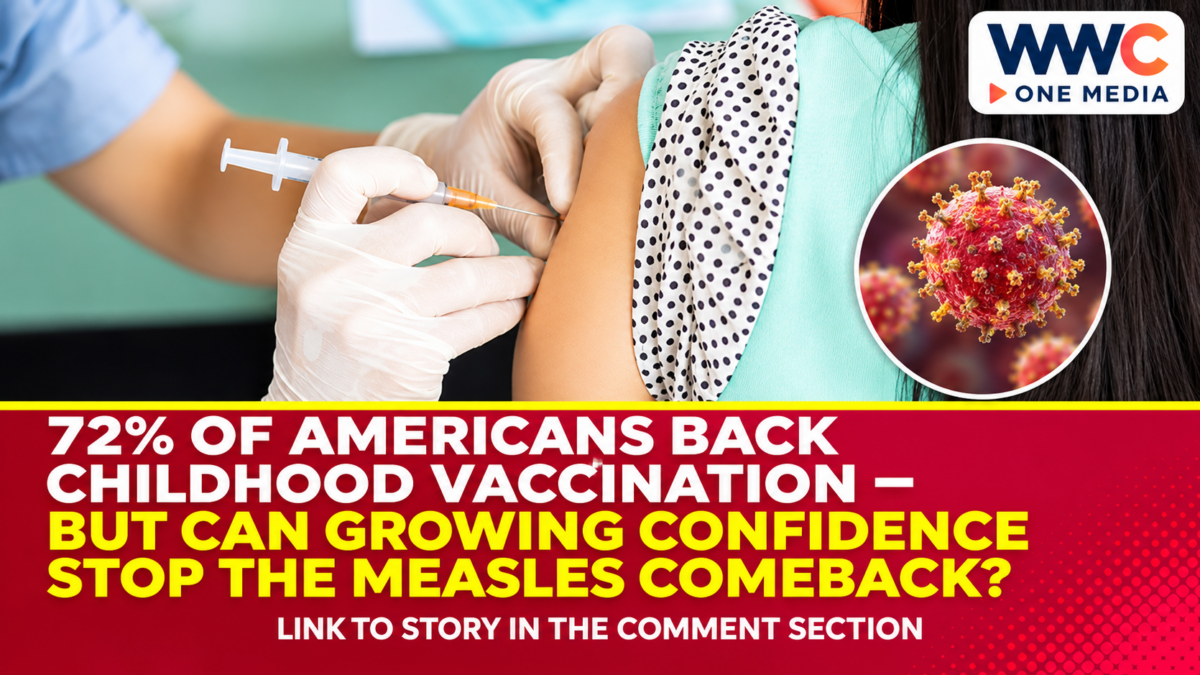
WASHINGTON, United States — Childhood vaccination support is showing modest signs of improvement in the United States, with 72% of American adults considering it extremely or very important for parents to vaccinate their children.
The latest Gallup survey, released on November 24, 2026, reveals that the proportion expressing the strongest support for childhood immunisation increased by seven percentage points compared with 2024.
However, the improvement comes against a troubling public health backdrop.
The United States recorded 5,838 confirmed measles infections as of November 19, 2026, and recently lost the measles elimination status it had maintained since 2000.
The contrast between public attitudes and actual disease transmission raises an important question: Can renewed confidence translate into sufficient immunisation coverage to protect vulnerable communities?
Childhood Vaccination Support Remains Below Historical Highs
Gallup’s October 1–19 survey found that 47% of American adults considered vaccinating children extremely important, while another 25% regarded it as very important.
Combined support reached 72%, compared with 69% in 2024.
Although the latest combined result represents a modest numerical improvement, it is statistically similar to the previous reading.
More significantly, childhood vaccination support remains substantially below the 94% recorded in 2001.
| Survey year | Extremely or very important |
|---|---|
| 2001 | 94% |
| 2024 | 69% |
| 2026 | 72% |
The latest results suggest that stronger public confidence is possible, but the long-term decline has not been reversed.
The timing of the survey is also important. Interviews were completed before the November 17 announcement that the United States had lost its measles elimination status.
Consequently, the survey cannot establish whether that announcement subsequently changed Americans’ vaccination attitudes.
America’s Measles Comeback Highlights Immunisation Gaps
The latest national disease surveillance figures illustrate the urgency of improving childhood immunisation coverage.
The US Centers for Disease Control and Prevention (CDC) recorded 5,838 confirmed measles infections by November 19, compared with 2,289 throughout 2025 and 285 in 2024.
The country has also recorded 43 new outbreaks in 2026.
These developments follow the withdrawal of America’s measles elimination designation, a setback examined in WWC ONE MEDIA’s coverage of the United States losing its measles elimination status after 26 years.
Measles elimination does not mean that a country can never record an imported infection. It refers to interrupting sustained domestic transmission.
Restoring that achievement will require effective disease surveillance and sufficient population immunity to prevent prolonged transmission.
For healthcare systems, prevention remains an important strategy for reducing avoidable medical complications and pressure on public health resources.
Political Differences Continue to Shape Vaccine Confidence
The latest survey identifies a substantial divide between Americans with different political affiliations.
Among Democrats and Democratic-leaning independents, 91% consider childhood vaccination extremely or very important. The corresponding figure among Republicans and Republican-leaning independents is 50%.
However, attitudes towards vaccination should also be distinguished from opinions concerning government requirements.
People may support vaccination while holding different views about how immunisation policies should be implemented.
For public health authorities, this distinction matters when developing educational programmes and communicating with communities.
The challenge is not simply to obtain agreement about vaccination policies. It is to help families make informed healthcare decisions using reliable scientific evidence.
Questions surrounding public confidence are not confined to the United States, as demonstrated by Mandaue’s measles vaccination campaign and the challenges associated with vaccine hesitancy.
Effective communication must address legitimate questions about vaccine benefits, possible side effects and individual medical circumstances without reinforcing unsupported health claims.
Vaccination Rates Reveal a More Urgent Challenge
Public opinion surveys measure attitudes, not the number of children who have received recommended vaccines.
Actual vaccination coverage provides a more direct indication of population protection.
American kindergarten MMR vaccination coverage declined from 95.2% in the 2019–2020 school year to 92.4% in 2025–2026, leaving approximately 280,000 kindergarteners at risk.
National averages can also conceal substantial differences between communities.
Even when overall vaccination coverage appears relatively high, neighbourhoods with larger concentrations of susceptible individuals may experience outbreaks.
This is particularly important for infants who are too young to receive routine vaccinations and people who cannot receive certain vaccines for medical reasons.
The practical difficulties of reaching eligible children have also been examined in Iloilo’s measles-rubella vaccination campaign.
For healthcare providers, improving coverage may require accessible vaccination services, reliable appointment reminders, appropriate follow-up and clear communication with parents.
Scientific Evidence Does Not Support a Vaccine-Autism Link
Gallup’s latest survey also examined public beliefs concerning vaccines and autism.
Such findings measure what respondents believe; they do not establish a medical relationship.
The World Health Organization’s Global Advisory Committee on Vaccine Safety reaffirmed in December 2025 that high-quality scientific evidence does not support a causal relationship between vaccination and autism spectrum disorder.
Its assessment examined systematic reviews incorporating research published between January 2010 and August 2025.
The committee also evaluated evidence involving vaccine ingredients, including thiomersal and aluminium.
Maintaining a clear distinction between public perceptions and scientific findings is essential when discussing childhood healthcare.
Vaccines, like other medical interventions, can have side effects and may be unsuitable for certain individuals with specific medical contraindications.
Nevertheless, unsupported claims should not be treated as equivalent to conclusions established through rigorous scientific research.
Parents with questions about vaccination should discuss their children’s individual circumstances with qualified healthcare professionals.
Why the MMR Vaccine Remains Important
Measles can cause serious complications, including pneumonia and inflammation of the brain.
The combined measles, mumps and rubella vaccine provides protection against three infectious diseases.
Two doses of measles-containing vaccine are approximately 97% effective against measles, compared with approximately 93% effectiveness after one dose.
Although breakthrough infections remain possible, vaccination substantially reduces the likelihood of developing the disease.
Healthcare professionals can advise families about appropriate vaccination timing, medical contraindications and additional precautions during outbreaks or international travel.
For communities, the benefits of immunisation extend beyond individual protection. High population immunity helps limit transmission and protects people who cannot receive certain vaccines.
What Happens Next for Childhood Vaccination?
The latest polling suggests that strong support for childhood immunisation has improved on some measures, but rebuilding confidence will require sustained effort.
The next meaningful indicators will include updated vaccination coverage, confirmed disease surveillance figures and future surveys measuring public attitudes.
Public health authorities must also distinguish between families experiencing practical barriers to vaccination and those who have concerns about vaccine safety or government policies.
These challenges may require different approaches.
For the United States and other internationally connected economies, preventing measles outbreaks remains important to healthcare capacity, educational continuity and community wellbeing.
The latest survey offers grounds for cautious optimism.
However, the ultimate measure of recovery will not be the percentage of people expressing support for childhood vaccination. It will be whether more eligible children receive appropriate protection and whether sustained measles transmission can be interrupted.
Frequently Asked Questions
What percentage of Americans support childhood vaccination in 2026?
Gallup found that 72% consider childhood vaccination extremely or very important. This includes 47% expressing the strongest level of support.
Has childhood vaccination support increased significantly?
The combined increase from 69% in 2024 to 72% in 2026 is not statistically significant. However, the strongest category of support increased by seven percentage points.
How many measles cases has the United States recorded in 2026?
The CDC reported 5,838 confirmed infections as of November 19, 2026. The figure remains preliminary.
Do childhood vaccines cause autism?
No. High-quality scientific evidence does not support a causal relationship between vaccines and autism.
How effective is the measles vaccine?
Two doses provide approximately 97% protection against measles, while one dose provides approximately 93% protection. Individual vaccination decisions should be discussed with a qualified healthcare professional.