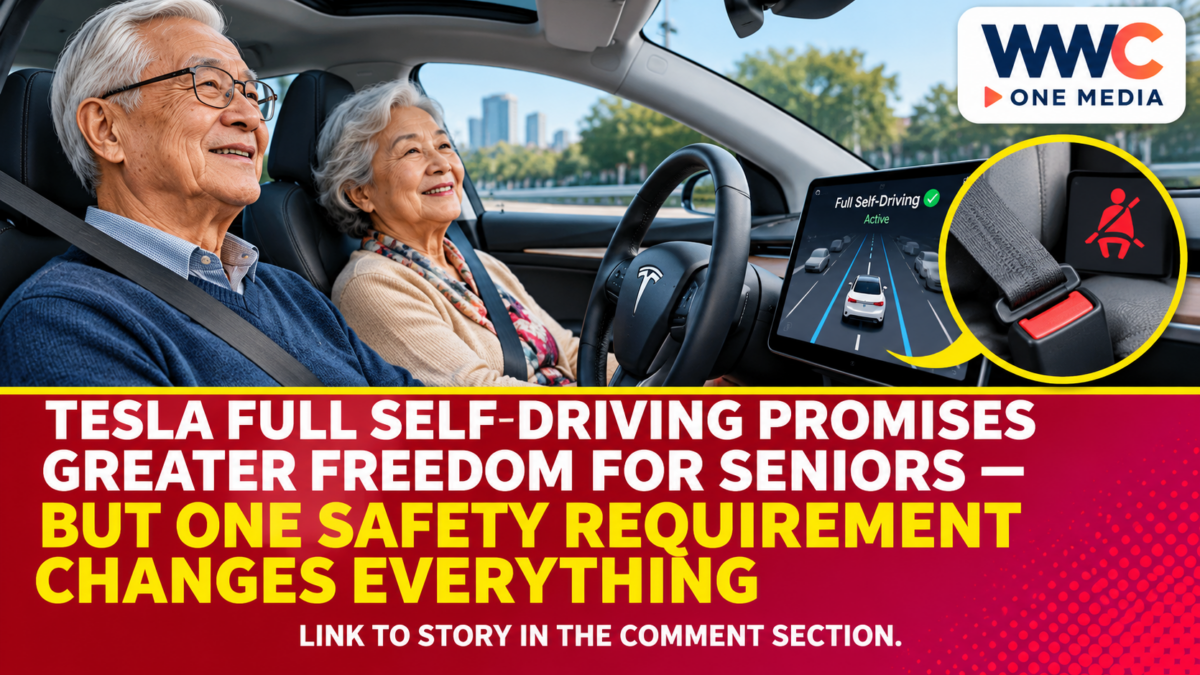
UNITED STATES — Tesla Full Self-Driving technology is being promoted as a way for older motorists to maintain their independence, but the electric vehicle manufacturer’s own operating instructions highlight a critical limitation: drivers must remain attentive and capable of taking immediate control.
The company has showcased how its Full Self-Driving (Supervised) software can assist elderly customers with everyday transportation, personal errands and long-distance journeys.
However, the technology raises an important question for the automotive industry as artificial intelligence becomes increasingly involved in transportation.
Can a vehicle that still requires continuous human supervision safely extend the driving years of someone whose ability to operate a car independently is declining?
The answer carries implications for consumers, automakers, insurance companies, regulators and the future of autonomous transportation.
Tesla Full Self-Driving Offers Independence — With Conditions
On July 13, 2026, Tesla published a customer story featuring a 93-year-old woman who acquired a vehicle equipped with Full Self-Driving (Supervised).
Tesla highlighted how the technology supported her ability to attend appointments, complete errands and visit her son, who lives 400 miles away.
The customer experience illustrates the potential appeal of advanced driving assistance for older adults who value independent transportation.
However, Tesla included an important qualification alongside the promotional material.
The vehicle remains non-autonomous, and its driver must be prepared to resume control whenever necessary.
This requirement creates a distinction between helping a qualified motorist complete a journey and enabling someone who can no longer drive safely to travel without human assistance.
A successful customer experience also does not establish that the software reduces accident risks for every older driver.
The technology’s suitability depends on individual circumstances, driving capabilities and the conditions under which the system operates.
What Tesla’s Self-Driving Technology Can Actually Do
Tesla Full Self-Driving (Supervised), commonly abbreviated as FSD, is an advanced driver-assistance system designed to perform several driving functions while remaining under human supervision.
Its capabilities include navigating intersections, changing lanes, following planned routes and negotiating highway entrances and exits.
Nevertheless, Tesla’s operating instructions acknowledge that intervention may become necessary in complex traffic environments, construction areas and narrow roads.
The software belongs to the category of Level 2 driving automation, which allows simultaneous assistance with steering and speed control while retaining the human driver’s responsibility.
That classification differs fundamentally from fully autonomous transportation.
| Driving responsibility | Tesla FSD Supervised | Fully autonomous driving |
|---|---|---|
| Steering and acceleration | Software assistance | Automated system |
| Continuous road supervision | Human driver | Automated system within applicable conditions |
| Emergency intervention | Human driver must remain ready | Automated system manages fallback |
| Driver required | Yes | Not required at Level 5 |
| Suitable replacement for an unfit driver | No | Potentially, subject to deployment and regulation |
The distinction is particularly relevant as Tesla develops other transportation products, including its Cybercab, whose commercial prospects have raised questions about personal ownership and autonomous vehicle use.
Consumers should not assume that every product marketed under the broader self-driving category provides the same level of automation.
Why Older Drivers Face a Different Safety Question
Age alone does not determine whether a person can drive safely.
Many older motorists retain the experience, judgement and physical capabilities necessary to operate vehicles responsibly.
Nevertheless, age-related changes in eyesight, coordination, reaction speed and cognitive function can affect certain individuals.
The US National Highway Traffic Safety Administration has recognised that automated transportation could eventually improve mobility for older adults while identifying questions about their ability to resume manual control when necessary.
Some older motorists may require earlier or more noticeable warnings when transitioning from automated assistance to manual driving.
This creates a potential challenge for systems that expect immediate human intervention.
A driver-assistance feature may reduce the physical effort associated with routine driving, but it cannot eliminate the responsibility to recognise unexpected hazards.
For a motorist who remains capable of driving independently, advanced assistance may provide additional convenience.
For someone whose medical or functional limitations prevent safe independent driving, supervised automation should not be treated as a replacement for appropriate transportation alternatives.
Families concerned about an older relative’s driving capabilities may benefit from seeking professional driving assessments and discussing mobility options before purchasing automated driving technology.
Federal Investigation Highlights the Importance of Driver Intervention
The safety requirements surrounding Tesla’s technology are not merely theoretical.
On October 7, 2025, the National Highway Traffic Safety Administration’s Office of Defects Investigation opened Preliminary Evaluation PE25012 concerning reported traffic safety violations involving Tesla vehicles operating with FSD engaged.
The investigation’s opening document identified an estimated vehicle population of 2,882,566.
It listed the following reported incidents:
| Investigation opening data | Reported number |
|---|---|
| Estimated vehicle population | 2,882,566 |
| Total reported incidents | 58 |
| Crashes or fires | 14 |
| Incidents involving injuries | 10 |
| Reported injuries | 23 |
| Reported fatalities | 0 |
The investigation addressed allegations involving vehicles proceeding through red traffic signals and entering lanes intended for opposing traffic.
A central issue was whether unexpected software behaviour could interfere with the driver’s ability to supervise the vehicle effectively.
These figures represent the investigation’s opening data from October 2025, not an updated November 2026 accident total.
They also do not establish that every incident resulted from a confirmed software defect or involved an elderly motorist.
Similar questions surrounding the performance and oversight of automated vehicles have emerged elsewhere in the Asia-Pacific, including Singapore’s autonomous vehicle testing and road safety scrutiny.
The common challenge is ensuring that automated driving technology can operate safely alongside other road users.
Tesla’s Marketing Presents a Wider Business Challenge
The commercial opportunity associated with automated transportation extends beyond traditional automotive manufacturing.
For technology companies, improving mobility could create new markets among people who experience difficulties using conventional transportation.
However, the way these products are described is particularly important.
Consumers may interpret self-driving terminology differently from engineers and regulatory authorities.
California’s Department of Motor Vehicles previously adopted administrative findings concerning Tesla’s marketing of driving-assistance technology under state law.
The regulatory action illustrates why manufacturers must communicate product capabilities and limitations clearly.
Consumer expectations also remain relevant in international markets, including South Korea’s controversy surrounding Tesla Full Self-Driving availability.
For automakers, the potential financial consequences of unclear product communication could include regulatory proceedings, litigation expenses and reputational damage.
These are potential business risks, not a prediction that Tesla will incur specific penalties because of its marketing to older drivers.
What Happens Next for AI-Powered Senior Mobility?
Advances in vehicle perception, artificial intelligence and driving software could eventually expand transportation options for older adults.
The automotive industry’s investment in better environmental awareness is reflected in developments such as LG Innotek’s sensor-equipped autonomous driving research vehicles.
Yet technical progress alone will not resolve every mobility challenge.
Manufacturers must also demonstrate that their systems operate reliably, communicate limitations effectively and accommodate the needs of their intended users.
For older consumers and their families, the important distinction remains whether a vehicle provides assistance to a capable driver or transportation that genuinely operates without one.
Tesla’s technology may represent a step towards more accessible personal transportation.
But until supervised driving assistance becomes genuinely autonomous under applicable operating conditions, the person behind the wheel remains an essential part of the safety system.
The ultimate promise of autonomous transportation is greater independence. Delivering that promise safely requires technology that does not ask people to perform responsibilities they can no longer manage.
Frequently Asked Questions
Can seniors use Tesla Full Self-Driving?
Yes, provided they remain qualified and capable of safely supervising the vehicle and intervening immediately when necessary.
Is Tesla Full Self-Driving fully autonomous?
No. Tesla Full Self-Driving (Supervised) is a Level 2 driver-assistance system requiring continuous human supervision.
Has Tesla FSD been proven safer for all elderly drivers?
No. The primary records reviewed do not establish a universal safety improvement for elderly drivers or motorists with functional impairments.
Can someone who is medically unfit to drive rely on Tesla FSD?
No. Supervised driving technology does not replace the physical and cognitive capabilities required to operate a vehicle safely.
Is Tesla’s Full Self-Driving technology subject to federal safety scrutiny?
Yes. NHTSA opened Preliminary Evaluation PE25012 on October 7, 2025, concerning reported traffic safety violations involving vehicles operating with FSD engaged.