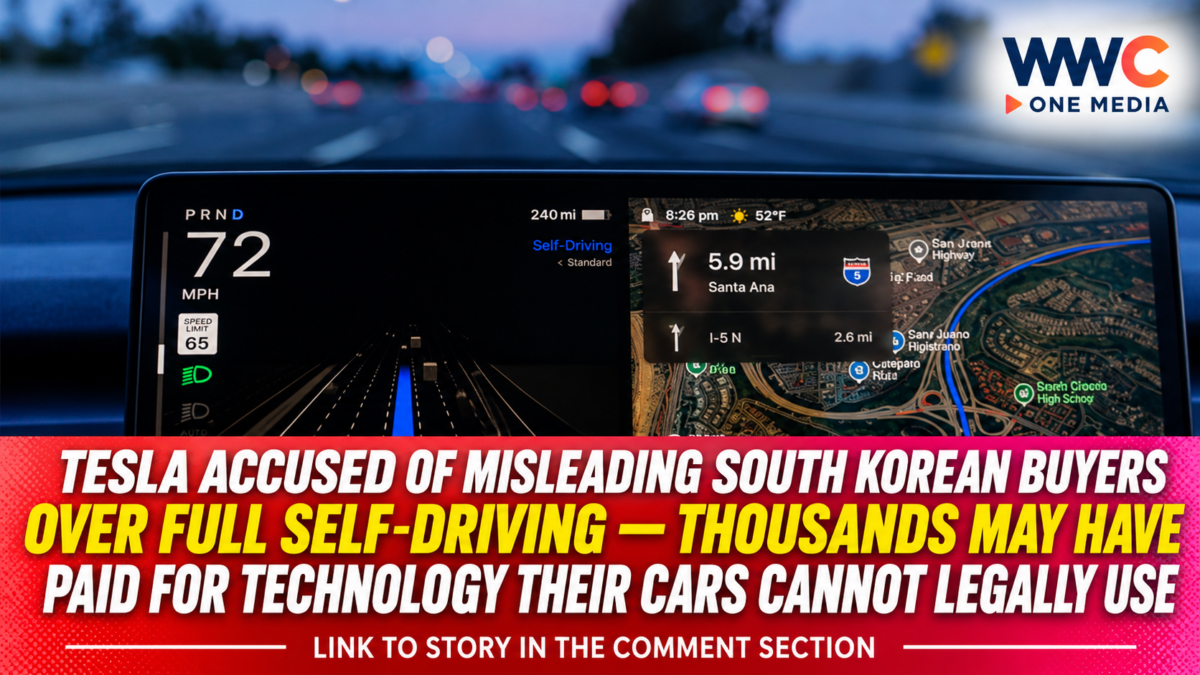
SEOUL / SOUTH KOREA — Tesla is facing renewed scrutiny in South Korea after a consumer advocacy group accused the electric vehicle manufacturer of misleading customers about the availability of its Full Self-Driving (Supervised) technology, with allegations that thousands of buyers paid for a feature their vehicles are not legally permitted to use.
The controversy centres on Tesla’s driver-assistance software, which has been marketed to South Korean customers for years. However, the technology is currently available only on a limited portion of Tesla vehicles registered in the country, largely because of differences in vehicle manufacturing origins and local safety certification requirements.
According to information presented by Tesla Korea’s country manager during parliamentary testimony, only around 20% of Tesla vehicles registered in South Korea are currently eligible to use the system.
Most Tesla vehicles sold in the country are manufactured in China, and those models have not yet received the necessary local certification for the feature.
The consumer group Citizens United for Consumer Sovereignty plans to file a complaint with South Korea’s Korea Fair Trade Commission (KFTC) on November 5, accusing Tesla of deceptive marketing.
The allegations could create another major challenge for the automaker as it expands its presence in one of Asia’s increasingly competitive electric vehicle markets.
But the central question is not simply whether Tesla’s technology works. It is whether customers were given clear information about what they were actually buying — and whether the company should be held accountable for selling a feature that many vehicles cannot currently activate.
The Main Allegation: Customers Paid for a Feature They Cannot Use
At the centre of the controversy is Tesla’s Full Self-Driving (Supervised), commonly known as FSD.
The software is designed to assist with driving tasks, including steering, braking, lane changes and navigating certain road situations. However, despite its name, it does not make a vehicle fully autonomous.
Drivers must remain attentive, supervise the system and be prepared to take control whenever necessary.
The consumer advocacy group alleges that Tesla marketed FSD to South Korean customers without adequately explaining that most vehicles being sold in the country were not legally eligible to use it.
The complaint reportedly argues that Tesla continued promoting the feature even though the company knew that regulatory restrictions prevented many customers from accessing it.
This distinction matters because customers may have purchased the software believing that it was available for immediate use or that activation would happen soon.
Instead, owners of certain China-manufactured vehicles have been left waiting for regulatory approval.
The group argues that selling an expensive software package under these circumstances could amount to deceptive commercial conduct.
Tesla has not publicly provided a response to the latest allegations in the reports reviewed for this article.
Why Most South Korean Teslas Cannot Use FSD
The problem is closely connected to where Tesla vehicles are manufactured.
South Korea recognises certain US vehicle-safety standards through its free trade agreement with the United States. This allows eligible US-manufactured Tesla vehicles to operate under the applicable arrangements.
However, Tesla’s China-manufactured vehicles face a different regulatory process.
Many of the vehicles sold in South Korea, including popular Model 3 and Model Y units, are produced at Tesla’s Shanghai factory.
Those vehicles must satisfy the relevant South Korean requirements before they can legally operate with the supervised FSD system.
As a result, the feature’s availability is not determined simply by whether a vehicle carries the Tesla badge or has compatible hardware.
Its eligibility also depends on manufacturing origin and regulatory approval.
Tesla has only recently started pursuing the necessary certification process for China-made vehicles, despite having marketed the software in South Korea for more than three years.
This has created a significant gap between what customers may have expected and what their vehicles can currently do.
More Than 170,000 China-Made Teslas Sold Since 2023
The scale of Tesla’s South Korean business makes the controversy particularly important.
According to data submitted by Tesla to the country’s National Assembly, the company has sold more than 170,000 Shanghai-manufactured vehicles in South Korea since 2023.
These vehicles represent a substantial portion of Tesla’s expanding presence in the market.
The consumer group has questioned whether customers purchasing these vehicles were adequately informed about the limitations affecting FSD.
The figures also highlight the potential size of the customer base affected by the certification issue.
However, the number of China-made Teslas sold should not be confused with the number of customers who actually purchased FSD.
The exact number of South Korean buyers who paid for the software on vehicles that cannot legally use it remains unclear.
Nevertheless, the potential scale of the dispute has placed Tesla’s marketing practices under increased scrutiny.
Tesla Reportedly Charged Up to 9.043 Million Won for FSD
The financial aspect of the controversy has attracted particular attention.
For years, Tesla offered FSD to South Korean customers through a one-time payment option priced at approximately 9.043 million won, equivalent to around US$6,726 at the exchange rate cited in the reporting.
The company later shifted to a monthly subscription model costing approximately 150,000 won, or around US$112.
The consumer group argues that customers who paid the substantial upfront price may have received little or no practical benefit if their vehicles were not legally eligible to use the technology.
Its representative, Choi Young-suk, argued that Tesla generated significant revenue by selling an expensive driver-assistance package to customers who could not use it.
The complaint is expected to ask the regulator to examine whether the company’s advertising and sales practices adequately disclosed these restrictions.
For consumers, the dispute raises an important issue: should a buyer be expected to pay thousands of dollars for software that may only become usable after future regulatory changes?
South Korea’s Fair Trade Commission Is Already Investigating Tesla
The latest complaint is not the first indication that South Korean authorities are examining Tesla’s marketing of FSD.
A KFTC official confirmed that the agency began investigating the company’s advertising earlier in 2026.
The regulator has reportedly received written responses from Tesla, although it has not publicly disclosed the full details of its investigation.
The planned complaint from Citizens United for Consumer Sovereignty could add further pressure by formally presenting the group’s allegations and requested remedies.
Among the measures it wants the regulator to consider are:
- A temporary order stopping Tesla from marketing FSD to vehicles that are not legally eligible to use it.
- Administrative fines if violations are established.
- Referral of the case to state investigators for further examination.
These are requests made by the advocacy group, not penalties that have already been imposed.
The KFTC will need to assess the evidence, Tesla’s explanations and the applicable consumer-protection rules before determining whether any enforcement action is justified.
Tesla Promoted FSD as ‘Coming Soon’, Complaint Alleges
One of the most important elements of the planned complaint concerns how Tesla presented the technology to prospective buyers.
The advocacy group alleges that Tesla promoted FSD as a feature that was “coming soon” and used a demonstration video filmed in South Korea without sufficiently explaining that only a limited portion of its vehicles could legally use the system.
The complaint argues that the marketing created expectations among customers that the technology would become available to their vehicles.
The distinction between future availability and present usability is crucial.
A software feature may be technically developed but still require regulatory approval before it can be used on public roads.
In this case, China-manufactured Tesla vehicles face a certification process that has not yet been completed.
If customers were not clearly informed of this limitation before purchasing the option, regulators may need to determine whether the marketing gave buyers a misleading impression.
Tesla’s precise position on the latest complaint has not been established in the publicly available reporting.
Parliamentary Hearing Exposes Tesla’s Certification Delay
The issue also surfaced during South Korea’s National Assembly audit in October.
On October 8, Tesla Korea country manager Seo Young-deuk acknowledged that the company had not formally requested testing of FSD by the Ministry of Land, Infrastructure and Transport or the Korea Transportation Safety Authority.
He said the company was prepared to undergo evaluation if the government established an appropriate verification process.
Two weeks after that hearing, Tesla applied for certification, according to the reporting.
The timing has become an important part of the consumer group’s argument.
The company had marketed FSD in South Korea for years, but the formal certification process for China-manufactured vehicles began only recently.
South Korea’s transport ministry has also indicated that the system does not comply with certain local safety requirements, including rules requiring drivers to keep their hands on the steering wheel.
These regulatory concerns help explain why FSD availability differs between US-made and China-made Tesla vehicles.
They also demonstrate that introducing advanced driving software into a new market requires more than simply releasing a software update.
What Exactly Is Full Self-Driving (Supervised)?
Tesla’s FSD system is often discussed as part of the broader race towards autonomous vehicles.
However, its name can create confusion about what the technology actually does.
Despite the Full Self-Driving label, the supervised system is not a fully autonomous vehicle technology that allows drivers to stop paying attention to the road.
It is a driver-assistance system that can perform certain driving tasks while a human remains responsible for monitoring its operation.
Drivers must be ready to intervene when the system encounters situations it cannot safely manage.
This distinction is particularly important because different countries have different regulations governing automated and assisted driving technologies.
A feature permitted in one market may not be authorised in another.
Even when a vehicle has compatible hardware and software, local approval may still be necessary before the system can be used legally.
The South Korean dispute therefore highlights the complicated relationship between technological development, product advertising and national vehicle-safety regulations.
Tesla’s South Korean Business Continues to Grow
The controversy comes at a time when Tesla is experiencing strong sales growth in South Korea.
The company has become one of the country’s most prominent imported-car brands, with demand driven in part by competitively priced China-manufactured electric vehicles.
Tesla surpassed BMW this year to become South Korea’s leading imported-car brand, according to the import data cited in the reporting.
The company registered 89,148 new vehicles in South Korea between January and September 2026, representing a 104.4% increase compared with the same period a year earlier.
The China-made Model Y has been a major contributor to this growth.
However, the FSD controversy could complicate the company’s relationship with customers who purchased vehicles expecting access to advanced driving technology.
A successful vehicle launch does not automatically guarantee that every software feature will be available in every market.
For Tesla, communicating these limitations clearly may become just as important as expanding its vehicle sales.
A Seoul Court Recently Rejected a Separate Tesla FSD Refund Lawsuit
The latest consumer complaint also comes shortly after another legal development involving Tesla’s Full Self-Driving package.
On October 29, the Seoul Central District Court rejected a lawsuit brought by 88 Tesla owners seeking refunds for money paid for the software.
The court ruled that Tesla had not breached its contractual obligations in that particular case.
It found that the FSD package did not promise fully autonomous, Level 5 driving without human intervention.
The court also noted that Tesla had provided certain functions included in the package, including Autopilot and Enhanced Autopilot features.
It further considered that some additional capabilities depended on technological progress and regulatory approval.
That ruling is separate from the new complaint planned by Citizens United for Consumer Sovereignty.
The court case concerned contractual obligations and refund claims brought by a group of vehicle owners. The latest complaint focuses on whether Tesla’s advertising and sales practices misled customers about the legal availability of FSD.
The two developments should not be treated as the same legal proceeding.
The rejection of the earlier refund lawsuit does not automatically determine whether the KFTC will find Tesla’s advertising practices compliant with South Korean consumer-protection rules.
Why This Dispute Could Matter Beyond South Korea
The controversy highlights a challenge facing electric vehicle manufacturers as they introduce increasingly advanced software across international markets.
Companies may develop a feature in one country and then face different technical, legal and regulatory requirements when introducing it elsewhere.
For consumers, the situation can become confusing when marketing materials describe a feature without clearly explaining the restrictions that apply to a particular vehicle.
The South Korean case could encourage closer scrutiny of how automakers advertise software packages, particularly when customers pay substantial amounts for features that depend on future approval.
It may also reinforce the importance of providing clear information about:
- Whether a feature is available immediately.
- Whether the vehicle is technically compatible.
- Whether local regulators have authorised its use.
- Whether additional certification is still required.
- Whether a customer can receive a refund if the feature remains unavailable.
These questions are becoming increasingly important as vehicles evolve from traditional mechanical products into software-driven platforms.
What Happens Next for Tesla and Its Customers?
The next major development is expected to come from the planned November 5 complaint to the Korea Fair Trade Commission.
The regulator will have to examine the consumer group’s claims and determine whether Tesla’s marketing complied with applicable laws.
It will also need to consider the company’s responses, the wording used in advertisements, the information provided to customers during purchases and the actual eligibility of different vehicle models.
If the regulator establishes that Tesla violated consumer-protection rules, it could consider enforcement measures within its legal authority.
However, no final finding of deceptive advertising has been announced in this case.
Tesla’s certification process for China-manufactured vehicles will also be closely watched.
Approval could eventually expand FSD availability, depending on the outcome of the relevant safety evaluations.
Until then, customers must distinguish between software that has been advertised, software that is technically supported and software that is legally permitted for their particular vehicle.
For buyers who have already paid for the feature, the uncertainty remains significant.
The Bottom Line
Tesla is facing a growing consumer-protection challenge in South Korea after an advocacy group accused the company of marketing Full Self-Driving software to customers whose vehicles cannot legally use it.
The figures highlight the scale of the dispute: only around 20% of Tesla vehicles registered in South Korea are currently eligible for FSD, while the company has sold more than 170,000 China-manufactured vehicles in the country since 2023.
Some customers reportedly paid as much as 9.043 million won for the software, despite restrictions that prevent many China-made models from using the system.
The Korea Fair Trade Commission is already investigating Tesla’s advertising, and a consumer advocacy group plans to submit a formal complaint seeking restrictions on marketing, administrative penalties and possible referral to investigators.
At the same time, a recent court decision rejecting a separate refund lawsuit demonstrates that the legal questions surrounding FSD are complex and depend on the specific claims, contracts and evidence involved.
For Tesla, the challenge is now about more than selling electric vehicles. It is also about ensuring that customers understand exactly what their software purchases provide — and whether those features can legally be used.
If customers pay thousands of dollars for a driving feature that their vehicles cannot currently activate, should automakers be required to offer clearer disclosures or refunds when regulatory approval remains uncertain?