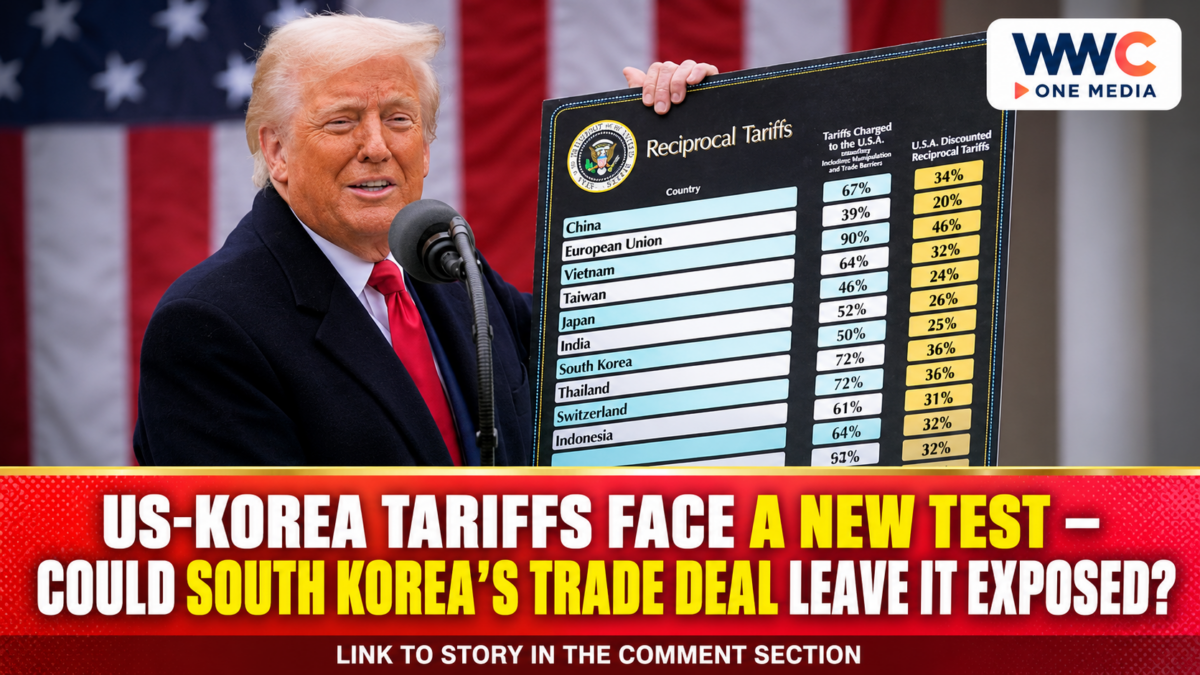
South Korea is among 16 economies under a U.S. investigation into manufacturing overcapacity that could lead to additional import duties, placing fresh uncertainty over an already complicated trade relationship. As of Nov. 25, 2026, the public investigation record identifies the countries under review and documents the hearing process, but does not establish a final tariff rate or an effective date for new duties under this particular case.
The distinction matters because Washington and Seoul reached a trade understanding in 2025 that set 15% treatment for specified tariff categories. A separate investigation, however, raises questions about how far those earlier arrangements protect South Korean exporters from additional trade measures.
For manufacturers, investors and suppliers, the issue is not simply whether another tariff announcement is coming. It is whether the final legal action, if one is taken, will change the cost of selling Korean-made goods in the United States.
US-Korea tariffs are tied to a wider manufacturing investigation
The Office of the United States Trade Representative initiated the structural excess-capacity investigation on March 11, 2026, under Section 301(b) of the Trade Act of 1974.
The 16 economies and trading partners named in the investigation are China, the European Union, Singapore, Switzerland, Norway, Indonesia, Malaysia, Cambodia, Thailand, Korea, Vietnam, Taiwan, Bangladesh, Mexico, Japan and India.
The USTR said the investigation would examine whether government acts, policies and practices relating to manufacturing capacity and production were unreasonable or discriminatory and burdened or restricted U.S. commerce. United States Trade Representative+1
The U.S. government’s argument is that production capacity in some economies has expanded beyond what domestic and global demand can absorb. The investigation notice describes the resulting conditions as potentially involving overproduction, persistent trade surpluses and unused manufacturing capacity.
These are the U.S. government’s stated concerns, not a final finding that every economy on the list has violated trade rules.
Section 301 provides a legal route for the U.S. government to investigate foreign trade practices and consider responsive measures. The investigation notice specifically invited public comments on whether action should be taken, including tariffs or non-tariff restrictions.
That means tariffs are among the possible outcomes, but the opening of an investigation does not itself impose new duties.
South Korea’s 2025 trade understanding adds a complication
South Korea entered the investigation with an existing trade understanding with Washington.
A joint fact sheet released by the two governments on Nov. 13, 2025, outlined the Korea Strategic Trade and Investment Deal. It included a 15% tariff treatment for originating South Korean goods for purposes of the reciprocal tariff under Executive Order 14257.
The document also addressed specific sectoral tariffs. It said U.S. Section 232 tariffs on South Korean automobiles, auto parts, timber, lumber and wood derivatives would be reduced to 15%, with conditions depending on the applicable U.S.-Korea Free Trade Agreement or most-favoured-nation tariff rate. The White House
The agreement also covered investment and industrial cooperation. It identified $150 billion in Korean investment in the shipbuilding sector and an additional $200 billion in investment commitments under a memorandum of understanding.
But the tariff provisions should not be interpreted as a universal 15% cap covering every possible U.S. trade action.
The reciprocal tariff arrangement and the sectoral Section 232 measures have their own legal foundations. The new manufacturing-capacity investigation is being conducted under Section 301. Its eventual treatment of South Korean goods would need to be established in the relevant U.S. determination and implementing documents.
This is the central uncertainty for exporters: a negotiated tariff understanding does not automatically answer how a separate investigation will be resolved.
A separate U.S. tariff measure already covers South Korea
The manufacturing-capacity investigation is not the only Section 301 matter affecting South Korea.
On July 23, 2026, the USTR announced final action in a separate investigation involving whether economies had imposed and effectively enforced prohibitions on imports of goods produced with forced labour.
The corresponding Federal Register notice listed South Korea among 54 economies found to have failed to impose and effectively enforce the relevant import prohibition. The notice established a 12.5% Section 301 duty rate for the relevant category, subject to exemptions and the terms of the measure. The additional duties applied to covered goods entered for consumption from July 24, 2026. United States Trade Representative+1
This measure must not be confused with the manufacturing-capacity investigation.
The first concerns government controls on imports produced with forced labour. The second examines manufacturing overcapacity and production policies. Both use Section 301, but they concern different alleged practices and separate administrative proceedings.
For businesses, the distinction is more than technical. Different investigations can have different product exemptions, tariff rates, effective dates and legal conditions. A company cannot calculate its full U.S. import costs by looking at a single headline rate.
The investigation record still matters more than a proposed rate
The USTR’s public investigation page lists the March 11 initiation notice and the May 5–8 public hearing documents. It also identifies the public-comment process and its deadlines.
The notice invited interested parties to submit evidence about manufacturing capacity, government policies, the effects on U.S. commerce and possible responses. It specifically asked whether tariffs or non-tariff measures should be considered.
As of Nov. 25, the public investigation page reviewed for this report did not list a final determination or a tariff schedule for this manufacturing-capacity case. United States Trade Representative+1
That absence is important. Without a final determination, product coverage and tariff rates should not be presented as settled. Nor should an expected announcement be described as an enacted measure.
The wider trade debate is also relevant to other economies in Asia. WWC has examined what the official U.S.–Philippines trade records confirm and what they leave unresolved. The Philippine case involves different legal and bilateral circumstances, but it demonstrates why companies need to distinguish an investigation, a government commitment and an implemented tariff change.
Why the next decision could affect supply chains
South Korea is a major manufacturing economy with important export industries. Changes in U.S. import costs can matter not only to Korean exporters but also to suppliers, distributors and manufacturers that use Korean components.
Automobiles, machinery, electronics and industrial materials operate through international supply chains. A tariff applied to a finished product can affect its price and competitiveness, while a duty on an intermediate input can change the cost structure of companies further down the production chain.
The precise effect would depend on the products included in any final measure, the applicable exemptions and whether other tariff provisions apply.
There is also a wider regional dimension. Companies in Southeast Asia may compete with Korean manufacturers for U.S. customers or supply components to Korean-led production networks. WWC’s coverage of the ASEAN–U.S. partnership and its 2026–2030 work plan examines the broader regional framework in which trade and economic cooperation are developing.
For South Korean businesses, the immediate priority is therefore clarity. An investigation notice is a warning that policy may change, but it is not a substitute for a final customs rule.
What happens next
The next decisive document would be a USTR determination explaining whether the practices examined in the manufacturing-capacity investigation are actionable and what response, if any, the United States will adopt.
If tariffs are selected, businesses will need the official rate, product scope, exemptions, effective date and customs instructions. Those details will determine whether the measure applies to particular Korean exports and how it interacts with existing tariff arrangements.
The two governments may also need to clarify how the new investigation relates to the 2025 trade understanding. Until formal documents settle that question, exporters should avoid treating the 15% provisions as a guaranteed ceiling on all future duties.
The investigation has put South Korea in the same review process as 15 other economies. The commercial consequences, however, will depend on the final decision—not simply on the fact that the country appears on the list.
Frequently asked questions
1. Is the United States imposing new tariffs on South Korea now?
The USTR has opened a Section 301 investigation that could lead to tariffs. The public investigation records reviewed for this report do not establish a final tariff rate or effective date for this particular case.
2. Why is South Korea included in the U.S. investigation?
The investigation examines government acts, policies and practices relating to structural excess capacity and manufacturing production. South Korea is one of the 16 economies named.
3. Does the 2025 U.S.–South Korea trade understanding guarantee a 15% tariff ceiling?
The 2025 fact sheet establishes 15% treatment for specified reciprocal and sectoral tariff categories. It does not establish a blanket ceiling for every separate trade action.
4. Is South Korea already subject to another U.S. Section 301 tariff?
Yes. A separate July 2026 action imposed duties on 60 economies over forced-labour import prohibitions. South Korea was included in the 12.5% category, subject to the measure’s exemptions and conditions.
5. When will the new manufacturing-capacity tariffs take effect?
No effective date for tariffs arising from this particular investigation was established in the USTR public records reviewed as of Nov. 25, 2026.