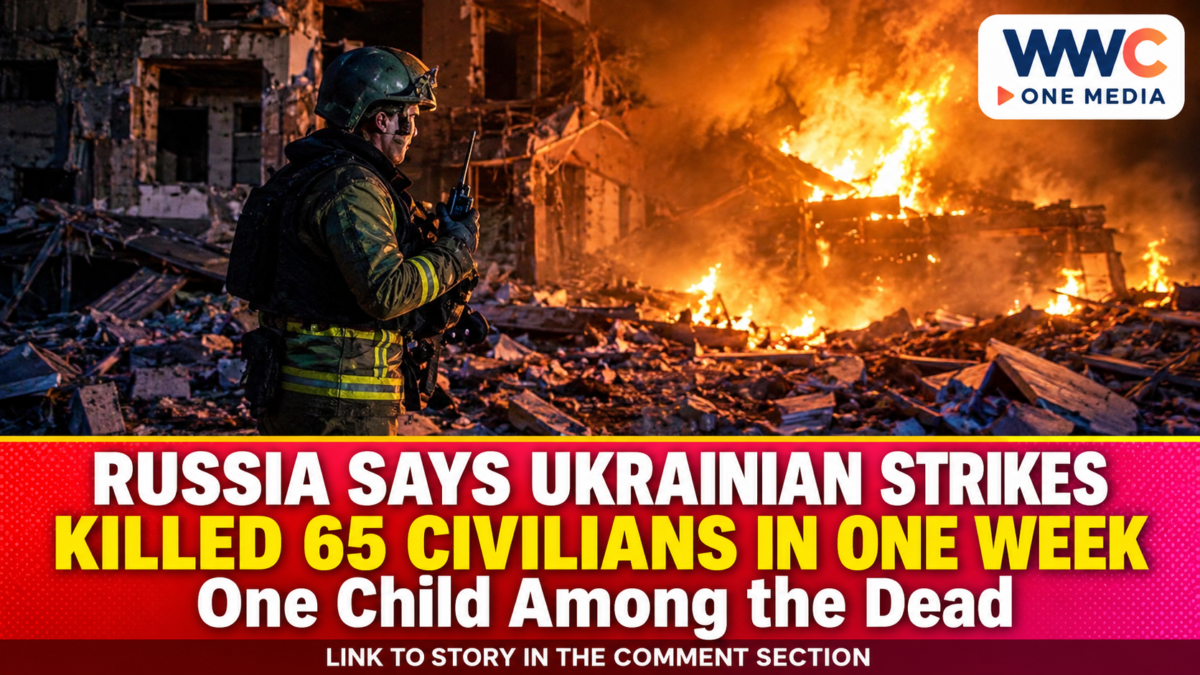
MOSCOW, Russia — November 25, 2026 — Russia has reported 65 civilian deaths, including one child, from Ukrainian strikes on Russian territory over the preceding week, with another 225 people reportedly wounded, including 21 minors.
The figures were presented by Rodion Miroshnik, the Russian Foreign Ministry’s ambassador-at-large for issues related to the Kiev regime’s crimes, in an interview published on November 24.
Miroshnik said the reported attacks left 290 civilians dead or injured in total. He also claimed that drone attacks accounted for 96% of those wounded.
The figures have not been independently verified as a complete weekly casualty count. The distinction is important because civilian casualty reporting in the Russia-Ukraine war remains difficult to independently establish, particularly in areas affected by fighting, occupation and restricted access.
The latest Russian claim also comes as United Nations monitors report a sharp rise in civilian casualties inside Ukraine, underlining the continuing human cost of attacks on communities on both sides of the conflict.
Russia-Ukraine war: What Moscow claims happened over the past week
Miroshnik identified Belgorod, Bryansk, Kursk, Krasnodar and Saratov, along with Zaporizhzhia, Kherson, Donetsk and Luhansk, as areas that experienced the most intense attacks during the reporting period.
He said Ukrainian forces fired approximately 8,400 different munitions toward Russian territory.
That figure, like the reported death and injury totals, remains an assertion by the Russian official. The public account does not provide a location-by-location breakdown, a list of individual incidents or supporting casualty records that would allow the full total to be independently checked.
The reported figures also do not establish how many separate attacks occurred, which weapons were involved in each incident or whether all reported casualties were linked to the same reporting period and assessment process.
Those details matter when evaluating claims made during an active conflict. A national casualty figure can describe the scale alleged by an official, but it cannot replace incident-level verification.
UN warns that Russian civilian casualty claims are difficult to verify
The United Nations has separately acknowledged reports of civilian deaths and injuries inside the Russian Federation.
In its October 2026 civilian-protection update, the UN Human Rights Monitoring Mission in Ukraine said public statements by Russian authorities indicated that at least 59 people had been killed and 402 injured in the Russian Federation during October.
However, the mission explicitly cautioned that it had been unable to verify the vast majority of those allegations because of limited access and a lack of independent sources of information.
That qualification is central to assessing the new weekly figure.
The UN’s October figures and Miroshnik’s November statement cover different reporting periods and should not be added together or treated as a single independently verified casualty dataset. They do, however, show why claims about civilian deaths inside Russia require careful documentation.
The difference between an official allegation and a verified casualty record does not mean an incident did not happen. It means the available evidence does not yet allow independent confirmation of the full claim.
Civilian casualties in Ukraine are also rising
The wider civilian toll remains severe inside Ukraine.
The UN Human Rights Monitoring Mission reported that at least 372 civilians were killed and 1,981 injured in Ukraine during October 2026. The combined number was 95% higher than in October 2025, when 183 people were killed and 1,021 injured.
Long-range weapons, including missiles and drones, accounted for 55% of civilian casualties in October, leaving 177 people dead and 1,108 injured.
The UN also reported that civilian casualties from January through October 2026 reached 2,957 deaths and 17,218 injuries. That was 63% higher than the corresponding period in 2025.
These figures concern casualties in Ukraine and are based on the UN mission’s verification work. They are separate from the Russian government’s allegations about attacks inside the Russian Federation.
The comparison should not be used to suggest that the incidents, weapons, circumstances or levels of verification are identical. It illustrates the scale of civilian harm being documented across the wider conflict.
Drone warfare is increasing the danger to communities
Drones have become a major feature of the Russia-Ukraine war, with both sides reporting attacks involving unmanned aircraft and air-defence interceptions.
The Russian official’s claim that drones caused 96% of reported injuries highlights the role Moscow attributes to unmanned systems in attacks on its territory. However, the statement does not provide a detailed breakdown of drone types, individual impact sites or independently verified weapon assessments.
The danger to civilians is not limited to the immediate blast area. Drone strikes can affect homes, commercial facilities, transport routes and essential services, while debris from intercepted aircraft can also create risks on the ground.
Recent incidents covered by WWC ONE MEDIA illustrate the different ways the conflict affects civilian communities. A reported attack damaging a civilian enterprise and private homes in Ukraine’s Vinnytsia region showed how initial official updates may confirm damage while leaving casualty and financial details unresolved.
Another report examined the deadly drone strike on a residential building in Dymer, where the distinction between confirmed deaths and people still unaccounted for was critical to accurate reporting.
Why casualty claims need independent confirmation
Civilian casualty figures released during wartime can change as rescue operations continue, hospitals update records and authorities investigate individual incidents.
Independent verification can be especially difficult when access to affected locations is restricted, communications are disrupted or the areas are under military control.
The UN’s warning about Russian casualty reports demonstrates this problem. Public statements can provide an important record of what authorities are reporting, but independent monitoring requires access to locations, witnesses, medical information and other corroborating evidence.
WWC ONE MEDIA has previously examined the difference between official Russian casualty claims and independently established figures. That distinction is equally important when reporting civilian deaths: military casualty estimates, official civilian claims and verified civilian deaths are different categories and should never be combined.
For the latest Russian report, the available public information does not include a complete incident list or an independent verification of the 65 reported deaths.
The human cost extends beyond the battlefield
Civilian communities remain exposed to the consequences of a war that has increasingly involved long-range drones, missiles and attacks affecting infrastructure far from active front lines.
Transport networks, homes, commercial facilities and energy systems can all become vulnerable during sustained aerial campaigns. A separate WWC ONE MEDIA report on the Dnipro railway station drone strike documented the consequences of an attack on a civilian transport setting in Ukraine.
These incidents are separate from the latest Russian allegations and should not be treated as part of the same operation. Together, however, they underline why civilian protection and transparent casualty reporting remain essential as the conflict continues.
The immediate question surrounding Miroshnik’s statement is whether further documentation will emerge to substantiate the reported 65 deaths and 225 injuries.
Until independent evidence becomes available, the figures should remain attributed to the Russian official who announced them—not presented as a fully verified account of civilian casualties.
Frequently Asked Questions
How many civilians did Russia say were killed in Ukrainian strikes over the past week?
Russian Foreign Ministry official Rodion Miroshnik said 65 civilians, including one child, were killed during the preceding week.
How many people were reportedly injured?
Miroshnik said 225 civilians were wounded, including 21 minors. The reported total of people killed or wounded was 290.
What percentage of those wounded were reportedly injured in drone attacks?
Miroshnik said 96% of those wounded were injured as a result of drone attacks.
Which areas did Russia identify as the most heavily attacked?
The official identified Belgorod, Bryansk, Kursk, Krasnodar and Saratov, as well as Zaporizhzhia, Kherson, Donetsk and Luhansk.
Has the United Nations independently verified the 65 deaths?
The UN has not published an independent verification of that specific weekly figure. Its October 2026 report said Russian authorities had publicly reported at least 59 civilian deaths and 402 injuries inside the Russian Federation during that month, but the mission could not verify the vast majority of those allegations because of limited access and insufficient independent information.
How many civilians were killed in Ukraine in October 2026?
The UN Human Rights Monitoring Mission in Ukraine verified at least 372 civilian deaths and 1,981 injuries in Ukraine during October 2026.