
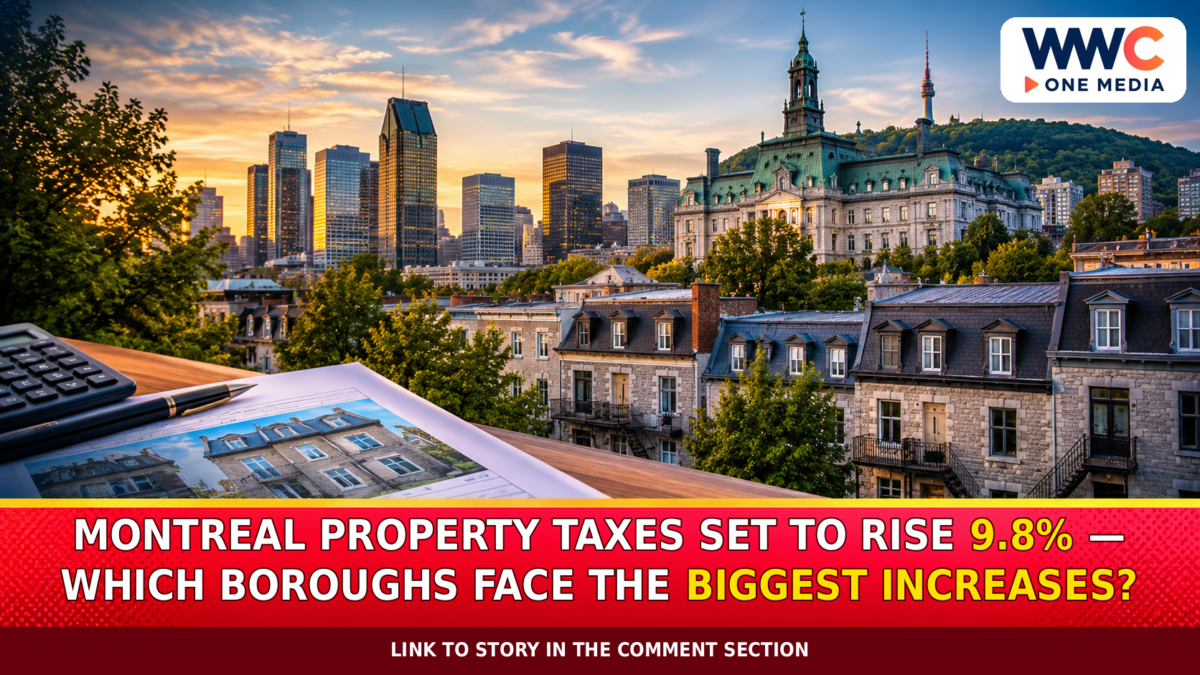
Montreal’s 2027 municipal budget, presented on November 24, sets out an average increase of 9.8% in total property-tax charges for residential buildings and 6.2% for non-residential properties across the city. The proposed budget also introduces a dedicated infrastructure-maintenance funding reserve, while borough-level tax decisions mean the final bill will vary depending on where a property is located.
The increase puts municipal finances and household affordability on a collision course. City officials are seeking money to maintain ageing roads and water systems, but property owners will have to absorb higher charges at a time when housing and other living costs remain major concerns.
The headline percentage is not a flat increase applied identically to every property. Montreal calculates property taxes using several elements, including a building’s assessment value, its classification, citywide rates and borough-specific charges. That makes the borough breakdown important—but it also means that a single citywide average cannot tell every owner what their next bill will be.
Montreal property taxes: what the 2027 budget actually proposes
The city’s budget sets total property-tax charge increases at an average of 9.8% for residential properties and 6.2% for non-residential properties. These figures combine decisions made by the central municipal council and the borough councils.
Montreal is also proposing a balanced operating budget of C$8.0 billion for 2027. Separately, its 2027–2036 ten-year capital investment programme totals C$23.4 billion, covering infrastructure and other long-term municipal investments.
The city says infrastructure preservation is a major priority. Its investment plan allocates 76.5% to protecting existing assets, while 23.5% is directed toward development, acquisition, new infrastructure and bringing existing facilities up to required standards. Water infrastructure is assigned C$7.1 billion over the decade, while road infrastructure is allocated C$6 billion. Ville de Montréal
The figures show why the city is seeking additional revenue: maintaining existing systems is a major financial commitment, not simply a matter of funding new construction.
Why borough-level charges make the difference
Montreal’s tax system includes citywide and borough-level components. The city explains that tax rates vary according to both the building category and the borough in which the property is located. Borough councils can set local service and investment taxes, meaning the local component can differ even when properties are subject to the same broad municipal budget.
Available borough records illustrate that variation. In Le Plateau-Mont-Royal, a November 2 council document describes a planned 11.5% increase in the borough’s local service tax for 2027. The document links the adjustment to funding local services, infrastructure upkeep and other borough responsibilities.
In Outremont, a November 3 municipal document sets the 2027 local services tax at C$0.0469 per C$100 of assessed value and identifies a 12% indexation for the year. That is an adjustment to the borough’s local tax component, not a statement that every Outremont property owner’s total bill will rise by 12%.
These examples should not be treated as a definitive ranking of the boroughs with the largest total property-tax increases. A local-tax adjustment is only one part of the final bill, and the effect also depends on the property’s assessed value and tax classification. ville.montreal.qc.ca+2
For property owners, the practical question is therefore not only how much the borough tax changes, but how that change combines with the citywide rates and the value assigned to the property.
Infrastructure funding is a major reason for the increase
One of the central measures in the 2027 budget is the creation of a reserve for the maintenance and renewal of infrastructure. The city says the reserve will receive C$139 million, financed through a dedicated infrastructure-maintenance and renewal tax.
The budget also identifies a C$70.6-million increase in tax revenue directed to the local water financial reserve. The funding is intended in part to continue the city’s water strategy, including C$38 million for that strategy and C$23 million in cash payments for water-related capital assets. Ville de Montréal+1
This approach shifts part of the cost of infrastructure upkeep directly onto the property-tax system. The city’s argument is that reliable roads, water networks and public facilities require sustained investment.
The challenge is accountability. Higher property charges are easier to justify when residents can see which assets are being repaired, how projects are prioritized and whether maintenance spending reduces future repair costs. Without clear reporting, taxpayers may see the increase primarily as a larger bill rather than a visible improvement in services.
What the increase could mean for homeowners and businesses
A higher property-tax charge affects owners differently depending on property value, use and location. Residential owners may face a larger annual bill, while landlords and commercial property owners must consider how higher municipal costs fit into their operating expenses.
The impact on tenants is less direct. Property taxes are generally billed to property owners, but owners may consider those costs when setting rents or deciding whether to invest in maintenance and improvements. That does not mean every landlord will raise rent by the same percentage; rent changes are subject to separate market and legal conditions.
For businesses, municipal taxes are one component of occupancy costs alongside rent, utilities, insurance, wages and other expenses. A 6.2% average increase in non-residential property-tax charges may therefore matter to firms already managing tight operating budgets.
The issue is not unique to Canada. WWC has examined how property valuation and local tax decisions can affect owners in its coverage of the Philippine debate over real-property tax increases and valuation reform. The legal systems differ, but both cases demonstrate why assessed values, tax rates and local government decisions need to be understood separately.
A similar revenue-versus-affordability debate is emerging in Cebu City’s proposed tax-code changes, where the central question is how local authorities can finance public services without placing excessive pressure on households and businesses. In the United States, Florida’s property-tax changes and their potential effects on local government finances show the other side of the same policy problem: reducing or changing property taxes can also affect the money available for municipal services.
What happens next
The 2027 budget figures are not yet the final adopted tax framework. Montreal’s own tax-rate information page says the budget must be adopted by the relevant authorities in late January before the rates enter into force.
The city has scheduled public study of the 2027 budget and its ten-year capital programme from November 25 to December 4. That process gives elected officials and the public an opportunity to examine spending priorities and the proposed revenue measures. Ville de Montréal+1
Property owners should wait for the adopted budget and the tax-rate documents applicable to their building category and borough before estimating their final 2027 bill. The citywide 9.8% residential average is an important warning of higher costs, but it is not a personalized calculation.
The larger test for Montreal will be whether the additional revenue produces measurable improvements in infrastructure and services—and whether the city can explain those results clearly to the taxpayers financing them.
Frequently asked questions
How much are Montreal property taxes expected to increase in 2027?
The city’s proposed budget sets the average increase in total property-tax charges at 9.8% for residential properties and 6.2% for non-residential properties.
Will every Montreal homeowner pay 9.8% more?
No. The 9.8% figure is a citywide average. A property’s final bill depends on its assessed value, building category, applicable citywide rates and borough-level charges.
Which Montreal boroughs have higher local tax adjustments?
Available borough records show an 11.5% planned increase in Le Plateau-Mont-Royal’s local service tax and 12% indexation of Outremont’s local services tax. These are local components, not comparable total-bill increases or a complete borough ranking.
Why is Montreal increasing property-tax charges?
The city says the budget will help finance infrastructure maintenance and renewal, including a C$139-million reserve, and support investment in water and road systems.
When will Montreal’s 2027 property-tax rates become final?
The city says the budget must be adopted by the relevant authorities in late January before the 2027 rates enter into force.










