
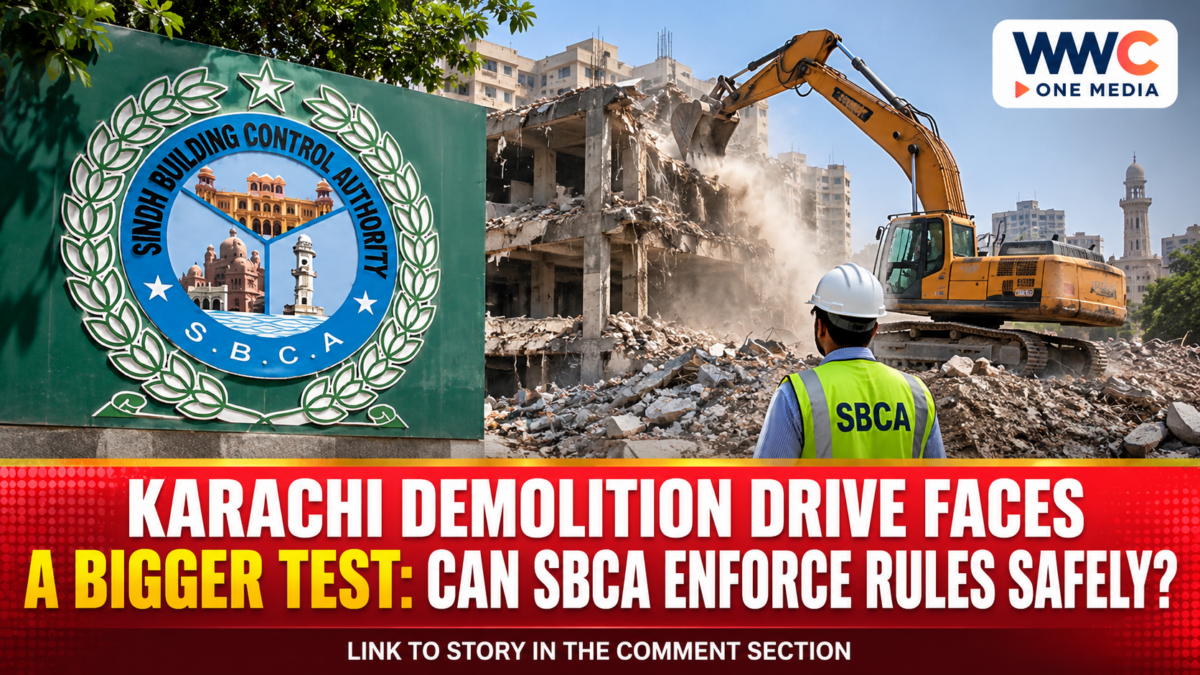
KARACHI, Pakistan — The Sindh Building Control Authority (SBCA) has reportedly ordered a renewed citywide push to identify and remove unauthorised construction, including additional floors and building portions, across Karachi’s 25 towns. The directive, issued at a meeting chaired by Director General Dr. Wasim Shamshad on November 24, comes as a government audit has documented serious gaps in the authority’s handling of dangerous buildings and demolition operations.
The timing puts a central question before Karachi’s building regulator: can it turn enforcement instructions into measurable action while ensuring that demolitions follow technical standards and legal safeguards?
The distinction matters. Removing an unauthorised structure is not simply a matter of sending a demolition team. Authorities must establish what was approved, identify the precise violation, follow the applicable process and ensure that the work itself does not create additional danger for residents, workers or neighbouring properties.
Karachi demolition drive meets an enforcement backlog
The Auditor-General of Pakistan’s February 2026 audit report on SBCA, covering financial year 2024–25, recorded that the authority had failed to demolish 740 buildings classified as dangerous by its Technical Committee. Of that total, 588 were in Karachi and 152 were in other divisions of Sindh. Auditor General of Pakistan
The Karachi figure was spread across several districts. The report listed 456 dangerous buildings in District South, 69 in District Central, 24 in Keamari, 18 in Korangi, 14 in East, five in Malir and two in West. Auditor General of Pakistan
These figures concern buildings classified as dangerous, not necessarily structures identified for unauthorised additional floors or other building-plan violations. The categories should not be combined: a building may be dangerous because of structural deterioration, while an unauthorised extension is a separate regulatory issue that requires examination against its approved plan.
Still, the audit figures show the scale of the authority’s wider enforcement responsibilities. A new campaign against unauthorised construction will operate alongside the existing need to assess, evacuate where required and address buildings already classified as hazardous.
Audit flags safety concerns in demolition work
The audit also examined how SBCA carried out demolition work. It recorded expenditure of Rs 10.429 million on demolition activities during the audited period and found that the authority had engaged contractors without the specialised machinery, professional expertise and safety equipment required for the work. Auditor General of Pakistan
The Auditor-General’s report described the practice as irregular and warned that using contractors without the necessary capabilities increased the risk of unsafe or uncontrolled demolition. It recommended that demolition work be assigned to pre-qualified contractors with specialised machinery, professional expertise and certified safety measures. Auditor General of Pakistan
That finding gives the latest enforcement push a second test. A higher number of demolition operations would not, by itself, demonstrate stronger regulation if the work is not properly planned, supervised and documented.
Demolition can affect adjoining buildings, roads, utilities and people occupying or working near a site. Technical planning and safety arrangements are therefore part of enforcement, not optional additions to it.
The wider construction sector faces similar questions about responsibility for the condition of sites and surrounding public infrastructure. WWC’s coverage of Quezon City’s construction-site restoration requirements examined how project proponents can be held accountable for debris, damaged roads and affected drainage after construction work.
A court ruling highlights the need for due process
A November 5, 2026 judgment by the Sindh High Court provides a recent example of why building-control action must be based on the actual approved plans and a documented inspection.
The case concerned a property on Main Haidry Road in North Nazimabad. The dispute involved whether additions, alterations and the division of a property into commercial portions complied with the applicable approvals. The court examined the original building plan, later permissions and the competing positions presented by the parties. Caselaw+1
The judgment explained that permission to change a property’s land use does not automatically authorise structural additions or alterations. It also said demolition cannot follow automatically from allegations: the authority must determine the precise nature and extent of any violation, examine the relevant approvals and observe the procedure required by law. Caselaw
The court dismissed the petition but directed SBCA to examine the complete property record, conduct a fresh inspection, compare the existing structure with the sanctioned plans and issue a reasoned decision. It said the exercise should preferably be completed within 60 days of receipt of a certified copy of the judgment. The court expressly stated that it had not made a final determination on the legality of any particular portion of the property. Caselaw
The ruling illustrates the difference between a complaint and an established violation. It also reinforces that enforcement must account for the documents and the rights of people who may be affected by an order.
Daily reviews and digital complaints need measurable results
The November 24 directive, as described in the reported official statement, includes daily working-day meetings to review unauthorised construction, dangerous buildings and the ongoing demolition operation at Gul Plaza. Officials were also directed to bring updated progress reports. The meeting discussed digitising challans, addressing complaints through the Smart Complaint Redressal Mechanism portal and improving coordination with the Association of Builders and Developers.
These measures could help the authority track enforcement more closely. Regular reviews can identify stalled cases, while digital complaint handling can make it easier to record when a complaint was received, which office was assigned to it and what action followed.
But the value of those systems depends on what they produce. A meeting schedule is not a demolition result, and a digitised complaint is not proof that a violation has been corrected.
A useful public reporting system would distinguish complaints received, inspections completed, violations confirmed, notices issued, appeals or hearings pending, demolition orders executed and cases resolved. It would also identify whether a structure was classified as dangerous or found to depart from an approved building plan.
WWC has examined comparable regulatory questions in its report on India’s building-rule enforcement and municipal oversight. Although the legal systems differ, the underlying accountability issue is similar: authorities need to show how reported violations are investigated and resolved.
Why the property market also needs predictable enforcement
Consistent building regulation matters to residents, buyers, tenants and developers. A building’s approved plans and permitted use affect what can lawfully be constructed, how the property can be occupied and what buyers may reasonably expect.
Uneven enforcement can create uncertainty for compliant developers while leaving residents exposed to risks from structures that have not been properly assessed. Conversely, demolition without a documented basis or proper procedure can create disputes and harm people whose rights have not been considered.
That is why predictable enforcement is more useful than enforcement measured only by the number of sites visited or structures removed. A credible system should be able to show that violations were identified through inspection, that affected parties received the process required by law and that any corrective action was carried out safely.
The same principle applies to building safety beyond the construction stage. WWC’s report on Malaysia’s building fire-safety responsibilities considered why compliance depends on documented standards and practical safeguards, rather than announcements alone.
What happens next
The next test for SBCA is whether its announced review process produces verifiable progress across Karachi’s towns. That includes updated information on dangerous buildings, inspections of suspected unauthorised construction, the status of demolition orders and evidence that contractors meet the required technical and safety standards.
The Auditor-General’s findings also leave a clear accountability question: whether the authority has addressed the deficiencies identified in the 2024–25 audit, including the use of contractors without specialised demolition capabilities.
For residents, the most meaningful evidence will not be the number of meetings held. It will be whether dangerous buildings are dealt with lawfully, unauthorised construction is assessed against approved plans and demolition work is completed without exposing the public to avoidable risks.
Frequently asked questions
1. What did SBCA order in Karachi on November 24, 2026?
The reported directive called for the identification and demolition of unauthorised construction, additional floors and building portions across Karachi’s 25 towns.
2. How many dangerous buildings did the Auditor-General identify in Karachi?
The February 2026 audit report recorded 588 dangerous buildings in Karachi among 740 across Sindh.
3. Did the audit identify problems with SBCA demolition contractors?
Yes. It found that demolition contractors engaged during the audited period lacked specialised machinery, professional expertise and required safety equipment.
4. Can SBCA demolish a building based only on a complaint?
A complaint alone does not establish a violation. The Sindh High Court has said the authority must examine relevant approvals, inspect the property, determine the precise violation and follow the procedure prescribed by law.
5. What should residents do if they suspect unauthorised construction?
They can submit a complaint through SBCA’s Smart Complaint Redressal Mechanism and retain the complaint reference and supporting information. The authority’s inspection and decision—not the complaint alone—determine whether a violation is established.










