
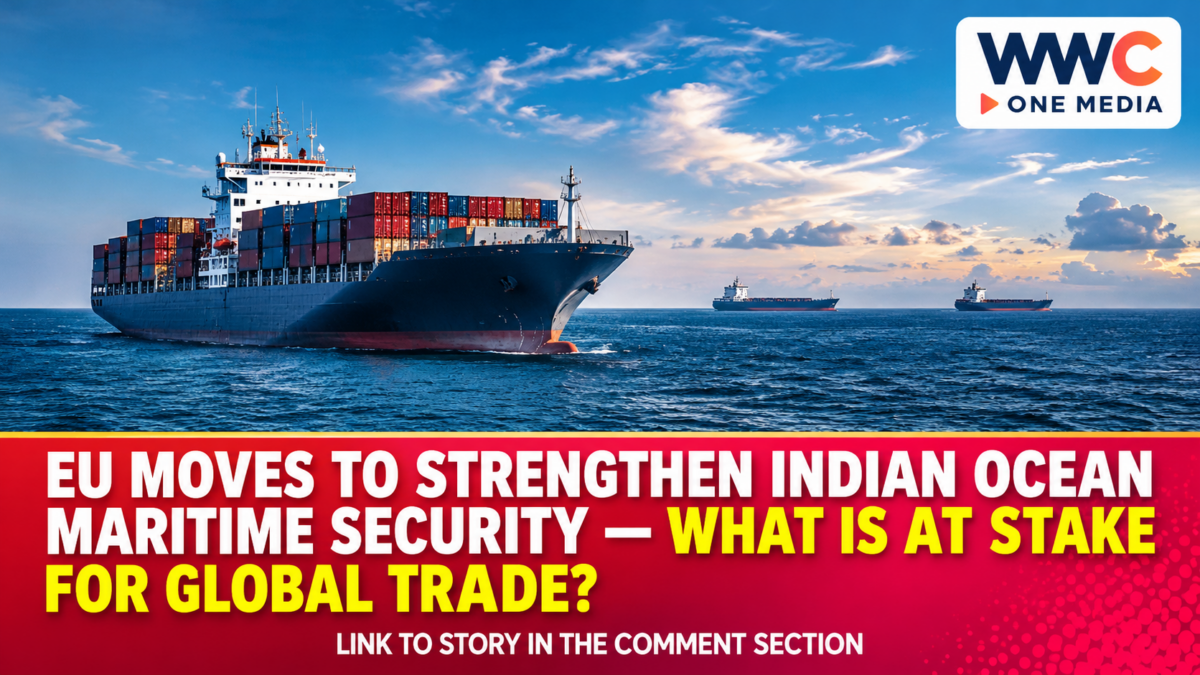
NEW DELHI, India — The European Union is seeking stronger cooperation on Indian Ocean maritime security following its first high-level roundtable with the Indian Ocean Rim Association (IORA) on November 24, 2026, bringing renewed attention to the protection of vital commercial shipping routes.
The initiative addresses maritime crime, including piracy and trafficking, while exploring closer coordination between governments and maritime security institutions.
For economies connected through international shipping networks, the implications extend beyond naval diplomacy. The security of commercial waterways is closely linked to the movement of goods, energy supplies, digital communications and the reliability of international trade.
The challenge now is whether these diplomatic commitments can produce measurable improvements in security at sea.
Indian Ocean Maritime Security Moves Higher on Europe’s Agenda
Europe’s engagement in the Indian Ocean reflects a growing recognition that economic security and maritime stability are interconnected.
The New Delhi roundtable provided a regional forum for discussing maritime surveillance, information exchange and institutional cooperation. It preceded the 29th IORA Committee of Senior Officials Meeting scheduled for November 25–26, 2026.
Rather than viewing maritime security exclusively as a military responsibility, regional cooperation can bring together coast guards, civilian authorities, maritime agencies and policymakers.
Better communication between these institutions could help governments respond more effectively to incidents involving commercial vessels and cross-border criminal activity.
The initiative adds another dimension to India’s expanding international maritime engagement, complementing broader discussions surrounding ASEAN–India maritime cooperation.
Importantly, diplomatic coordination does not automatically establish a collective defence obligation or a new military alliance.
Why Maritime Security Matters to Global Businesses
More than 80% of global trade is transported by sea, making maritime stability a central consideration for internationally connected economies.
Disruptions along major shipping corridors can create commercial consequences far beyond the locations where incidents occur.
When shipping companies encounter heightened security risks, potential responses include changing vessel schedules, reviewing insurance coverage and adopting additional protective measures.
These adjustments may increase operating expenses or extend delivery times.
For manufacturers, retailers, logistics companies and commodity traders, reliable shipping is therefore an important component of business planning.
Energy importers also have an interest in maintaining predictable maritime transport, particularly when alternative delivery arrangements are limited.
These are potential economic consequences of maritime instability, not evidence that the November 24 roundtable has already changed freight rates or insurance premiums.
The economic value of stronger maritime cooperation will ultimately depend on whether participating institutions can translate discussions into effective action.
Europe’s Naval Operations Add an Operational Dimension
The EU’s existing naval presence provides an operational foundation for its regional security engagement.
European Union Naval Force Operation ATALANTA contributes to maritime security in the western Indian Ocean and the Red Sea.
Its responsibilities include protecting vulnerable shipping, particularly vessels supporting World Food Programme humanitarian activities, and addressing piracy and other unlawful maritime activity within its mandate.
The operation illustrates how international maritime cooperation can serve both commercial and humanitarian interests.
However, naval operations represent only one component of a wider maritime security system. Information exchange, legal cooperation, institutional training and civilian emergency response can also influence the effectiveness of regional security arrangements.
Similar questions about operational coordination and regional partnerships have emerged in discussions surrounding Japan’s expanding Indo-Pacific defence cooperation.
Undersea Infrastructure Emerges as Another Strategic Priority
Modern maritime security is no longer limited to protecting vessels travelling across international waters.
Submarine communications infrastructure is also economically significant, with undersea cables carrying up to 99% of international data flows.
Damage to this infrastructure could disrupt digital services, business communications and cross-border transactions.
On September 24, 2026, the EU and India held their fifth Maritime Security Dialogue in Brussels, where they agreed to reinforce cooperation against unlawful maritime activities and improve the protection of essential maritime infrastructure, including submarine cables.
The discussions also addressed the development of regional capabilities and maritime security training.
This earlier agreement demonstrates that European and Indian maritime engagement was already developing before the November roundtable.
The protection of undersea infrastructure also forms part of wider regional security discussions explored in WWC ONE MEDIA’s coverage of the Trump–Modi Quad meeting and Indo-Pacific cooperation.
For internationally connected businesses, maritime infrastructure protection increasingly concerns both physical supply chains and digital connectivity.
India and the EU Build on a Broader Strategic Partnership
The latest engagement comes amid a wider expansion of European and Indian diplomatic cooperation.
In January 2026, India and the European Union signed a Security and Defence Partnership.
Their inaugural Security and Defence Dialogue followed in New Delhi on March 6, 2026, providing a framework for discussions covering maritime security, cybersecurity, counterterrorism, space and other security concerns.
Economic cooperation has progressed through a parallel diplomatic process.
On November 9, 2026, the seventh EU–India Strategic Partnership Review Meeting examined trade and investment cooperation, supply-chain resilience, emerging technologies and international connectivity.
Taken together, these engagements show how security and economic diplomacy are becoming increasingly connected.
The November maritime roundtable expands the discussion into a regional setting involving IORA rather than limiting cooperation to bilateral EU–India relations.
This distinction matters because maritime challenges frequently involve jurisdictions and institutions across multiple countries.
What Happens Next?
One existing European initiative that could support continued engagement is EnMAR+, a maritime cooperation programme launched in September 2026 and scheduled to run until February 2028.
The programme extends earlier maritime security work into the Red Sea and western Indian Ocean, with attention to institutional cooperation, infrastructure protection and coordination against regional maritime threats.
The planned activities provide a framework through which European engagement could develop beyond high-level meetings.
Across the wider Indo-Pacific, other regional initiatives, including the proposed ASEAN Maritime Centre, reflect interest in improving coordination on maritime affairs.
The next test for EU–IORA cooperation will be whether diplomatic discussions produce clearly defined programmes, stronger institutional capabilities and practical mechanisms for sharing information.
Businesses and policymakers should distinguish those future outcomes from the commitments already announced.
The Indian Ocean roundtable represents a diplomatic milestone, but its long-term economic significance will depend on implementation.
For international trade, the objective is not simply more maritime security meetings. It is greater confidence that the waterways and infrastructure connecting economies remain dependable.
Frequently Asked Questions
What happened at the EU maritime security meeting in New Delhi?
The EU held its inaugural high-level maritime security roundtable with IORA on November 24, 2026, to explore cooperation against maritime threats.
What is the Indian Ocean Rim Association?
IORA is an intergovernmental organisation that encourages regional cooperation and development among countries connected to the Indian Ocean.
What is Operation ATALANTA?
Operation ATALANTA is an EU naval mission supporting maritime security, anti-piracy efforts and the protection of vulnerable shipping in its designated operational area.
Why does Indian Ocean maritime security matter to businesses?
Reliable shipping routes support international trade. Maritime disruptions can potentially affect transportation expenses, insurance arrangements, energy deliveries and supply-chain schedules.
Did the New Delhi meeting establish a new military alliance?
No new military alliance was announced in the official November 24 statement. The meeting focused on strengthening cooperation and addressing shared maritime security challenges.










