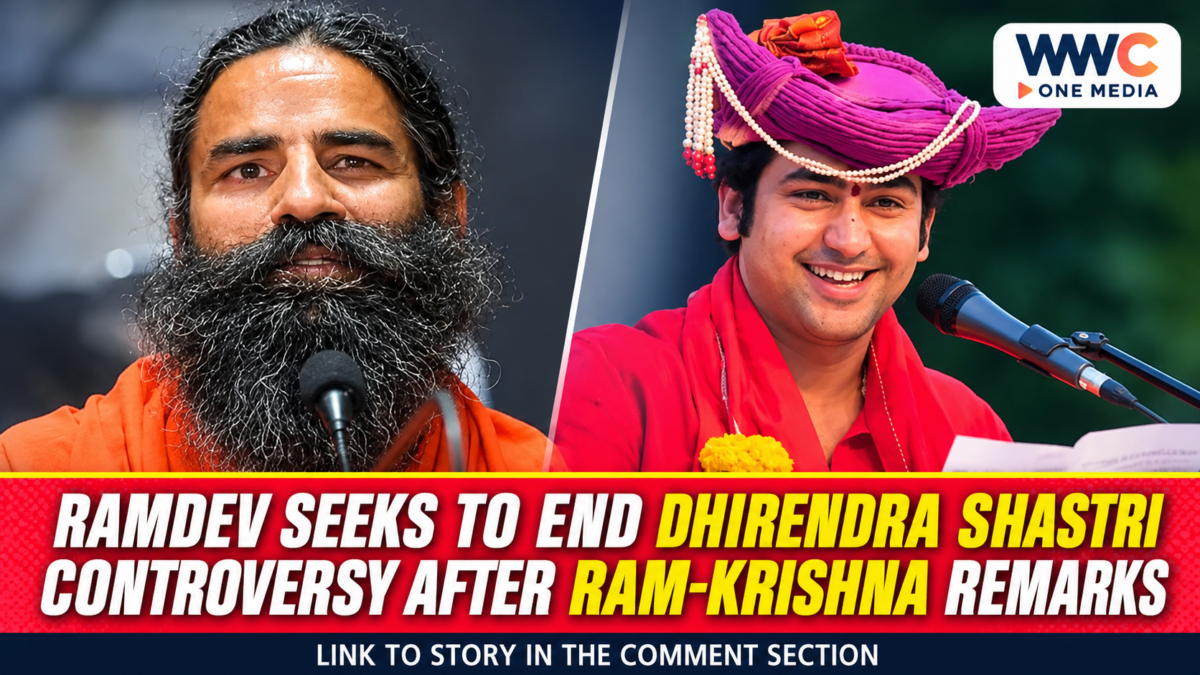
HARIDWAR, India, November 25, 2026 — Yoga guru Swami Ramdev has appealed for an end to the controversy involving Bageshwar Dham head Dhirendra Krishna Shastri, saying their disagreement over remarks about Lord Ram, Lord Krishna and Sanatan Dharma should not become a wider confrontation among followers.
The latest development in the Ramdev Dhirendra Shastri controversy came after the yoga guru clarified that he had personally spoken with Shastri and expressed his concerns about comments he considered inappropriate and hurtful.
Speaking in Haridwar on November 24, Ramdev described the religious preacher as a younger brother, a disciple and someone he regarded with affection. He said his criticism was motivated by concern rather than personal hostility.
Ramdev also urged supporters of both religious figures to stop arguing, attacking one another online and escalating the disagreement.
His intervention has shifted attention from the initial exchange of criticism toward a broader discussion about religious responsibility, public influence and the importance of avoiding divisions within Hindu communities.
Why Ramdev Objected to Dhirendra Shastri’s Remarks
The disagreement centers on comments attributed to Shastri comparing the characteristics and representations of Lord Ram and Lord Krishna.
During a religious discourse, Shastri discussed the differences between the two revered figures, including Lord Ram’s upright posture and Lord Krishna’s distinctive tribhanga posture, in which the body bends at three points.
The remarks circulated online and prompted criticism from devotees and religious figures who believed the comparison could be interpreted as disrespectful or as suggesting a distinction in the status of the two deities.
Shastri subsequently issued an apology, explaining that he had no intention of insulting either deity or suggesting that one was superior to the other.
He also emphasized his devotion to Lord Krishna and said his comments were intended to reflect devotional traditions rather than disrespect.
However, the discussion continued, eventually drawing a strong response from Ramdev.
Ramdev Says Religious Deities Should Not Be Compared
Ramdev explained that one of his principal concerns involved the comparison of Hindu deities and revered incarnations.
He maintained that such comparisons should not create divisions among devotees, stressing that Lord Ram, Lord Krishna, Lord Hanuman, Lord Shiva and the Divine Mother should not become subjects of religious rivalry.
According to Ramdev, using the names of deities to create distinctions among communities or groups goes against the broader principles of Sanatan Dharma.
He also expressed concern about associating Sanatan Dharma with superstition, exaggerated claims or religious practices that could mislead followers.
Ramdev described Sanatan Dharma as a tradition centered on spiritual knowledge, universal values and the welfare of humanity.
His comments extended beyond the disagreement with Shastri, highlighting what he considers the responsibility of religious speakers to understand the traditions they publicly represent.
‘He Is Like My Younger Brother,’ Ramdev Explains His Criticism
Despite his earlier strong remarks, Ramdev adopted a conciliatory tone when discussing his personal relationship with Shastri.
He said he had spoken directly with the Bageshwar Dham leader and explained the issues that had caused him concern.
Ramdev described Shastri as someone younger whom he considers almost like a child, a younger brother and a disciple.
He acknowledged that some of Shastri’s statements had hurt him, prompting him to reprimand the preacher.
However, Ramdev said Shastri accepted the criticism with affection, which he considered a positive response.
He also expressed regret that the disagreement had become a public controversy, suggesting that disagreements between senior and younger religious figures should ideally be addressed privately.
Ramdev’s clarification appeared intended to prevent the dispute from developing into a prolonged confrontation between their respective supporters.
Dhirendra Shastri Responds to Ramdev’s Criticism
Shastri also responded to the criticism, expressing respect for Ramdev and indicating that he did not view the remarks as a personal attack.
According to reports, Shastri said Ramdev was a respected spiritual figure and that he was willing to accept both praise and criticism from him.
He recalled that Ramdev had praised him during an earlier religious gathering before subsequently expressing strong objections to some of his statements.
Shastri suggested that the criticism could be understood as an expression of concern and affection from someone he respects.
His response helped reinforce the possibility that the disagreement would not develop into a prolonged personal feud.
A Wider Debate Over Religious Leadership and Public Responsibility
The Ramdev Dhirendra Shastri controversy has also highlighted a wider question about the influence of religious personalities in contemporary public life.
Religious speakers command large audiences through public gatherings, televised discourses and social media platforms. Their statements can quickly reach millions of people, making the choice of words particularly important when discussing sensitive religious subjects.
Ramdev has also criticized what he considers misleading claims and superstition being promoted in the name of Sanatan Dharma.
His broader argument is that religious traditions should not be used to encourage hostility, exploit public faith or create unnecessary divisions.
The controversy therefore extends beyond a disagreement about the descriptions of Lord Ram and Lord Krishna. It raises questions about the standards expected of influential religious figures and the responsibility that comes with addressing large audiences.
At the same time, Shastri’s apology and subsequent response indicate that the disagreement does not necessarily represent a permanent break between the two personalities.
Ramdev Appeals for Unity Instead of Online Confrontation
One of Ramdev’s clearest messages was directed at the supporters of both religious figures.
He urged them not to engage in online attacks, personal insults or campaigns of criticism against one another.
He argued that internal disagreements should not weaken social unity or turn religious differences into unnecessary conflict.
Ramdev also emphasized that the preservation of Sanatan Dharma should take priority over defending individual personalities.
His appeal came amid growing public attention surrounding the exchange, demonstrating how comments made by influential spiritual leaders can quickly become broader online controversies.
For now, both figures have expressed respect for one another, offering a possible path toward cooling tensions.
Whether the controversy will completely subside remains to be seen. However, Ramdev’s latest statement makes his position clear: disagreements over religious teachings should not become reasons for division among followers.
The episode serves as a reminder that public influence carries responsibility, particularly when discussions involve deeply held religious beliefs and traditions.
HARIDWAR, India — November 25, 2026 — Yoga guru Swami Ramdev has appealed for an end to the controversy surrounding Bageshwar Dham head Dhirendra Krishna Shastri, revealing that he had personally spoken with the religious preacher after publicly criticizing remarks comparing Hindu deities Lord Ram and Lord Krishna.
In a public clarification in Haridwar on November 24, Ramdev described Shastri as a younger brother, disciple and someone he regarded like a son. He said their conversation allowed him to communicate his concerns directly and urged supporters of both religious figures not to prolong the disagreement.
The intervention marks a significant development in a controversy that has moved beyond a religious discourse into a wider public debate about religious expression, the responsibilities of influential spiritual leaders and the interpretation of Hindu traditions.
However, Ramdev’s appeal to end the dispute does not, by itself, establish that all disagreements between the two figures have been resolved.
Why Ramdev Challenged Dhirendra Shastri
The controversy originated from remarks made by Shastri during a Ram Katha programme in Karera, Shivpuri district, Madhya Pradesh.
During the religious discourse, Shastri compared the physical postures and attributes associated with Lord Ram and Lord Krishna.
His comments referred to Krishna’s tribhanga posture, a traditional depiction in which the body bends at three points, as well as his association with flute-playing and Vrindavan. These were contrasted with Lord Ram’s upright posture and association with the bow and arrow.
The remarks circulated widely through social media, prompting objections from people who considered the comparison inappropriate and disrespectful toward Lord Krishna.
Shastri subsequently issued a public clarification and apology. He maintained that his comments had been misunderstood and that he had no intention of creating distinctions between Lord Ram and Lord Krishna.
The controversy nevertheless continued to attract attention, particularly after Ramdev publicly challenged the language used in discussing the two deities.
Ramdev Explains Why He Was Hurt
Ramdev’s criticism became particularly prominent following his remarks at a gathering organised by the Mahila Patanjali Yog Samiti in Jamshedpur, Jharkhand, on November 22.
He objected to comparisons between Hindu deities and questioned the conduct of religious speakers who, in his view, associated Sanatan Dharma with superstition, hypocrisy and practices lacking proper religious understanding.
His criticism focused on two connected issues: the need to avoid disrespectful comparisons between deities and the importance of maintaining standards of conduct when speaking in the name of religion.
Ramdev also questioned practices associated with certain spiritual gatherings that claim to address supernatural disturbances.
His comments were directed at what he regarded as potentially misleading religious performances, rather than establishing that every spiritual gathering or religious practice follows the same approach.
The remarks generated additional attention because of Shastri’s prominence and the public nature of their disagreement.
Private Conversation Becomes a Turning Point
By November 24, Ramdev had adopted a more conciliatory tone.
Speaking in Haridwar, he disclosed that he had spoken directly with Shastri and communicated two principal concerns.
The first concerned comparisons between deities and the divisions that could emerge when religious figures or their followers portray one divine figure as superior to another.
Ramdev argued that such comparisons were inconsistent with his understanding of Sanatan Dharma, which he described as a tradition that should not create divisions among devotees.
His second concern involved the association of religious traditions with blind faith and hypocrisy.
He maintained that Sanatan Dharma should not be used to justify practices that, in his assessment, undermine its spiritual and philosophical principles.
Ramdev also explained that his criticism came from a personal relationship with Shastri. By describing the preacher as a younger brother, disciple and son-like figure, he presented the disagreement as an intervention intended to correct conduct rather than encourage a public confrontation.
He appealed to supporters not to turn the disagreement into a prolonged conflict.
How Dhirendra Shastri Responded
Shastri also addressed the disagreement during an appearance in Pathankot, with his response published in a video report on November 24.
He acknowledged Ramdev’s criticism and indicated that he continued to regard the yoga guru with affection and respect.
The response was notably restrained, with Shastri emphasising the importance of accepting both praise and criticism.
His comments also referred to the need for decorum and discipline when discussing religious figures and traditions.
This response provides an important part of the developing story: the disagreement has not simply involved two public figures exchanging criticism. Both have now publicly addressed the issue, with Ramdev calling for an end to the controversy and Shastri responding without escalating the personal confrontation.
Nevertheless, neither a conciliatory public statement nor an expression of mutual respect should automatically be interpreted as confirmation that every underlying concern has been resolved.
Why Bageshwar Dham Matters in the Wider Debate
Bageshwar Dham, located in Madhya Pradesh’s Chhatarpur district, has become a prominent religious destination associated with Dhirendra Krishna Shastri.
Its public profile has expanded alongside Shastri’s religious programmes, public appearances and messaging about Hindu identity and religious traditions.
The institution has also attracted attention beyond religious gatherings. Indian Prime Minister Narendra Modi visited the site in 2025 for the foundation-stone ceremony of the Bageshwar Dham Medical and Science Research Institute.
Shastri’s public influence makes statements delivered during religious programmes particularly consequential. Remarks that might otherwise remain within a local gathering can reach much larger audiences through recorded speeches and social media distribution.
This is part of a wider transformation in how religious institutions communicate with followers. Digital platforms allow spiritual leaders to reach audiences far beyond their physical places of worship, but they also expose public statements to immediate scrutiny and competing interpretations.
WWC ONE MEDIA has previously examined how religious institutions influence communities through its reporting on India’s efforts to connect mental healthcare with religious shrines and rural communities.
The Bigger Issue: Religious Influence and Public Responsibility
The Ramdev-Shastri disagreement raises a broader question about the responsibilities attached to religious influence.
Spiritual leaders frequently address audiences who regard their teachings as expressions of religious authority. Their words can shape public understanding, influence community relationships and affect how followers interpret religious traditions.
That influence makes accuracy, context and restraint particularly important.
The distinction between explaining religious symbolism and making comparisons that followers interpret as disrespectful can become especially sensitive when public figures discuss revered deities.
The issue also illustrates how social media can intensify disagreements. Short video clips may circulate independently of their original setting, allowing statements to reach audiences who have not watched the complete discourse.
This makes it important to distinguish the original remarks, subsequent explanations and reactions from interpretations added by online commentators.
A similar question of how faith, identity and community are expressed through religious spaces and traditions appears in WWC ONE MEDIA’s examination of the architecture of belief across different religious communities.
The wider discussion also connects with India’s debate over religious freedom and the treatment of minority communities, although the two controversies concern different issues and should not be conflated.
What Happens Next?
For now, Ramdev has made clear that he does not want the disagreement to continue escalating. His public explanation suggests that his intervention was intended to protect religious unity while maintaining the personal relationship he shares with Shastri.
Shastri’s response indicates that he is willing to acknowledge criticism without turning the exchange into a prolonged personal confrontation.
The remaining question is whether their respective followers will accept that approach.
The controversy demonstrates how quickly religious commentary can become a wider public issue when influential personalities and deeply held beliefs intersect.
It also highlights the importance of responsible communication in an environment where religious speeches can reach millions of people through digital platforms.
Ramdev has called for the disagreement to end. Whether that appeal will bring lasting closure, however, will depend not only on the two religious leaders but also on how their supporters respond in the days ahead.